
100-07 State Operations Manual: Chapter 3 - Additional Program Activities
us-cms-medicare-manuals-pub-100-07-som107c03pdf100-07 State Operations Manual: Chapter 3 - Additional Program ActivitiesGuidance
State Operations Manual
Chapter 3 - Additional Program Activities
Table of Contents
(Rev. 202, 06-19-20)
Transmittals for Chapter 3
Adverse Actions
3000 - Adverse Actions - General
3000A - Applicability
3000B - State Ombudsman Programs
3000C - CMS Authority to Terminate Medicare and Medicaid Participation
3001 - Initial Denials of Medicare Provider/Supplier Requests for Program Participation
3001A - Authority for Adjudicating Denials
3001B - Vacated Actions Which Are Not Denials
3001C - Vacated Actions Which Are Denials
3001D - RO Processing of Denials
3005 - Basis for Terminating Provider Participation - Citations and Discussion
3005A - Medicare Provider Agreements
3005B - Termination of Coverage of Supplier Services Subject to Certification
3005D - Cause for Termination
3005E - Termination of Title XIX-Only NFs, ICFs/IID, Hospitals and Psychiatric
Hospitals
3005F - Termination Action Based Upon Onsite Survey by RO or Validation
Survey of a Deemed Provider or Supplier by RO or SA
3005G - Look Behind Authority of CMS
3005G1 - “Look-Behind” Termination or Cancellation of ICF/IID
Agreement by the Secretary
3005G2 - Old “Look-Behind” Termination of a NF or ICF/IID by the
Secretary
3005G3 - SMA Disagrees With SA Determination
3006 - Denial of Payments in Lieu of Termination of ICFs/IID
3006A - Authority to Deny Payment for Any New Admissions for
ICFs/IID
3006B - Criteria for Imposing Denial of Payments for New Admissions
3006C - Agency Procedures
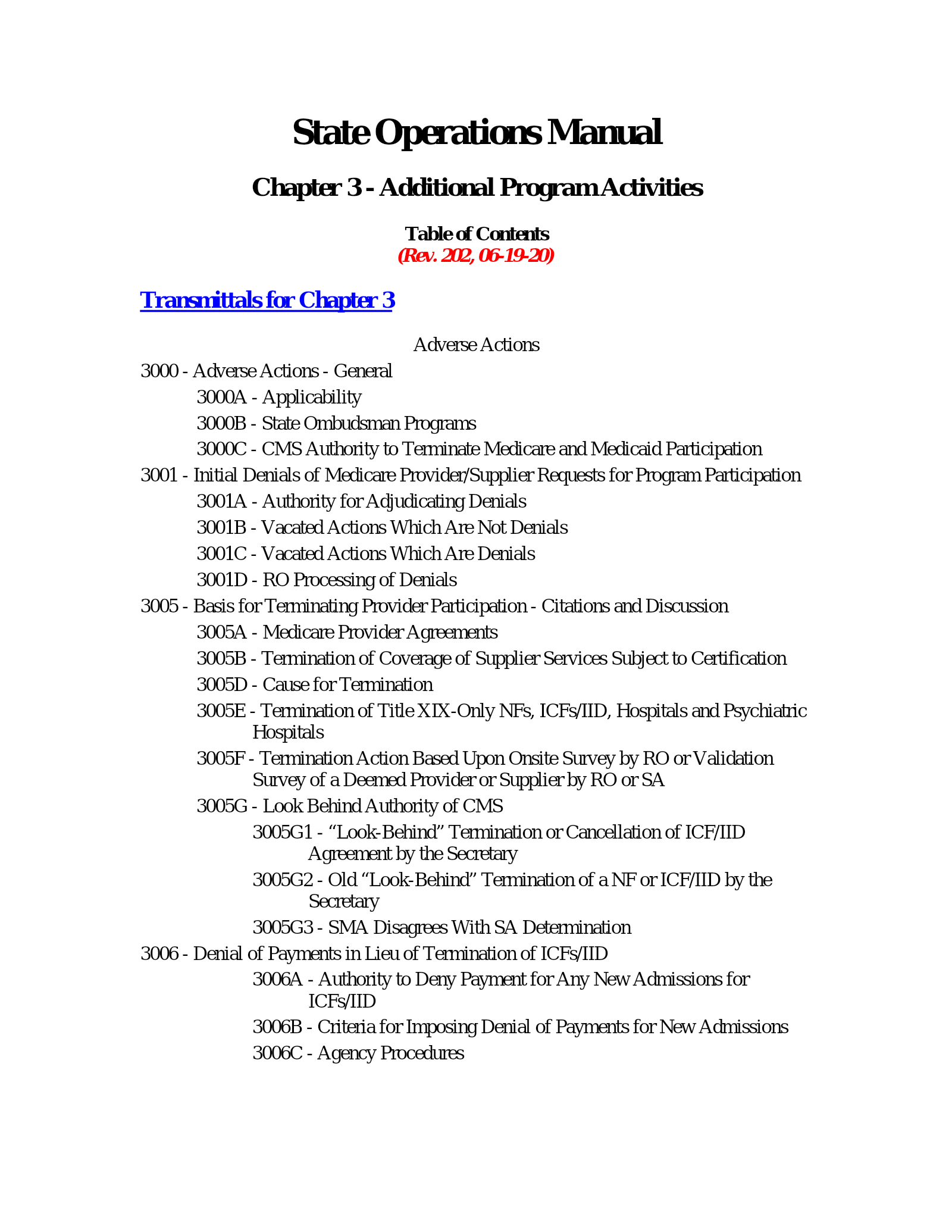
3006D - Effect of Sanction on Status of Clients Admitted, Discharged, or
on Temporary Leave and Readmitted Before or After Effective
Date of Denial of Payment
3006F - Duration of Denial of Payment and Subsequent Termination of an
ICF/IID
3006.1 - Sanctions for ICFs-IID - or Nonimmediate Jeopardy
3006.1A - General
3006.1B - Introduction
3006.1C - Examples of Alternative Sanctions
3006.1D - Alternatives to Termination in Nonimmediate Jeopardy
Situations
3006.2 - Directed Plan of Correction (DPoC)
3006.2A - Purpose
3006.2B - Basis for Imposition of a DPoC
3006.2C - Elements of a DPoC
3006.2D - Notice of Imposition of DPoC
3006.3 - Directed In-Service Training
3006.3A - Purpose
3006.3B - Appropriate Resources for Directed In-Service Training
Programs
3006.3C - Further Responsibilities
3006.3D - Notice of Imposition of Directed In-Service Training
3006.4 - State Monitoring
3006.4A - Purpose
3006.4B - Qualifications
3006.4C - When to Impose State Monitoring
3006.4D - Frequency
3006.4E - Duration
3006.4F - Notice of Imposition of State Monitoring
3006.4G - Payment for and Obligation of Funds by a State Monitor
3006.5 - Achieving Continuous, Substantial Compliance
3006.5A - Introduction
3006.5B - Duration of a Sanction
3006.5C - Achieving and Maintaining Substantial Compliance
3006.6 - Criteria for Review of State Plans for Approval or Disapproval of
Alternative Sanctions
3006.6A - Introduction
3006.6B - Alternative Remedies
3008 - Services After Termination
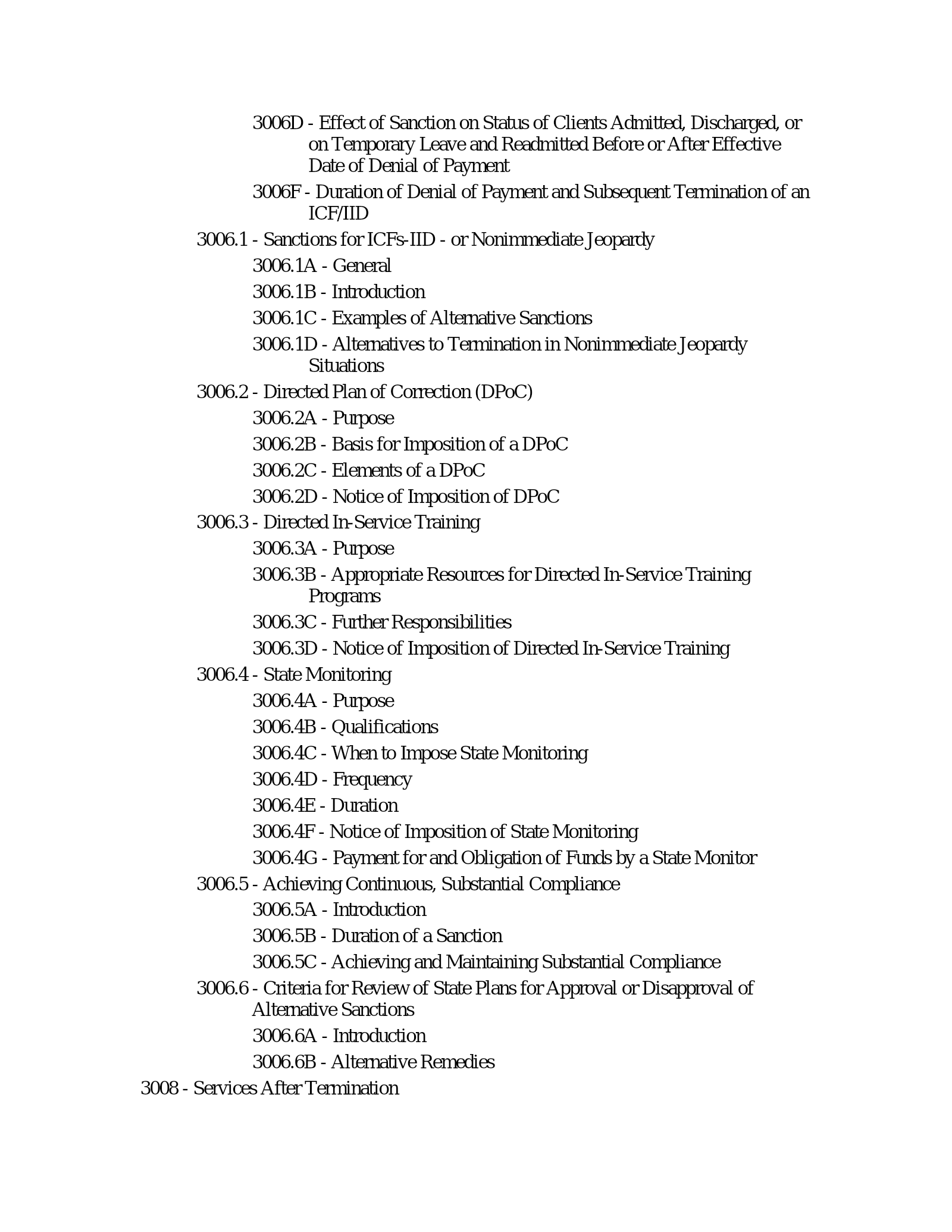
3008.1 - Services After Termination of a Medicare Provider Agreement
3008.2 - Services for which Federal Financial Participation (FFP) May Be
Temporarily Continued After Termination of a Medicaid Provider
Agreement or Nonrenewal or Cancellation of an ICF/IID Provider
Agreement
3008.3 - Relocating Patients Displaced by Termination or Closure
3008.3A - General
3008.3B - Relocation of Medicaid Patients
3008.3C - Relocation Activities
3010 - Termination Procedures - Immediate Jeopardy to Patient Health and Safety
(Medicare)
3010A - Substantial Noncompliance With Program Requirements Which Poses
Immediate Jeopardy to Patient Health or Safety
3010B - Processing of Immediate Jeopardy Terminations
3012 - Termination Procedures – Substantial Noncompliance; No Immediate Jeopardy
(Medicare)
3012.1 - Termination of Psychiatric Hospitals
3012.2 - Termination of Organ Procurement Organizations (OPO)
3012.2A - Termination Procedures
3012.2B - Reconsideration Procedures
3012.2C - Appeal Procedures
3012.3 – Termination of Organ Transplant Programs
3014 - RO Termination Action Based on Onsite Survey of Medicare Provider or Supplier
(Excluding SNFs) Conducted by RO Staff
3016 - Intervening Actions That Do Not Postpone or Delay Termination Timetable -
(Includes Credible Allegations)
3016A - Credible Allegation of Compliance
3016B - Informal Hearings Do Not Interrupt Timetable
3016C - Acceleration of Timetable
3016D -Termination Development Coinciding With Change of Ownership
(CHOW) Development
3016E - Disagreement over Deficiencies
3016.1 - Provider Undergoes Chow During Termination Proceedings
3018 - Termination - SA Documentation Requirements
3018A - Documentation to Support Proposed Termination
3018A1 - Current Survey Report
3018A2 - Previous Survey Reports
3018B - Record of Contacts With Providers/Suppliers
3018C - Notification to Provider/Supplier of Deficiencies and Recommendation
of Termination
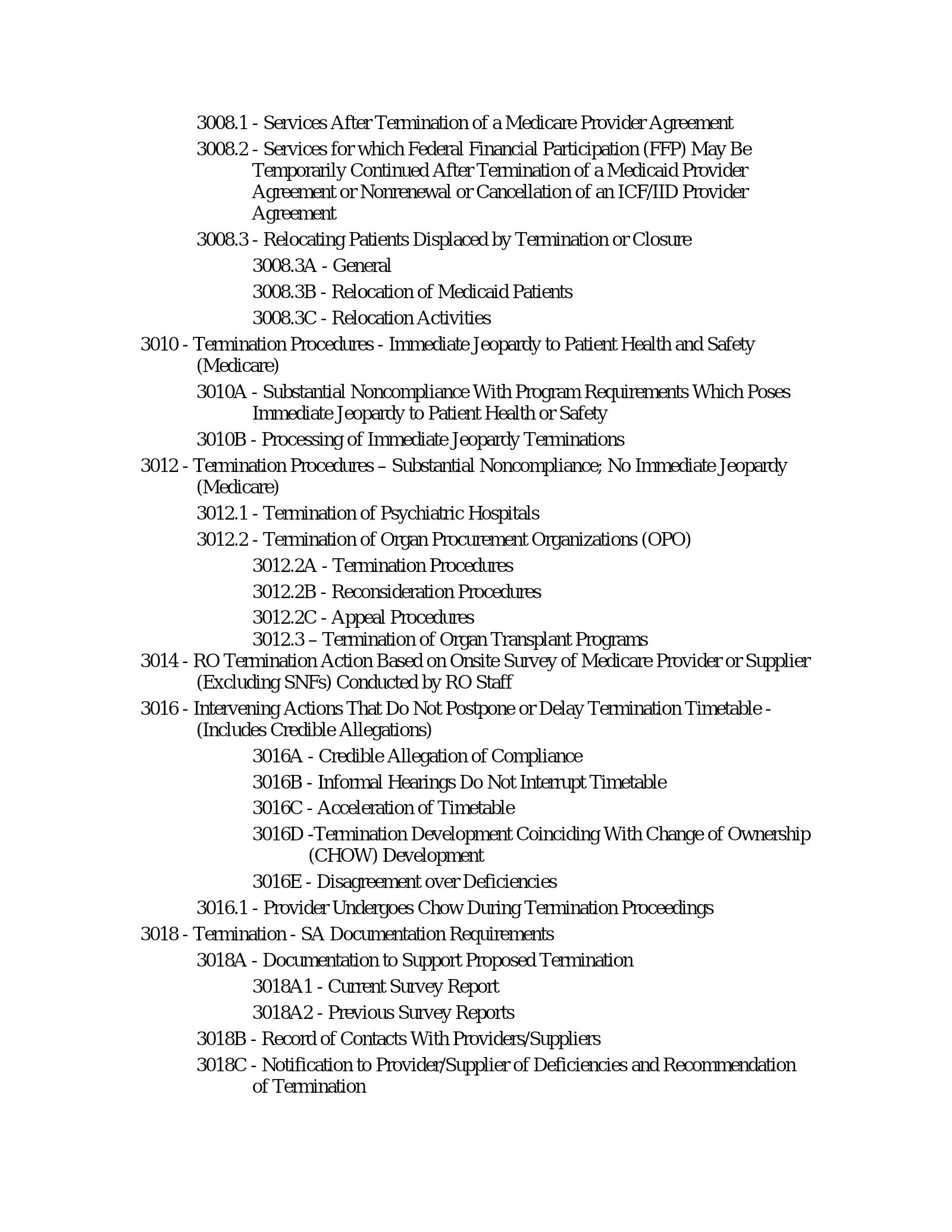
3020 - Additional SA Communications With Providers/Suppliers
3022 - Notice of Termination (Medicare)
3024 - RO Termination Processing Sequence - Noncompliance With CoPs or Conditions
for Coverage (Excluding SNFs)
3026 - Significance of Documentary Evidence in Determining Noncompliance
3026A - Statement of Deficiencies
3026B - Plan of Correction (PoC)
3026C - Revisit Reports and Subsequent Statements of Deficiencies
3026D - SA Certification (Completed Certification and Transmittal (Form CMS-
1539))
3026E - Survey Reports
3026F - Documents of Collateral Evidence
3026G - Notice of Termination
3028 - Documentation Guide List - Termination for Noncompliance With
§§1866(b)(2)(A) and (C)
3028A - Documentation Appropriate to All Cases
3028B - Additional Documentation - Charging for Covered Services and/or
Refusing to Refund Incorrect Collections
3028C - Additional Documentation - Failure to File Cost Reports
3028D - Additional Documentation - Failure to Make Satisfactory Overpayment
Arrangements
3028E - Additional Documentation - Admission Policies and Practices
3030 - Provider Agreement Terminations - Noncompliance with §§1866(b)(2)(A) and (C)
3030A - Cause for Termination
3030B - Preparing Termination Cases
3030C - Preliminary Notice to Provider
3030D - Violation of §§1866(b)(2)(A) and (C)
3032 - Termination for Violations of §§1866(a)(1)(E), (F), (G), and (H)
3034 - Public Notice - Involuntary Termination
3034A - For Providers
3034B - For Suppliers
3034C - For Hospitals, CAHs, and SNFs
3034D - For HHAs and Hospices
3034E - For Other Providers and Suppliers
3036 - Billing for Public Notice of Termination or Withdrawal
3036A - Advertising Order, SF-1143
3038 - Rescinding or Postponing Effective Date of Termination
3038A - Initial Action
3038B - Criteria for Credible Allegation
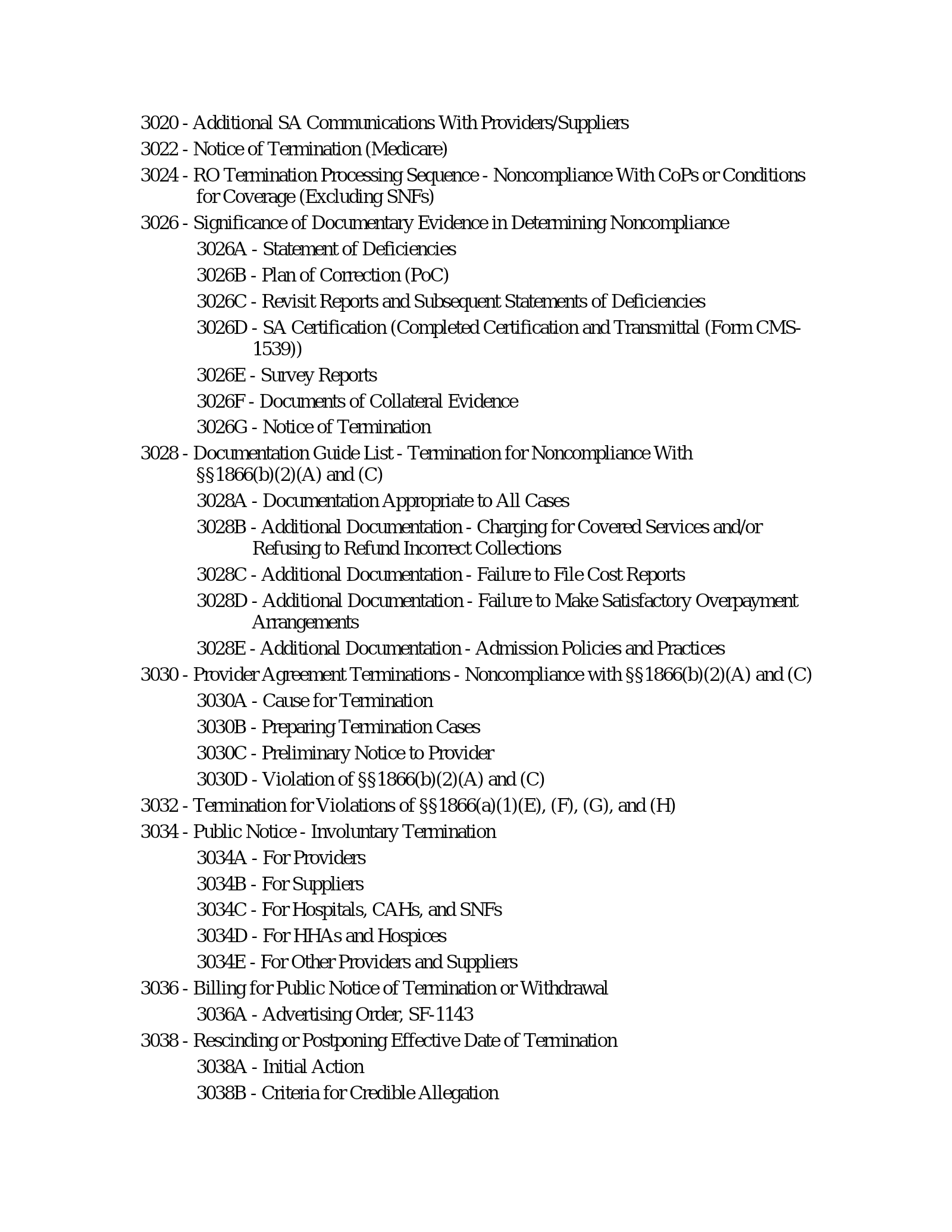
3038C - Form of Public Notice of Termination Retraction for Providers
3038D - Form of Public Notice of Termination Retraction for Suppliers
3040 - Terminating Medicaid ICF/IID Eligibility Based on “Look Behind” Determination
3040A - Termination Procedures
3040A1 - Immediate Jeopardy
3040A2 - No Immediate Threat to Patients’ Health and Safety
3042 - Disallowance of FFP to State Because State Fails to Follow Correct Certification
Procedures for Medicaid Providers
3044 - Terminating Approval for Suppliers
3046 - Voluntary Terminations
3046A - General
3046B - Decision by Provider or Supplier to Remain in the Medicare Program
3046C - Notice to Public
3046D - Effective Date of Voluntary Termination
3047 - 3047 - Notice to MAC - Voluntary Termination
3048 - Notice to Provider or Supplier - Voluntary Termination
3048A - Voluntary Termination
3048B - Close of Business
3049 - Completing Certification and Transmittal (Form CMS-1539)
3049A - Voluntary Terminations and Close of Business
Reconsideration, Hearings, and Appeals
3050 - Initial Determinations Versus Administrative Actions - Right to Review
3052 - Nature of Reconsideration Determination - SA Procedures
3052A - Right to Reconsideration of Initial Denial
3052B - Request for Reconsideration
3052C - Acknowledgment of Reconsideration Request
3052D - Documentation of File
3054 - Reconsideration - RO Procedures – Excluding SNFs and NFs
3054A - Review
3054B - RO Receipt of Request
3054C - Acknowledgment or Reconsideration Request
3054D - Reconsideration Determination
3054E - RO Notice of Reconsidered Determination
3054E1 - Denial Reversal (Approval)
3054E2 - Denial Affirmed
3054E3 - Acting Official for Reconsideration Denial Notices
3058 - Hearing on §1910(b) Cancellation of Medicaid Eligibility
3060 - Appeals of Adverse Actions for Medicaid Non-State Operated NFs (Non-State
Operated) and ICFs/IID (Not Applicable to Federal Terminations of Medicaid
Facilities)
3060A - Informal Reconsideration
3060B - Evidentiary Hearing
3060C - Informal Reconsideration (Applies to ICFs/IID for Denial of Payment for
New Admissions Only)
3060D - Judicial Review
3060E - Impartial Decision Maker (Hearing Officer)
Prospective Payment System (PPS)
3100 - Hospitals and Hospital Units Excluded From the Inpatient Prospective Payment
System (IPPS) - Introduction
3102 - General Information on IPPS Exclusion Deemed Providers and Suppliers
3104 - Criteria for PPS-Excluded Hospitals
3104A - Psychiatric Hospitals
3104B - Rehabilitation Hospitals
3104C - Children’s Hospitals
3104D - Long-Term Care Hospitals
3104E - Hospital within Hospitals
3106 - Criteria for Psychiatric and Rehabilitation Units
3106A - General Criteria for Units
3106B - Specific Criteria for Psychiatric Units
3106C - Specific Criteria for Rehabilitation Units
3108 - SA First-Time Verification Procedures for Hospitals and Units
3108A - Rehabilitation Hospitals and Rehabilitation Units of Hospitals
3108B - Psychiatric Units of Hospitals
3110 - SA Reverification of PPS-Excluded Hospitals and Units
3110A - Annual Reverification Process for Nonaccredited, PPS-Excluded,
Rehabilitation Hospitals and Units
3110B - Reverification Process for Rehabilitation Hospitals and/or Units
Accredited by CARF Under CIRP or JCAHO
3110C - Reverification Process for Psychiatric Units of Hospitals:
3112 - RO Procedures for Exclusion from PPS for Hospitals and Units
3112.1 - RO Procedures for First-Time Exclusion of Hospitals and Units
3112.2 - RO Verifying Continued Compliance With Exclusion Criteria by
Currently Excluded Hospitals or Units
3112.2A - Self-Attestation Procedures for PPS-Excluded Hospitals and
Units
3112.2B - RO Verifying Exclusion Eligibility of Other Facilities
3112.3 - Role of FIs in Reverification of PPS Excluded Hospitals and Units
Changes in Provider Status or Services
3200 - Action Based on Changes in Provider Organization, Services, or Action of Other
Approving Agencies
3202 - Change in Size or Location of Participating SNF and/or NF
3202A - Requirements for Distinct Part Certification
3202A1 - Meet Distinct Part Certification
3202A2 - Do Not Meet Distinct Part Certification
3202B - Changes in Bed Size of Participating SNF and/or NF
3202C - General Request Filing Requirements
3202D - Exceptions
3202E - Change in Designated Bed Location(s)
3202F - RO or SA (as appropriate) Actions Upon Receipt of Written Request for
Change in Bed Size/Location
3202G - Evaluation
3202H - Survey Considerations
3206 - Existing ESRD Facility Relocation, Expansion, or Addition of New Service
3210 - CHOW of Providers and Suppliers
3210A - Existing PoC
3210B - Compliance With Health and Safety Standards
3210C - Compliance With Ownership and Financial Interest Disclosure
Requirement
3210D - Compliance With Civil Rights Requirements
3210E - All Medicare Sanctions and Penalties
3210.1 - Determining Ownership
3210.1A - General
3210.1B - SA Actions to be Taken Following CHOW
3210.1C - Certification of Accredited Providers/Suppliers Which Change
Ownership
3210.1D - CHOW Situations
3210.1E - CHOW Analysis General Rules
3210.2 - RO Role in CHOW Determination
3210.3 - CHOWS Involving Multi-Regional Chain Organizations
3210.4 - Other Changes Related to CHOW - RO Procedures
3210.4A - New Owner Requests Different Intermediary
3210.4B - New Owner Sets Different Fiscal Reporting Period
3210.4C - New Provider Number Must Be Issued
3210.5 - New Owner Refuses to Accept Assignment of the Provider Agreement
3210.5A - New Owner Refuses to Accept Assignment of Previous
Owner’s Provider Agreement
3210.5B - Withdrawal After CHOW - Provider
3210.5C - CHOW and Withdrawal - Supplier
Expansion of Services
3220 - Certifications of Additional Services
3220A - Services in Compliance
3220B - Services Not In Compliance (HHAs, RHCs, and ESRD Facilities)
3222 - Specific Requirements for Expansion of Services
3222A - HHA’s Request to Provide OPT Services on Its Premises
3222B - RHC’s Request to Provide Visiting Nurse Services
3224 - Addition of Sites to an Existing Provider
Validation Surveys of Accredited Providers and Suppliers
3240 - Validation Surveys - General
3241 – Objective of Validation Surveys
3242 - Representative Sample Validation Surveys of Deemed Providers/Suppliers
3243 - Substantial Allegation Validation Surveys of Deemed Providers/Suppliers
3244 - SA Preparation for Validation Survey
3246 - Provider/Supplier Authorization for Validation Survey
3248 – Provider/Supplier Refusal to Permit Validation Survey
3252 - SA Forwarding Validation Survey Records to RO
3254 - RO Actions Following Validation Survey
3254A – Providers/Suppliers Found in Compliance Following Validation Survey
3254B - Providers/Suppliers Found Not In Compliance With One or More
Conditions Following Validation Survey and Noncompliance Constitutes
Immediate Jeopardy
3254C - Condition-level Deficiencies That Do Not Pose Immediate Jeopardy
3254E - Plans of Correction
3254F - Termination
3254G - Compliance with All Conditions After Correction of Deficiencies
3256 - RO Provision of Information to Accrediting Organizations
3257 - Reinstatement to Accrediting Organization Jurisdiction
3258 – Termination of Accreditation
Handling Public Inquiries
3300 - Confidentiality and Disclosure of Records - Citations and Applicability
3302 - Federal Freedom of Information Act (FOIA)
3304 - Multi-Program Information in SA Files
3305 - Sharing State Licensure Information With Medicare Contractors
3308 - Information That May Be Disclosed to Public
3308A - Information Disclosable to Public Under CMS Rules That May Be
Disclosed Directly by the SA
3310 - Requests for Information About Nonparticipating Institutions
3312 - Charges for Information
3314 - Time Periods for Disclosure Other Than Nursing Homes
3316 - Information Furnished to Original Source
3318 - Disclosure of Information To and From Operating Components
3319 - Monthly Quality Indicator Comparison Reports Policy
3319A - Purpose
3319B - Contents
3319C - Differences From Facility Quality Indicator Profile Report
3319D - Delivery of Report
3319E - Release of Report
3319F - Monthly Quality Indicator Comparison Report Guidelines
3320 - Necessary Preclearance With RO Before Releasing Confidential Information
Additional State Agency Responsibilities
3330 - HHA Toll-Free Hotline and Investigative Unit
3330A - HHA Hotline Function
3330B - HHA Hotline Information
3330C - Disclosure of Information
3330D - Record Keeping Requirements
3330E - Public Awareness
3330F - Hotline Investigative Unit
Response to Subpoenas Served On and Suits Against the State Agency
3350 - Subpoena for Program Records
3352 - Forthwith Subpoena
3354 - Subpoena for SA Licensure Records
3356 - Suit Against SA

Adverse Actions
3000 - Adverse Actions - General
(Rev. 1, 05-21-04)
3000A - Applicability
(Rev. 1, 05-21-04)
The Regional Office (RO) and State survey agency (SA) follow the procedures in this
part if an adverse action is likely to be initiated against Medicare participating providers
and suppliers. Because many Medicare providers and suppliers also participate in the
Medicaid program and Federal procedures must also be followed when surveying and
certifying providers that only participate in the Medicaid program, these procedures
generally apply to both programs. Exceptions for Medicaid are noted. (See also Chapter
7 for specifics pertaining to SNFs and NFs.)
For Medicaid-only facilities, termination procedures are not State plan requirements.
However, a State risks disallowance of Federal matching funds for failure to use Federal
standards and the forms, methods, and procedures prescribed by CMS. (See
42 CFR 442.30.)
3000B - State Ombudsman Programs
(Rev. 1, 05-21-04)
To coordinate with the State ombudsman network, the SA should establish procedures to:
• 	Notify the State ombudsman of decisions to initiate proceedings to terminate, or
nonrenew a provider agreement;
• 	Notify the State ombudsman of voluntary terminations and planned terminations,
including dates of closure;
• 	Consider ombudsman information about situations in the facility and the
credibility of the provider’s allegations of compliance; and
• 	Share Statements of Deficiencies and Plans of Correction (PoCs).
3000C - CMS Authority to Terminate Medicare and Medicaid
Participation
(Rev. 123, Issued: 10-03-14, Effective: 10-03-14, Implementation: 10-03-14)
1. 	Noncompliance with Conditions of Participation (CoPs), Conditions for
Coverage, or Requirements for SNFs - The RO is delegated authority to terminate
Medicare participation of any certified provider or supplier because of
noncompliance with the applicable regulatory requirements, or Conditions of
Participation (CoPs) or Conditions for Coverage (CfCs).
2. 	Violations of Medicare Provider Agreements or certified Supplier Approvals,
Quality Improvement Organization (QIO) Sanctions, or Program Abuse - The
Secretary’s authority to terminate provider agreements or certified supplier
approvals is delegated to the Associate Regional Administrator and may be
redelegated to the RO Branch Chief, but other components may also be
authorized to find that termination is in order. Accordingly, the RO processes
terminations on grounds other than noncompliance with the CoPs. See §3032.
3. 	“Look Behind” Cancellation of Medicaid Intermediate Care Facility/Individuals
with Intellectual Disabilities (ICF/IID) Agreements - The ROs are authorized to
cancel the approval of an ICF/IID to participate in the Medicaid program when
the ICF/IID fails to comply substantially with the applicable CoPs. (See §1910(b)
of the Act.)
4. 	Termination of Nursing Facility (NF) Medicaid Agreements - The ROs are, under
certain circumstances, authorized to terminate a NF’s participation in the
Medicaid program. (See §1919(h) of the Act and Chapter 7 of the SOM.)
3001 	- 	Initial 	Denials 	of 	Medicare 	Provider/Supplier 	Requests 	for
Program Participation
(Rev. 1, 05-21-04)
Denials are made only when there has been an expression, written or otherwise, of
interest in participating (or in expanding the scope of existing participation) and/or an
initial survey is performed. Because the RO makes the compliance decision for Medicare
and approves an effective date of participation, the SA should not lead the
provider/supplier to believe that the provider/supplier has been approved and can start to
furnish services to Medicare beneficiaries.
An initial denial is made when, after evaluating the evidence the adjudicating office (in
this case the RO) finds that the requirements of law and regulation are not met. The SA
forwards recommendations for initial denials to the RO within 10 working days after the
date of survey. Formal written denial notices that explain the right to appeal are issued
by the RO as soon as possible.
3001A - Authority for Adjudicating Denials
(Rev. 1, 05-21-04)
The RO adjudicates all approvals or disapprovals for Medicare participation. 42 CFR
498 addresses determination and appeal procedures. Title 42 CFR Part 488 provides the
basis for denying suppliers of services. The statutory authority is implied in §§1819,
1832, 1861, and 1881 of the Act which authorize the Secretary to establish CoPs or CfCs.
3001B - Vacated Actions Which Are Not Denials
(Rev. 1, 05-21-04)
If the SA is contacted by a potential provider and it schedules a survey, but the survey is
canceled after finding that the party is either no longer interested in participating or in
meeting program requirements, the SA notifies the RO by Form CMS-1539, indicating
the lack of interest. The RO sends a written notice to the potential provider to document
the reason why certification action was not completed. Despite the lack of interest, if the
potential provider operates a SNF, and the SA has sufficient information, the SA prepares
a §1819(a)(1) (formerly §1861(j)(1)) certification, if indicated. (See §2164.)
3001C - Vacated Actions Which Are Denials
(Rev. 1, 05-21-04)
If a potential provider or supplier is surveyed and deficiencies are cited, the SA forwards
Form CMS-1539 and related documentation to the RO, even when the request for
participation is withdrawn. The RO either notifies the provider or supplier of the failure
to meet eligibility requirements or affirms the provider’s or supplier’s request to
withdraw. The SA uses Form CMS-1539 to transmit all certification forms and pertinent
documents to the RO within 45 calendar days of the survey. A §1819(a)(1) certification
is included, if indicated.
NOTE: The RO, based on notification by the FI or carrier of their inability to verify
environment data, may issue the provider or supplier a notice of Medicare denial of
participation.
3001D - RO Processing of Denials
(Rev. 1, 05-21-04)
The RO processes the denial and sends the provider or supplier a formal notice, with a
copy to the SA, the State Medicaid Agency (SMA), and the intermediary, if applicable,
documenting the basis for the action.
The RO includes the following information in the formal notice:
• 	The date of the notice;
• 	The decision and reason for it (cite provisions of the law or regulations not met);
• 	The right to request participation in the future; and
• 	The procedures to follow for a formal reconsideration and a hearing before an
administrative law judge (ALJ).
A denial notice must be signed by the RO official delegated to adjudicate denials.
3005 - Basis for Terminating Provider Participation - Citations and
Discussion
(Rev. 1, 05-21-04)
3005A - Medicare Provider Agreements
(Rev. 1, 05-21-04)
Provider agreements and agreements with clinics that provide Outpatient Physical
Therapy (OPT) and Community Mental Health Centers (CMHCs) are terminated by the
RO under the authority of §1866(b) of the Act. (See 42 CFR 489.52-489.57.) Medicare
providers (as defined in §2002) must substantially meet each of the applicable CoPs or
requirements for participation.
3005B - Termination of Coverage of Supplier Services Subject to
Certification
(Rev. 1, 05-21-04)
Sections 1832(a), 1861(g), (p), (s), and (aa) and 1881(b) of the Act authorize the
Secretary to establish CfCs of supplier services and thus implicitly authorize
determinations that the Conditions cease to be met. Title 42 CFR 498.3(b) provides that
the Secretary makes findings, setting forth pertinent facts and conclusions, and an initial
determination as to whether a supplier meets the respective Conditions. The
determination can be a result of the written request by the supplier to start or expand
services or to establish that it continues to meet respective CfCs. An adverse
determination may involve one or more areas of services offered by a supplier. While
these adverse determinations are not in the regulations as “terminations,” their effect on
payment for the supplier’s services is the same as when a provider agreement is
terminated. Procedures for certifying supplier noncompliance parallel those for
certifying provider noncompliance.
For example, the agreement into which an Ambulatory Surgical Center (ASC) or Rural
Health Clinic (RHC) enters is a specific agreement related to those suppliers, not a
provider agreement.
3005D - Cause for Termination
(Rev. 1, 05-21-04)
The CMS may terminate Medicare provider participation if the provider does not comply
with a CoP or Requirement for SNFs/NFs, or fails to provide an acceptable PoC for other
requirements. (See 42 CFR 489.53.)
Certain causes for termination are unrelated to certification and have no impact on the
SA. The CMS may terminate provider participation if:
1. 	The provider places restrictions on the persons it accepts for treatment, and fails
either to exempt Medicare beneficiaries from the restrictions, or to apply the same
restrictions to Medicare beneficiaries as to all other persons seeking care;
2. 	The provider refuses to permit examination of its records by or on behalf of CMS
for verification of information it furnished as a basis for payment;
3. 	The provider has knowingly and willfully made false statements or
representations of a material fact for use in a request for payment;
4. 	The provider has submitted, or caused to be submitted, requests for payment
under Medicare, or amounts for items and services, substantially in excess of the
costs incurred;
5. 	The provider has furnished items or services which CMS determined to be
substantially in excess of the needs of individuals or of a quality that failed to
meet professionally recognized standards; or
6. 	The provider fails to:
• 	Permit photocopying of any records necessary to determine compliance;
• 	Furnish information necessary for CMS to determine whether payments
are or were due under Medicare and the amount due;
• 	Furnish information on business transactions as required;
• 	Disclose information on convicted principals;
• 	Furnish ownership information;
• 	Comply with civil rights requirements; or
• 	Furnish notice of discharge rights.
7. 	A hospital or critical access hospital that has reason to believe it may have
received an individual by another hospital in violation of 42 CFR 489.24 fails to
report the incident.
8. 	A hospital fails to furnish inpatient services to TRICARE or CHAMPVA
beneficiaries or to veterans.
9. 	A critical access hospital fails to maintain an annual average length of stay of 96
hours or less.
The SA certifies provider compliance with Medicare requirements. FIs generally are
responsible for dealing with matters related to payment and coverage. However, in the
course of a survey, the SA may encounter information indicative of program abuse or
failure to meet requirements described in the above list. The SA communicates these
areas of concern to the RO.
3005E - Termination of Title XIX-Only NFs, ICFs/IID, Hospitals and
Psychiatric Hospitals
(Rev. 123, Issued: 10-03-14, Effective: 10-03-14, Implementation: 10-03-14)
Under 42 CFR 431.54(f), the State Medicaid Agency may “lock out,” i.e., restrict the
participation of a Medicaid provider for a reasonable period if it has found that the
provider has abused the Medicaid program. The SMA may take this action in response
to, or independent of any SA or accrediting organization recommendation. Note that the
Medicaid program, unlike the Medicare program, does not distinguish between
“providers” and “suppliers” and the term “provider” applies to both for Medicaid
purposes.
In order to determine that a provider has abused the Medicaid program, the SMA must
find that in a significant number or proportion of cases the provider has:
• 	Furnished services at a frequency or amount not medically necessary
(§431.54(f)(2)(i)); or
• 	Furnished Medicaid services of a “quality that does not meet professionally
recognized standards of health care.” (§431.54(f)(2)(ii)).
Additional conditions required before imposing any restriction on a provider are found in
§431.54(f).
Medicaid-only NFs and ICFs/IIDs
Medicaid regulations provide for terminations, and for ICFs/IID cancellations, but do not
describe the implementing procedures. Each SMA has procedures for terminating
agreements with NFs and ICFs/IID when they are not in substantial compliance with
program requirements. In any Medicaid-only noncompliance situation, the SA initiates
the action, prepares the necessary documents, and forwards them to the SMA, which has
responsibility for the termination, nonrenewal, or cancellation of the agreement (see
§7300 for the exception regarding State operated NFs). In this case, the SMA notifies
CMS and the public of its action and affords the facility notice and opportunity for a
hearing before an ALJ prior to termination.
Medicaid-only Hospitals and Psychiatric Hospitals
42 CFR 482.1(a)(5) notes generally that any hospital or psychiatric hospital that
participates in Medicaid must meet the Medicare CoPs. Medicaid regulations at 42 CFR
440.10 (hospitals) and §440.140 and 440.160 (psychiatric hospitals) require Medicaid-
participating hospitals and psychiatric hospitals to comply with the Medicare CoPs. If a
SA survey of a Medicaid-only hospital or psychiatric hospital finds substantial
noncompliance, i.e., condition-level noncompliance, including immediate jeopardy, with
the CoPs, the SA follows the standard SOM processes for requiring a plan of correction
and conducting revisits. If the hospital or psychiatric hospital fails to come into
substantial compliance in a timely manner, the SA notifies the SMA, which takes
appropriate action in accordance with Federal Medicaid regulations and State plan
provisions.
Likewise, in the case of a hospital or psychiatric hospital that participates in Medicaid
based on accreditation by a CMS-approved Medicare hospital or Medicare psychiatric
hospital accreditation program, the accrediting organization (AO) must notify both CMS
and the SMA if the facility’s accreditation is terminated for any reason. The SMA may
in such cases request the SA to conduct a survey to determine the hospital’s or
psychiatric hospital’s compliance with the CoPs, or may proceed directly to take
appropriate action in accordance with Federal Medicaid regulations and State plan
provisions.
If the SMA decides to restrict the provider’s participation in Medicaid, the SMA is
responsible for:
• 	Giving notice to the provider and opportunity for appeal, in accordance with
procedures established by the SMA (§431.54(f)(1));
• 	Notifying CMS and the general public of the provider’s restriction and its
duration (§431.54(f)(3)); and
• 	Ensuring that restrictions do not result in denying Medicaid recipient reasonable
access to services of adequate quality (§431.54(f)(4)).
If the SMA restricts a Medicaid-only hospital’s or psychiatric hospital’s Medicaid
participation, it gives notice to CMS via the SA. The SA forwards the notice to the RO.
The RO terminates the hospital’s or psychiatric hospital’s Medicaid-only CCN, unless the
SMA notice contains a date certain when the provider’s participation in Medicaid will
resume.
3005F - Termination Action Based Upon Onsite Survey by RO, or
Validation Survey of a Deemed Provider or Supplier by RO or SA
(Rev. 123, Issued: 10-03-14, Effective: 10-03-14, Implementation: 10-03-14)
RO Conducts Survey:
When substantial noncompliance, including immediate jeopardy to patient health and
safety, is identified in the course of a survey conducted by RO staff, the RO initiates
termination procedures. Survey findings and factual development are the responsibility
of the RO. However, the SA may be asked to assist in documenting or developing
aspects of the termination. The SA (and the SMA, if the provider/supplier also
participates in Medicaid) is notified by the RO of the action taken.
RO or SA Validation Survey of a Deemed Provider or Supplier
Section 1864(c) of the Social Security Act provides that SAs conduct validation surveys
of deemed providers and suppliers, at the direction of the CMS RO. The RO may also
choose to conduct the validation survey with RO surveyors, or with a mixture of SA and
RO surveyors. There are two types of validation surveys:
• 	Full, standard surveys of a representative sample of deemed providers and
suppliers, and
• 	Focused substantial allegation, i.e., complaint investigation surveys.
Representative Sample Validation Survey: If the representative sample validation survey
identifies either an immediate jeopardy or substantial, i.e., condition-level,
noncompliance and the RO agrees with this finding, the RO initiates termination of the
deemed provider or supplier, including an opportunity for the provider/supplier to make a
timely correction of the deficient practices to avoid termination.
Substantial Allegation Validation Survey:
• 	If the survey identifies an immediate jeopardy and the RO agrees with this
finding, the RO initiates termination of the deemed provider or supplier,
including an opportunity for the provider/supplier to make a timely correction of
the deficient practices to avoid termination.
• 	If the survey identifies substantial, i.e., condition-level, noncompliance and the
RO agrees with this finding, the RO may either:
• 	initiate termination of the deemed provider or supplier, including an
opportunity for the provider/supplier to make a timely correction of the
deficient practices to avoid termination; or
• 	Require the SA to conduct a full survey of the provider or supplier.
Termination action would be initiated if the full survey identifies substantial
noncompliance.
See Chapter 5, Section 5110 for more details on post-survey procedures after a
substantial allegation validation survey.
3005G - Look Behind Authority of CMS
(Rev. 1, 05-21-04)
3005G1 - “Look-Behind” Termination or Cancellation of ICF/IID
Agreement by the Secretary
(Rev. 92, Issued, 11-22-13, Effective: 11-22-13, Implementation: 11-22-13)
The CMS has authority under §1910(b) of the Act to terminate approval of an ICF/IID to
participate in the Medicaid program when it determines that the facility fails to comply
substantially with the CoPs, 42 CFR Part 483, Subpart I, or to submit an acceptable PoC.
The cancellation is prospective, usually after the provider has had the opportunity for a
formal hearing before an ALJ.
If there is no immediate jeopardy to resident health and safety and CMS elects to
terminate, the ICF/IID is afforded an opportunity for a pre-termination hearing before an
ALJ. If the effective date of termination is held in abeyance pending an ALJ’s ruling and
the ICF/IID makes a credible allegation of compliance while the hearing is pending, it is
up to the RO to determine whether it is in the recipients’ and the government’s interest to
resurvey the facility and dispose of the case based on the findings. If a revisit is made
and the ICF/IID failed to achieve compliance, adverse action continues based on the
findings of the first Federal survey and the revisit. If the ALJ affirms the CMS decision,
the effective date of termination is set by the ALJ.
If there is an immediate jeopardy to resident health and safety, CMS terminates or
cancels approval of the ICF/IID and affords it the opportunity for a post-termination ALJ
hearing.
Following termination, ICFs/IID wanting readmission must request a survey from the
RO. The RO directs the SA to do a survey unless it feels that a Federal survey is
necessary. The CMS must be satisfied that the reasonable assurance provision is met
before the State executes a Medicaid agreement with the ICF/IID.
3005G2 - Old “Look-Behind” Termination of a NF or ICF/IID by the
Secretary
(Rev. 92, Issued, 11-22-13, Effective: 11-22-13, Implementation: 11-22-13)
Under 42 CFR 442.30, a provider agreement of a SNF, NF, or ICF/IID is considered
invalid for purposes of providing FFP to the State unless the State has followed proper
survey and certification procedures. For example, the SMA may have issued the provider
agreement even though it had not certified the facility as being in compliance. Other
examples of procedural error include, but are not limited to:
• 	The SA documents noncompliance yet certifies compliance;
• 	The SA certifies compliance, but all cited deficiencies are not covered by an
acceptable PoC;
• 	The SA fails to survey against all applicable requirements; or
• 	The SA fails to use federally approved survey and certification documents.
When procedures are not followed by either the SA or SMA, CMS considers the provider
agreement void from its inception, and the State is disallowed FFP for bills related to the
facility for the period covered by that Medicaid agreement. This type of adverse action,
referred to as “Old Look Behind,” is covered in more detail in §3042.
3005G3 - SMA Disagrees With SA Determination
(Rev. 1, 05-21-04)
With the exception of State-operated NFs, the SA surveys and certifies compliance of
Medicaid facilities with health and safety requirements to the SMA. The SMA is
responsible for reviewing certifications to ensure that the SA has adhered to procedural
requirements. If the SMA disagrees with the SA’s certification, it first contacts the SA to
resolve the issue. If the issue cannot be resolved, it contacts the RO. To resolve the
dispute, the RO conducts a Federal survey of the facility or take other action as
necessary.
3006 - Denial of Payments in Lieu of Termination of ICFs/IID
(Rev. 92, Issued, 11-22-13, Effective: 11-22-13, Implementation: 11-22-13)
3006A - Authority to Deny Payment for Any New Admissions for
ICFs/IID
(Rev.92, Issued, 11-22-13, Effective: 11-22-13, Implementation: 11-22-13)
Section 1902(i) of the Act and 42 CFR 442.118 provide the SMA with an alternative to
terminating ICFs/IID that fail to meet program requirements. This sanction is the one-
time denial of payment for new admissions for a period of up to 11 months after the
month it was imposed, if the facility’s deficiencies do not present an immediate jeopardy
to residents’ health and safety. A decision is made at the end of 11 months whether to
continue participation. However, the 11-month period can be shortened if circumstances
change and there is immediate jeopardy to health and safety before 11 months have
passed. Alternatively, the State might rescind the denial of payments in fewer than 11
months if full compliance is achieved or if the ICF/IID has made significant, good-faith
efforts and progress in achieving compliance.
3006B - Criteria for Imposing Denial of Payments for New Admissions
(Rev. 1, 05-21-04)
The SMA retains the right to establish its own criteria for imposing this sanction.
However, the SMA may not use this sanction if the facility’s deficiencies pose immediate
jeopardy to the health and safety of its clients.
3006C - Agency Procedures
(Rev. 92, Issued, 11-22-13, Effective: 11-22-13, Implementation: 11-22-13)
Before denying payment for new admissions, the SMA must comply with the following
requirements:
• 	Provide the ICF/IID up to 60 calendar days to correct the cited deficiencies and
comply with the CoP.
• 	If at the end of the specified period the ICF/IID has not achieved compliance, give
the facility notice of intent to deny admissions and the opportunity for an informal
hearing.
• 	If the ICF/IID requests a hearing and the decision of the hearing is to deny
payment, the SMA must provide the facility and the public, at least 15 calendar
days before the effective date of the sanction, a notice that includes the effective
date of the sanction and the reasons for the denial of payment.
3006D - Effect of Sanction on Status of Clients Admitted, Discharged, or
on Temporary Leave and Readmitted Before or After Effective Date of
Denial of Payment
(Rev. 1, 05-21-04)
The client’s status on the effective date of the denial of payment is the controlling factor
in determining whether readmitted clients are subject to the denial of payment.
Guidelines are as follows:
• 	Clients who were admitted and discharged before the effective date of the denial
of payment are considered new admissions if they are readmitted on or after the
effective date. Therefore, they are subject to the denial of payment;
• 	Clients admitted on or after the effective date of the denial of payment are
considered new admissions. If readmitted after being discharged, they continue to
be considered new admissions, and are subject to the denial of payment;
• 	Clients admitted before and discharged on or after the effective date of the denial
of payment are considered new admissions if subsequently readmitted. Therefore,
they are subject to the denial of payment;
• 	Clients admitted before the effective date of the denial of payment who take
temporary leave before, on, or after the effective date of the denial of payment are
not considered new admissions upon return and therefore, are not subject to the
denial of payment; and
• 	Clients admitted on or after the effective date of the denial of payment who take
temporary leave are not considered new admissions, but continue to be subject to
the denial of payment.
NOTE: The term “temporary leave” refers to clients who leave temporarily for
any reason. If clients were not subject to a denial of payment when they went on
temporary leave, the term indicates that upon return they are not considered new
admissions for the purposes of the denial of payment. Therefore, the term
“temporary leave” is used to justify a resumption of any interrupted payment upon
re-entry into the facility.
The term “leave of absence” is defined as any situation where the client is absent,
but not discharged, for reasons other than admission to a hospital, SNF or NF, or
distinct part of a SNF or NF. The term “leave of absence” is used for the purpose
of preventing duplicate payments during an absence by assuring that the absence
is not due to a temporary alternate inpatient arrangement. If the client is not on a
leave of absence but is actually temporarily in an alternate inpatient situation, any
ongoing payment to the facility will be interrupted as mentioned above.
The client who is not subject to the denial of payment sanction and who goes on
temporary leave, whether there is a leave of absence, will not be considered a new
admission for the purposes of the denial of payment sanction, upon his/her return
to the facility. Any interrupted payment will be resumed. In either situation, it is
expected that the client will return to the facility following leave.
3006F - Duration of Denial of Payment and Subsequent Termination of
an ICF/IID
(Rev. 92, Issued, 11-22-13, Effective: 11-22-13, Implementation: 11-22-13)
The denial of payment for new admissions will continue for eleven months unless, before
the end of that period, the SMA finds that the ICF/IID has corrected the deficiencies or is
making a good faith effort to achieve compliance with the CoPs or the deficiencies are
such that it is necessary to terminate the facility.
The SMA must terminate the facility’s provider agreement:
• 	Upon finding that the ICF/IID has been unable to achieve compliance with the
CoPs during the 11-month period that payments were denied for new admissions;
and
• 	Termination is effective the day following the last day of the denial of payment
period.
3006.1 - Sanctions for ICFs-IID - or Nonimmediate Jeopardy
(Rev. 92, Issued, 11-22-13, Effective: 11-22-13, Implementation: 11-22-13)
3006.1A - General
(Rev. 92, Issued, 11-22-13, Effective: 11-22-13, Implementation: 11-22-13)
The Balanced Budget Act (BBA) of 1997 provided the statutory authority for States to
establish and impose sanctions that are additional to the already existing alternative
sanction of denial of payment for new admissions, and which are alternative to
termination in cases where the ICF/IID’s deficiencies are not determined to pose
immediate jeopardy to client health and safety. This strategy recognizes that deficiencies
take on greater or lesser significance depending on the specific circumstances and client
outcomes in each facility, and that additional enforcement options should be available so
that the enforcement consequence to the facility is effective, proportionate, and
appropriate to the specifics of the noncompliance.
3006.1B - Introduction
(Rev. 92, Issued, 11-22-13, Effective: 11-22-13, Implementation: 11-22-13)
Section 1902(i)(1)(B) of the Act, as revised by the BBA of 1997, provides that the State
may establish alternative sanctions to use as enforcement remedies for deficiencies that
do not constitute immediate jeopardy to client health and safety if the State can
demonstrate to CMS’ satisfaction that its alternative sanctions are effective in deterring
noncompliance and correcting deficiencies (see §3006.6). One or more alternative
sanctions may be imposed against private or State operated ICFs/IID instead of provider
agreement termination, and may also be imposed instead of or in addition to the existing
alternative sanction of denial of payment for new admissions. Examples of sanctions that
may be appropriate as alternative sanctions are listed in subsection C.
3006.1C - Examples of Alternative Sanctions
(Rev.92, Issued, 11-22-13, Effective: 11-22-13, Implementation: 11-22-13)
States should consider establishing the following alternative sanctions in their State plan
for noncompliant ICFs/IID having nonimmediate jeopardy deficiencies:
• 	Directed plan of correction;
• 	Directed in-service training; and
• 	State monitoring.
States are not limited to establishing and using these alternative sanctions and may
submit others for CMS’ approval. When the State wants to use alternative sanctions, it
must be authorized to do so under its State plan by CMS (see §3006.6). In order to be
approved, the State must provide specified information to indicate that the alternative
sanction and its application is not inconsistent with applicable statutory and regulatory
requirements, as well as demonstrate to CMS’ satisfaction that the alternative sanction is
effective in deterring noncompliance and correcting deficiencies. Many States already
have experience in imposing the three intermediate sanctions specified above against
nursing homes (SNF/NFs) that fail to meet participation requirements. States also have
experience in imposing remedies under their State licensure authority and may also wish
to submit any of those to CMS for approval as alternative remedies for ICF/IID. While
we want States to have the three specified intermediate sanctions listed above available
for ICF/IID enforcement purposes, States are free to submit others for CMS approval as
well.
3006.1D - Alternatives to Termination in Nonimmediate Jeopardy
Situations
(Rev. 1, 05-21-04)
When the facility is found to have deficiencies that do not immediately jeopardize the
health and safety of individuals served, the State may, in lieu of terminating the facility’s
provider agreement:
1. 	Deny payment for all new Medicaid admissions to the facility after the effective
date of the sanction;
2. 	Impose one or more of the alternative sanctions that CMS has approved; or
3. 	Do both (1) and (2) above. Deny payment for all new Medicaid admissions to the
facility after the effective date of the sanction and impose one or more of the
alternative sanctions that CMS has approved.
3006.2 - Directed Plan of Correction (DPoC)
(Rev. 1, 05-21-04)
3006.2A - Purpose
(Rev. 92, Issued, 11-22-13, Effective: 11-22-13, Implementation: 11-22-13)
A DPoC is a plan that the State develops to require an ICF/IID to take action within
specified time frames. The purpose of the DPoC is to achieve correction and continued
compliance with the CoPs.
A DPoC differs from a traditional PoC in that the State, not the facility, develops the
PoC. Achieving compliance is the provider’s responsibility, whether or not a DPoC was
followed. If the facility fails to achieve substantial compliance after complying with the
DPoC, the State may impose another alternative sanction (or sanctions) until the facility
achieves substantial compliance or it is terminated from the Medicaid program.
3006.2B - Basis for Imposition of a DPoC
(Rev. 1, 05-21-04)
Use of a DPoC should be dependent upon causal factors identified by the SA. For
example, a DPoC may be an appropriate sanction when a facility has no system in place
for detecting abuse and neglect. The DPoC would specify that the facility must develop a
system and must have that system in place within a specified time frame.
3006.2C - Elements of a DPoC
(Rev. 1, 05-21-04)
The DPoC includes all elements of a traditional plan of correction (see §3006.5.C), as
well as when the corrective action must be accomplished, and how substantial
compliance will be measured.
3006.2D - Notice of Imposition of DPoC
(Rev. 1, 05-21-04)
A DPoC may be imposed 15 calendar days after the facility receives notice of this
sanction. The date the DPoC is imposed does not mean that all corrections must be
completed by that date.
3006.3 - Directed In-Service Training
(Rev. 1, 05-21-04)
3006.3A - Purpose
(Rev. 92, Issued, 11-22-13, Effective: 11-22-13, Implementation: 11-22-13)
Directed in-service training is a sanction that may be used when the SA concludes that
education is likely to correct the deficiencies. This remedy requires the staff of the
ICF/IID to attend in-service training program(s). The purpose of the directed in-service
training is to provide knowledge required to achieve compliance and remain in
compliance with the CoPs.
3006.3B - Appropriate Resources for Directed In-Service Training
Programs
(Rev.92, Issued, 11-22-13, Effective: 11-22-13, Implementation: 11-22-13)
Facilities should use programs developed by well-established organizations of intellectual
disabilities, developmental disabilities, mental health or health services education, such
as special education departments in colleges or universities or schools of medicine, State
departments/bureaus of mental health/ intellectual disabilities or developmental
disabilities; Developmental Disabilities Councils; Federally funded State protection and
advocacy agencies serving people with developmental disabilities; professional
organizations with expertise in developmental disabilities, and a State may provide
special consultative services for obtaining this type of training. The SA may also compile
a list of resources that can provide directed in-service training and could make this list
available to facilities and interested organizations. Facilities may request to use training
resources internal to the organization, if the trainer was not directly involved with the
area sanctioned. Examples of directed in-service training topics include, but are not
limited to, client rights issues, behavior intervention, active treatment, health and safety,
and outcome measures.
3006.3C - Further Responsibilities
(Rev. 1, 05-21-04)
The facility bears the expense of the directed in-service training. After the training has
been completed the SA will assess whether agency staff has demonstrated competency in
the area(s) of deficiency and whether compliance has been achieved. If the facility still
has not achieved substantial compliance, the State may impose one or more additional
sanctions.
3006.3D - Notice of Imposition of Directed In-Service Training
(Rev. 1, 05-21-04)
Directed in-service training may be imposed 15 calendar days after the facility receives
notice of this sanction. The SA will determine time frames for completion of the directed
in-service training.
3006.4 - State Monitoring
(Rev. 1, 05-21-04)
3006.4A - Purpose
(Rev. 1, 05-21-04)
A State monitor oversees the correction of cited deficiencies in the facility as a safeguard
against further noncompliance when a situation with a potential for jeopardizing health
and safety has occurred, but has not risen to the level of immediate jeopardy.
3006.4B - Qualifications
(Rev. 1, 05-21-04)
The SA identifies state monitors as appropriate professionals to monitor cited
deficiencies. A State monitor:
• 	Is an employee or contractor of the SA;
• 	Is not an employee, designee or contractor of the monitored facility;
• 	Does not have an immediate family member who is a client of the facility;
• 	Is not a person who has been terminated for cause by the facility; and
• 	Is not a former contractor who had a contract canceled for cause by the facility.
3006.4C - When to Impose State Monitoring
(Rev. 1, 05-21-04)
When considering whether or not to impose State monitoring for current noncompliance,
the State may want to consider whether:
• 	The facility has a history of noncompliance which may suggest that it would
benefit from external surveillance during corrections;
• 	The facility has had numerous complaints; or
• 	The State is concerned that the situation in the facility has the potential to worsen.
States are not limited to considering only these factors and are free to consider any others
that would assist them in making remedy determinations.
3006.4D - Frequency
(Rev. 1, 05-21-04)
When State monitoring is imposed, the SA appoints a monitor or monitors. Monitoring
may occur anytime in a facility; e.g., 24 hours a day, 7 days a week, if necessary or less
often such as once a week to monitor specific areas. In all instances, monitors have
complete access to all areas of the facility, as necessary, for performance of the
monitoring activity. Factors used to decide how often a facility is monitored may include,
but are not limited to, the following:
• 	The nature and seriousness of the deficiency(ies) as specified by the SA; and
• 	The timing and frequency of when the problems occurred; e.g., mealtimes,
evening shifts, daily, etc.
Monitors may be assigned to the facility at these specific times for a specified number of
days, as determined by the SA, to ensure corrective action.
3006.4E - Duration
(Rev. 1, 05-21-04)
The sanction is discontinued when the facility’s provider agreement is terminated or
when the facility has demonstrated to the satisfaction of the SA that it is in substantial
compliance with the Conditions of Participation.
3006.4F - Notice of Imposition of State Monitoring
(Rev. 1, 05-21-04)
Notice requirements for this sanction state that it may be imposed immediately. No notice
is required because the sanction imposes no hardship or expense on the facility.
3006.4G - Payment for and Obligation of Funds by a State Monitor
(Rev. 1, 05-21-04)
The facility will not be required to pay the salary of the State monitor; nor will the State
monitor have managerial authority to obligate facility funds.
3006.5 - Achieving Continuous, Substantial Compliance
(Rev. 1, 05-21-04)
3006.5A - Introduction
(Rev. 1, 05-21-04)
In order to safeguard the health, welfare and safety of individuals served within a facility,
it is imperative that a facility not only attain substantial compliance in each area of
identified deficiency(ies), but that it maintain/remain in continuous compliance.
3006.5B - Duration of a Sanction
(Rev. 1, 05-21-04)
A sanction is discontinued when the facility’s provider agreement is terminated or when
the facility has demonstrated to the satisfaction of the SA that it is in substantial
compliance with the Conditions of Participation.
3006.5C - Achieving and Maintaining Substantial Compliance
(Rev. 1, 05-21-04)
The facilities must establish policies and procedures to remedy deficient practices and to
ensure that correction is lasting. Facilities must take the initiative and responsibility for
monitoring their own performance continuously to sustain compliance. In order for a PoC
to be acceptable, it must include the following elements:
1. 	Core Elements of PoC:
a. 	How the corrective action will be accomplished for individuals found to have
been affected by the deficient practice;
b. 	How the facility will identify other individuals who have the potential to be
affected by the same deficient practice, and how the facility will act to protect
individuals in similar situations;
c. 	What measures will be put into place or systemic changes made to ensure that
the deficient practice will not recur;
d. 	How the facility will monitor its corrective actions/performance to ensure that
the deficient practice is being corrected and will not recur, i.e. what program
will be put into place to monitor the continued effectiveness of the systemic
change to ensure that solutions are permanent; and
e. 	When corrective action must be accomplished.
3006.6 - Criteria for Review of State Plans for Approval or Disapproval
of Alternative Sanctions
(Rev. 1, 05-21-04)
3006.6A - Introduction
(Rev. 1, 05-21-04)
This section implements §1902(i)(1)(B) of the Act and provides guidance to the RO
relative to reviewing for approval or disapproval, State plan amendments for alternative
enforcement sanctions.
3006.6B - Alternative Remedies
(Rev. 1, 05-21-04)
If a State wishes to establish alternative sanctions in addition to the already existing
alternative sanction of denial of payment for new admissions, to be used in situations of
nonimmediate jeopardy, the State plan should describe:
• 	Timing and notice requirements;
• 	When the remedy will be applied;
• 	How the alternative remedy is effective in deterring noncompliance; and
• 	Factors considered in selecting the remedy.
3008 - Services After Termination
(Rev. 1, 05-21-04)
Payment may be made for a limited time for some patients after the effective dates of
termination. (See §§3008.1 and 3008.2.)
3008.1 - Services After Termination of a Medicare Provider Agreement
(Rev. 1, 05-21-04)
Effective the date the provider agreement is terminated, no payment will be made under
the agreement. (See 42 CFR 489.55.) However, payment is available for up to 30
calendar days after the effective date of termination for beneficiaries admitted before the
effective date of termination for:
• 	Inpatient hospital services;
• 	Psychiatric hospital services; and
• 	SNF services.
Also, payment is available for up to 30 calendar days for care furnished under a plan
established before the effective date of termination for:
• 	Home Health Agency (HHA) services; and
• 	Hospice care.
3008.2 - Services for which Federal Financial Participation (FFP) May
Be Temporarily Continued After Termination of a Medicaid Provider
Agreement or Nonrenewal or Cancellation of an ICF/IID Provider
Agreement
(Rev. 123, Issued: 10-03-14, Effective: 10-03-14, Implementation: 10-03-14)
Federal Financial Participation (FFP) may continue for up to 30 calendar days after the
effective date of termination if the Medicaid beneficiaries were admitted to the entity
before the effective date of termination and the State is making reasonable effort to
transfer those beneficiaries to other facilities or to alternate care or to ensure that they are
appropriately discharged. (See 42 CFR 441.11.) Services for which FFP may be
continued are:
• 	Inpatient hospital services (for both dually-participating and Medicaid-only
hospitals);
• 	Inpatient hospital services for individuals age 65 or older in institutions for mental
disease (IMD) (for both dually-participating psychiatric hospitals and Medicaid-
only psychiatric hospitals which are IMDs);
• 	NF services;
• 	NF services for individuals age 65 or older in IMD;
• 	Inpatient psychiatric services for individuals under age 21(for both dually-
participating and Medicaid-only psychiatric hospitals); and
• 	ICF/IID services.
3008.3 - Relocating Patients Displaced by Termination or Closure
(Rev. 1, 05-21-04)
3008.3A - General
(Rev. 92, Issued, 11-22-13, Effective: 11-22-13, Implementation: 11-22-13)
There are instances when patients in Medicare and Medicaid long-term care facilities
need to be transferred to other facilities. Specific actions, decisions, and events that
require the relocation of patients include:
• 	Voluntary or involuntary termination of provider agreement;
• 	Expiration or renewal of an ICF/IID provider agreement ;
• 	The provider’s inability to provide care and related services because of fire,
natural disaster, loss of staff, or another reason beyond its control;
• 	The provider’s voluntary termination of participation in Medicaid and/or
Medicare; and
• 	Closure of a facility.
3008.3B - Relocation of Medicaid Patients
(Rev. 1, 05-21-04)
The SMA has the primary responsibility for relocating Medicaid patients and for ensuring
their safe and orderly transfer from a facility that no longer participates in Medicaid to a
participating facility. This is because the State remains responsible for the care and
services provided to Medicaid patients. The State’s transfer policies must:
• 	Consider the nature and severity of the facility’s failure to meet standards;
• 	Consider the availability of alternative facilities;
• 	Ensure that the situation is explained to the recipient and the recipient is permitted
to exercise an informed choice as to whether he or she wishes to move and, if so,
to which available facility.
• 	Provide that qualified personnel will assess patients’ medical and psychological
condition and needs, including the necessity to prepare the patient for transfer;
• 	Provide for adequate and appropriate transportation on the day the patient is
moved; and
• 	Apprise the receiving facility of the patient’s condition and needs.
3008.3C - Relocation Activities
(Rev. 1, 05-21-04)
The State should develop a long-term care patient relocation plan for the orderly transfer
of patients. The plan should provide for:
• 	Decisions to be made on relocation of patients on a case-by-case basis;
• 	Independent current assessment of the patient’s need for institutional care and the
level and type of care needed;
• 	Procedures they will employ to ensure that the transferring facility maintains
acceptable health care standards and takes necessary precautions to minimize fire
hazards;
• 	Description of the organization and staffing necessary to implement the plan; and
• 	Necessary agreements and approvals for the transfer of the patient.
The State plan should have a degree of flexibility that will enable it to be used for the
relocation of any number of patients. The frequency with which States will implement
their patient relocation plans will vary considerably from State to State. However, it
should be developed as an ongoing, standard operating procedure that can be
implemented quickly and efficiently. The plan should be developed by the State
Medicaid agency in conjunction with the SA.
3010 - Termination Procedures - Immediate Jeopardy to Patient Health
and Safety (Medicare)
(Rev. 1, 05-21-04)
(See §§7307 - 7309 for SNFs/NFs.)
3010A - Substantial Noncompliance With Program Requirements
Which Poses Immediate Jeopardy to Patient Health or Safety
(Rev. 1, 05-21-04)
“Immediate Jeopardy” is interpreted as a crisis situation in which the health and safety of
patients is at risk. Generally, it is a deficient practice that indicates the operator’s
inability to furnish safe care and services, although it may not have resulted in actual
harm. The threat of probable harm is real and important and could be perceived as
something that will result in potentially severe temporary or permanent injury, disability,
or death. Therefore, it must be perceived as something that is likely to occur in the very
near future. If the patients are not protected effectively from the threat, or if the threat is
not removed, there is a high probability that serious harm or injury could occur at any
time or already has occurred and may occur again.
A list of operational definitions of what can constitute an immediate jeopardy to patient
health and safety is presented as a guide to be used by all surveyors. (See Appendix Q.)
Generally, the criteria applies to most providers and suppliers, although some criteria
may apply to only certain types of providers or suppliers. The operational definitions are
not intended to be all-inclusive, nor are they intended to inhibit the professional judgment
of the surveyors. Surveyors may find that an immediate jeopardy does not exist when the
definitions seem to apply or that such a threat does exist even though the definitions do
not address the situation or condition observed by the surveyors.
The key factor in the use of the immediate jeopardy termination authority is, as the name
implies, limited to immediate and serious. The threat must be present when you are
onsite and must be of such magnitude as to seriously jeopardize a patient’s health and
safety. There should be no other application of immediate jeopardy terminations. Do not
use these procedures to enforce compliance quickly on more routine deficiencies.
3010B - Processing of Immediate Jeopardy Terminations
(Rev. 123, Issued: 10-03-14, Effective: 10-03-14, Implementation: 10-03-14)
When an immediate jeopardy to patient health or safety is documented, the SA and RO
complete termination procedures within 23 calendar days. Processing times given here
are the maximum allowed. Do not postpone or stop the procedure unless compliance is
achieved and documented through onsite verification. If there is a credible allegation that
the threat or deficiency has been corrected, the SA conducts a revisit prior to termination
if possible.
Deemed Providers/Suppliers:
See Chapter 5, Section 5110.2, for the procedures and timelines applicable when an SA
validation survey identifies an immediate jeopardy in a deemed provider or supplier.
Special Procedures for IJ in Psychiatric Hospital Surveys Conducted by CMS’ Contract
Surveyors
When a psychiatric hospital survey is conducted by CMS contract surveyors and they
identify immediate jeopardy to patient health or safety, the RO will make the final
determination as to whether or not there is an immediate jeopardy situation. 	The CMS
contract surveyors will notify the RO during survey if possible that immediate jeopardy
to patient health or safety is identified. On the last day of the survey, CMS contract
surveyors contact the CMS Central Office (CO) and the applicable RO to certify
noncompliance and that an immediate jeopardy exists. The CMS contract surveyors
discuss their findings with the provider and tell the providers that they are mailing the RO
by overnight express mail completed Forms CMS-1537A and CMS-2567. A copy is also
mailed to CO for review. The RO reviews the survey package (Forms CMS-1537A and
CMS-2567), and if it determines noncompliance, it mails Form CMS-2567 to the
provider. After doing so, the RO follows the 23 calendar day termination procedure as
outlined below beginning with the fifth working day.
All Other SA Surveys with IJ Findings: 23-Day Termination Procedures
1. 	Date of Survey - The date of the survey is the date on which the entire survey is
completed, regardless of when the exit conference is held.
2. 	Second Working Day - No later than 2 working days following the survey date.
The SA:
• 	Telephones the RO that it is certifying noncompliance and that an
immediate jeopardy exists; and
• 	Notifies the provider/supplier (by overnight express mail, FAX or e-mail)
of its deficiencies and informs the provider/supplier that it is
recommending termination to the RO, which will issue a formal notice.
The notice advises the provider/supplier of its right to due process, the
expected schedule for termination action, and that the deficiency must be
corrected and verified by the SA to halt the termination. If the provider
also participates in Medicaid, the SA notifies the SMA of its certification
of noncompliance.
3. 	Third Working Day - The SA forwards all supporting documentation to the RO
(e.g., statement of deficiencies, correspondence, contact reports, Form CMS-
1539). The SA forwards the information by overnight mail to assure that the RO
receives it in time to meet the 5-working-day deadline. Upon receipt of the SA
information, the RO reviews the documents and makes its determination of
noncompliance.
4. 	Fifth Working Day - The provider/supplier and the public are then notified by the
RO of the proposed termination action by the most expeditious means available.
A press release to the radio and television stations serving the area in which the
provider/supplier or institution is located is acceptable if a newspaper notice
cannot be arranged in the time allotted. Notice must be made at least 2 calendar
days prior to the effective date of termination. (See 42 CFR 488.456(c).)
5. 	Tenth Working Day - If the SA only sent notification of the IJ deficiencies on the
second working day to the provider/supplier and RO, and there are other, non-IJ
deficiencies, (non-IJ condition and standard level), then the SA must write up
another 2567 with the non-IJ deficiencies and forward copies to the
provider/supplier, the RO and SMA within ten working days. The SA retains a
copy for its records.
6. 	Twenty-Third Calendar Day - The termination takes effect unless compliance is
achieved or threat is removed. If the threat has been removed, but deficiencies
still exist at the Condition level, the SA gives the provider/supplier up to 67 more
calendar days, or 90 calendar days total (23 plus 67). These dates are maximum
times, and participation may be terminated earlier if processing allows. However,
the RO must adhere to both the provider/supplier and public notice timeframes.
If the RO disagrees based upon its review of the documentation, the RO discusses the
results of the review with the SA and solicits further evidence to support the SA’s
recommendation. The RO confers with the SA as to the appropriate action to be taken.
Should the RO and the SA fail to agree that an immediate jeopardy exists, a revisit will
be conducted by the RO and the SA together to ascertain whether or not immediate
jeopardy to the patient’s health and safety exists or has been removed. If the RO and SA
agree that an immediate jeopardy exists, no revisit is necessary by the RO. 	Under no
circumstances should the RO reverse a SA recommendation that an immediate jeopardy
has been removed or not removed unless the determination is made on the basis of an
onsite determination by Federal surveyors.
Medicaid agreements with facilities that concurrently participate in Medicare should be
terminated on the same date the Medicare agreement is terminated. For NFs that also
participate as SNFs (i.e., dually-participating), the State’s timing of termination shall
control if it does not occur later than six months after the last day of the survey when both
CMS and the State find that a facility is not in substantial compliance and the facility’s
participation should be terminated. (See 42 CFR 488.452.)
For NFs, ICFs/IID, Medicaid-only hospitals and Medicaid-only psychiatric hospitals,
where State law or the State Medicaid plan permits, Medicaid-only facilities with an
immediate jeopardy situation should be terminated by the State Medicaid Agency within
the above time limits.
3012 - Termination Procedures – Substantial Noncompliance; No
Immediate Jeopardy (Medicare)
(Rev. 123, Issued: 10-03-14, Effective: 10-03-14, Implementation: 10-03-14)
Deemed Providers/Suppliers:
See Chapter 5, Section 5110.3, in the case of a substantial allegation validation survey, or
Section 5110.4c, in the case of a representative sample validation survey for the
procedures to follow when an SA validation survey identifies substantial noncompliance
in a deemed provider or supplier.
All Other Non-Long Term Care Providers/Suppliers
(See §§7310 - 7313 and §7400 for SNFs/NFs)
Failure to substantially meet one or more Conditions is a cause for termination of
participation. “Substantially,” for purposes of this section, is defined as meeting the
applicable CoPs or CfCs. Any provider/supplier that does not substantially meet the
Conditions is considered to be limited in its capacity to furnish services at an adequate
level or quality. Compliance with Conditions; i.e., condition-level deficiencies, can never
be certified based upon a PoC or acceptable progress since the law specifically requires
that all CoPs or CfCs must be met. If there is not an immediate jeopardy to patient health
or safety, the RO and the SA use the following schedule:
1. 	Date of Survey - The date of the survey is the date on which the entire survey is
completed regardless of when the exit conference is held.
2. 	Tenth Working Day – On the 10th working day, the SA sends a warning letter and
the Form CMS 2567 containing the deficiencies to the provider/supplier and the
RO. The SA informs the provider/supplier in writing that there is a determination
of noncompliance and that it is recommending termination to be effective within
90 calendar days from the date of the survey. The recommended termination date
is included in the letter. The SA informs the provider/supplier that the
termination process provides an opportunity to make corrections and achieve
compliance. 	This opportunity allows the provider/supplier ten calendar days to
complete and return a plan of correction on the Form CMS 2567. The SA should
state in the letter that it will make a revisit within 45 calendar days of the survey if
a credible allegation of compliance is received. Termination takes effect as
planned if compliance is not achieved. This notice serves as a warning letter to
the provider or supplier. The SA allows the provider/supplier 10 calendar days to
complete and return the plan of correction).
3. 	Forty-Fifth Calendar Day - If the facility has made a credible allegation of
compliance (see §3016.A.), the SA conducts a revisit to determine whether
compliance or acceptable progress has been achieved. Only 2 revisits are
permitted; one within 45 calendar days and one between the 46th and 90th
calendar days. If a second credible allegation of compliance is made prior to the
effective date of termination, the SA telephones the RO and submits
documentation to support the second revisit (only the second revisit is subject to
RO approval). If the facility fails to make a credible allegation, no revisit is
necessary.
4. 	Fifty-Fifth Calendar Day - If compliance has not been achieved, the SA certifies
noncompliance. The SA forwards the certification and supporting documentation
to the RO. The SA notifies the provider/supplier that termination is
recommended and alerts the SMA if the provider/supplier is also participating in
Medicaid.
5. 	Sixty-Fifth Calendar Day - Within 65 calendar days following the date of survey,
the RO determines whether survey findings continue to support a determination of
noncompliance.

6. 	Seventieth Calendar Day - The RO sends an official termination notice to the
provider/supplier, the public, and the SMA if the provider/supplier also
participates in Medicaid. Notices must be made at least 15 calendar days before
the effective date of termination.
7. 	Ninetieth Calendar Day - Termination takes effect if compliance is not achieved.
It can take effect in fewer than 90 calendar days if required procedures are
completed.
NOTE: All timeframes are maximum. The RO may terminate more quickly as long as
the regulatory requirements for notification of the public and provider/supplier are
satisfied.
3012.1 - Termination of Psychiatric Hospitals
(Rev. 123, Issued: 10-03-14, Effective: 10-03-14, Implementation: 10-03-14)
Deemed Psychiatric Hospitals
See Chapter 5, Section 5110.3 for the procedures to follow when a validation survey of a
deemed status psychiatric hospital conducted by the SA identifies substantial
noncompliance. For validation surveys conducted by CMS contract surveyors who
assess compliance with the special psychiatric conditions (42 CFR 482.61 and 42 CFR
482.62 - the “B” tags), whether as part of a representative sample survey where the SA
surveys for compliance with the regular hospital conditions (the “A” tags), or as a
substantial allegation survey focused solely on the B tags, contract surveyors send their
survey findings within 10 working days from the last day of survey to the CMS RO, not
to SAs, with a copy to CMS CO. The CO reviews the survey findings for
appropriateness and completeness of documentation and forwards them to the RO with
CO’s recommendations for issuance of a determination of compliance or noncompliance.
The RO makes the determination and notifies the hospital. If any of the regular hospital
conditions (the A tags) or either of the two special psychiatric conditions, the B tags) is
found not in substantial compliance, the 90 calendar-day termination procedures begin
the date of the RO’s notice to the hospital with the survey report. The procedures to be
followed after the RO issues its notice are the same as in Chapter 5, Section 5110.3,
except that in some cases revisits would be conducted by the contract surveyors in
addition to or instead of the SA.
Non-deemed Psychiatric Hospitals, Based on CMS Mental Health Surveyors’ Survey
The termination process for psychiatric hospitals using CMS mental health surveyors is
consistent with the 90 calendar-day timeframe for other providers. However, due to the
additional administrative process of sending the survey findings to the CO, day 1 of the
90 day termination timeframe begins on the date the RO receives the psychiatric survey
report form findings from CO. The CMS mental health surveyors send the survey
findings within 10 working days from the last day of survey to the CO, not to SAs and
ROs. The CO reviews the survey findings for appropriateness and completeness of
documentation and forwards them to the RO for final review and determination of
compliance or noncompliance. If either of the two special psychiatric conditions is not in
compliance (42 CFR 482.61 and 42 CFR 482.62), the 90 calendar-day termination
procedures begin the day the RO receives the survey report.
Follow the termination procedures and timeframes below:
• 	First Day - Date of RO receipt of the survey findings from CO.
• 	First – Tenth Working Day - The RO reviews the survey report for adequacy of
documentation to determine whether the documentation supports a finding of
noncompliance with either psychiatric hospital requirement. (See 42 CFR 482.61
and 482.62.)
The RO notifies the CO via telephone if it does not concur with the CMS mental health
surveyors’ findings regarding noncompliance with the psychiatric hospital requirements.
Note that day 1 of the termination procedures begins the day the RO receives the
completed psychiatric hospital survey report, not the day the RO reviewed the report for
concurrence or nonconcurrence with the findings.
• 	Tenth Working Day - The RO notifies the provider of the cited deficiencies. The
RO informs the provider in writing that a determination of noncompliance has
been made and that termination will be effective 90 calendar days from the RO’s
receipt of the survey report form (see Exhibit 180). Also the RO informs the
provider that the termination process provides the opportunity to make
corrections, and that if it reasonably believes that compliance has been achieved,
it should notify the RO immediately. Explain that a revisit will be made within 45
calendar days from the RO’s receipt of the survey report form if a credible
allegation of compliance is received. However, termination takes effect as
planned if compliance is not achieved. This notice serves as a warning notice to
the hospital, and it contains the proposed termination date. (The provider is to
complete and return the POC to the RO within 10 calendar days.)
• 	Forty-Fifth Calendar Day - If the provider makes a credible allegation of
compliance, the RO notifies CO and requests a revisit using the CMS mental
health surveyors. The revisit to determine whether compliance has been achieved
is to be conducted by the 45th calendar day. If a provider has not alleged
compliance by the 45th calendar day, it is not precluded from making an initial
credible allegation between the 46th and 90th calendar day.
• 	Fifty-Fifth Calendar Day - If a revisit has been made and compliance has not been
achieved, the RO notifies the provider of the deficiencies that are not corrected
and of any new deficiencies noted on the revisit.
• 	Forty-Sixth - Ninetieth Calendar Day - If the provider makes a credible allegation
of compliance, the RO notifies the CO to schedule a second revisit to be
conducted before the ninetieth day to determine whether compliance has been
achieved.
• 	Seventieth Calendar Day - The RO sends an official termination notice to the
hospital and a copy to the SMA if the provider also participates in the Medicaid
program.
• 	Seventy-Fifth Calendar Day - The RO publishes the public notice.
Non-deemed Psychiatric Hospitals, Based on SA Surveys
• 	The procedures in Section 3012 are followed.
3012.2 - Termination of Organ Procurement Organizations (OPO)
(Rev. 112, Issued: 04-11-14, Effective, 04-11-14, Implementation: 04-11-14)
If an OPO voluntarily terminates its agreement, it must send a written notice to the CMS
RO with the proposed effective date. The CMS RO approves the proposed termination
date or sets a different date no later than 6 months after the proposed effective date or sets
a date less than 6 months after the proposed effective date if it determines that a different
date would prevent a disruption of services to the service area. When an OPO ceases
organ procurement services in its service area, this will be considered a voluntary
termination by the OPO. The CMS RO determines the effective date and notifies the
OPO.
OPOs are involuntarily terminated when they fail to meet the requirements of
certification at 42 CFR 486.303, including one or more conditions for coverage (CfC) or
when they are not in substantial compliance with and any other applicable Federal
regulations or provisions of titles XI, XVIII, or XIX of the Social Security Act (the Act).
The provider agreement between the OPO and the Secretary may be involuntarily
terminated at anytime during the 4-year certification cycle or at the end of a cycle may
not be renewed (re-certified) for another 4 year cycle. The CMS RO notifies CO, the
FI/MAC and the Organ Procurement Transplantation Network (OPTN) that the OPO has
been terminated and the effective date of the termination. The CMS RO follows the
termination procedures detailed below.
3012.2A - Termination Procedures
(Rev. 112, Issued: 04-11-14, Effective, 04-11-14, Implementation: 04-11-14)
1. 	If the OPO is determined to be out of compliance with one or more CfCs, initiate
termination of the provider agreement. CMS RO notifies the OPO of the pending
termination date and the timeframes for submitting any additional information to
support that appropriate corrections have been made and compliance achieved.
2. 	If the OPO achieves compliance, as determined through an onsite or desk review,
send Model Letter: Organ Procurement Organization Approval. (See Exhibit
172.)
3. If the OPO fails to achieve compliance, send Model Letter: Organ Procurement
Organization Notice of Termination. (See Exhibit 173.) The letter informs the
OPO of:
a. 	Reasons for the determination;
b. 	The effective date of the determination;
c. 	The deficiencies cited and the requirements not met;
d. 	The OPOs right to seek reconsideration; and
e. 	The timeframe for submitting additional data.
4. Open the service area for competition. (See §2812.3 and Exhibit 175.)
5. 	Publish a public notice in the newspapers.
6. 	Send copies of the public notice with a cover letter to:
a. 	Association of Organ Procurement Organizations
1364 Beverly Road, Suite 100
McLean, VA 22101;
b. 	Current Organ Procurement and Transplantation Network (OPTN)
The current OPTN is:
UNOS
Post Office Box 2484
Richmond, VA 23225;
c. 	CMS Central Office
d. 	Hospitals that have a working relationship and agreements with the OPO;
e. 	Bordering OPOs;
f. 	Medicaid/Medicare State Agencies; and
g. 	FI/MAC of the terminated OPO.
3012.2B - Reconsideration Procedures
(Rev. 112, Issued: 04-11-14, Effective, 04-11-14, Implementation: 04-11-14)
The OPO may appeal the termination decision under 42 CFR 486.314.
The CMS RO mails notice to the OPO of a termination initial determination. The notice
contains the reasons for the termination action, the effective date of the termination, and
the OPO’s right to seek reconsideration. If the OPO is dissatisfied with the termination
action, it has 15 business days from receipt of the notice of the termination action to
submit its request in writing to the appropriate CMS RO to seek reconsideration of that
determination from CMS. The request for reconsideration must state the issues or
findings of fact with which the OPO disagrees and the reasons for the disagreement.
An OPO must seek reconsideration before it is entitled to seek a hearing before a hearing
officer. If an OPO does not request reconsideration or its request is not made timely, the
OPO has no right to further administrative review.
The CMS RO will make a written reconsidered determination within 10 business days of
receipt of the request for reconsideration, affirming, reversing, or modifying the initial
determination.
An OPO dissatisfied with the CMS reconsideration decision, must file a request for a
hearing before a CMS hearing officer within 40 business days of receipt of the notice of
the reconsideration determination. If an OPO does not request a hearing or its request is
not received timely, the OPO has no right to further administrative review.
3012.2C - Appeal Procedures
(Rev. 112, Issued: 04-11-14, Effective, 04-11-14, Implementation: 04-11-14)
If the OPO submits a request for a formal hearing, the CMS RO sends a complete
administrative record that includes any additional materials submitted by the OPO, and a
copy of the reconsideration decision and sends the supplemental administrative record to
the CMS hearing officer.
CMS will provide the hearing officer with:
a) 	A copy of the CMS OPO Database report ranking of all OPO(s) utilizing the
most recent data collection period, based upon compliance with the regulatory
data requirements at §486.318 through §486.328.
b) 	Copies of all written correspondence between the OPO and the CMS RO
relevant to the certification action under appeal;
c) 	All relevant e-mail correspondence between the OPO and the RO;
d) 	Any pertinent entries from a correspondence log if utilized; and
e) 	Relevant Survey and Certification Memoranda and guidance.
3012.3 – Termination of Organ Transplant Programs
(Rev. 190, Issued: 06-14-19, Effective: 06-14-19, Implementation: 06-14-19)
Transplant programs with one or more condition-level deficiencies other than 482.80
and 482.82 are placed on a 90 calendar-day termination track.
However, if the program is found to be out of compliance with CoPs 482.80 or
482.82 and submits a request for reconsideration based on mitigating factors, the
program will be given 210 days to come into compliance with these conditions.
The 90 day termination track is enforced if the program does not come back into
compliance regardless of whether the program is also on a 210 day termination
track.
Please note that the termination of the transplant program’s Medicare approval does
not affect the associated hospital’s provider agreement for participation as a
Medicare-certified hospital. However, condition level findings at the hospital CoPs,
may affect the hospitals provider agreement if corrections are not made timely.
HRSA and, if applicable the ESRD Network for a kidney program, are notified by the
applicable RO of either a voluntary or involuntary termination of Medicare
participation.
“The Heath Resources Administration (HRSA) (and if kidney program add ESRD
Network) will be notified of this termination in order for them to provide assistance as
indicated with potential recipient transfers to another Medicare-approved program.”
3014 - RO Termination Action Based on Onsite Survey of Medicare
Provider or Supplier (Excluding SNFs) Conducted by RO Staff
(Rev. 123, Issued: 10-03-14, Effective: 10-03-14, Implementation: 10-03-14)
When substantial noncompliance, including immediate jeopardy to patient health and
safety, is determined by a survey team consisting of RO rather than SA surveyors,
whether in the course of a Federal Look-behind survey, in response to a complaint, as
part of the validation effort of a deemed provider or supplier, or to support other program
needs, the RO initiates termination procedures as provided in §§3010 or 3012. The RO
notifies the SA and the SMA of the action being taken. The RO completes the
Certification and Transmittal, Form CMS-1539 in the Automated Survey Processing
Environment (ASPEN) and ensures that the CMS National Data Base is updated to
include the termination action. (See Chapter 7 for SNFs and NFs.)
3016 - Intervening Actions That Do Not Postpone or Delay Termination
Timetable - (Includes Credible Allegations)
(Rev. 1, 05-21-04)
3016A - Credible Allegation of Compliance
(Rev. 1, 05-21-04)
A credible allegation is a statement or documentation:
• 	That is realistic in terms of the possibility of the corrective action being
accomplished between the exit conference and the date of the allegation; and
• 	That indicates resolution of the problems.
If the provider/supplier makes an additional credible allegation that the deficiency(ies) is
corrected following an earlier revisit or between the 46th and 90th calendar day prior to
the effective date of termination, notify the RO by telephone. The SA submits all
evidence or documentation regarding the facility’s allegation and its recommendation
regarding the facility’s alleged compliance. The RO makes a determination whether a
second revisit is appropriate.
The SA conducts a second revisit if one is approved by the RO. The SA forwards all
supporting documentation, along with Form CMS-1539, certifying
compliance/noncompliance to the RO immediately following the revisit.
Only compliance can stop a termination action.
3016B - Informal Hearings Do Not Interrupt Timetable
(Rev. 1, 05-21-04)
The process may not be postponed to accommodate informal hearings or meetings or to
give the provider additional time to achieve compliance. Such discussion may, however,
be conducted within the procedural time limits in §3012, as deemed appropriate by the
RO. This 90 calendar-day procedure provides adequate time for the provider to achieve
compliance if the decision by the RO is to wait the full time allowed and if the well being
of patients is not jeopardized in the interim.
3016C - Acceleration of Timetable
(Rev. 1, 05-21-04)
The SA switches from the 90-day procedures in §3012 to the accelerated procedures in
§3010 at any point when there is an immediate threat to patient health and safety.
3016D -Termination Development Coinciding With Change of
Ownership (CHOW) Development
(Rev. 1, 05-21-04)
A CHOW does not affect completion of a termination action. The SA does not postpone
any required termination, nor does it solicit a PoC from the new owner. Court appointed
receivership is not a basis for cessation of the termination process. Following
termination, the new owner may, however, request approval for participation as a new
provider, subject to reasonable assurance provisions (reasonable assurance only for
Medicare). (See §2016.)
3016E - Disagreement over Deficiencies
(Rev. 1, 05-21-04)
(See also §7212 about Informal dispute Resolution for SNFs and NFs)
A provider that disagrees with any SA finding regarding a cited deficiency or an
acceptable PoC should be advised to annotate its position on the PoC, and should specify
why the SA’s citation is not correct. This information does not interrupt the termination
process, but is publicly disclosable and is included in the documentation considered
during subsequent reconsideration and hearings.
3016.1 - Provider Undergoes Chow During Termination Proceedings
(Rev. 1, 05-21-04)
If the SA learns that the provider is initiating a CHOW, it does not interrupt completion
of its documentation of the certification of noncompliance. The SA continues to
document noncompliance of the previous owner. The SA does not send a Form CMS-
1539 to report the change.
3018 - Termination - SA Documentation Requirements
(Rev. 1, 05-21-04)
3018A - Documentation to Support Proposed Termination
(Rev. 1, 05-21-04)
All documents to support a proposed termination must be complete, accurate, and logical
in sequence. Each document must be dated and signed by the preparer or indicate the
date of receipt in the SA. The documentation must be supported by a complete current
survey report or, in the case of an HHA, required CMS forms.
3018A1 - Current Survey Report
(Rev. 1, 05-21-04)
The SA reviews the current survey report or required forms to ensure that all items are
properly completed. If there are any changes or erasures, the SA initials the item and
explains the basis for the modification in the explanatory remarks column.
The SA includes the following information in the explanatory remarks column for each
item “not met”:
• 	A description of the deficiency;
• 	Whether the deficiency existed during the previous survey and whether
compliance was achieved, and then not sustained; and
• 	Current PoCs, if any.
In addition, the SA includes with the package an estimate of whether there is a prospect
of compliance with all eligibility requirements within the time limits and the basis for this
opinion.
3018A2 - Previous Survey Reports
(Rev. 1, 05-21-04)
The SA reviews previous survey reports for consistency. If a deficiency is reported on
the current survey report that has obviously existed for some time, explain why it was not
reported previously; e.g., serious structural defects, inadequate fire escapes.
The SA explains any conclusions that might be questioned, especially if certain
requirements are being weighed heavily. For example:
• 	The majority of standards are “not met,” yet the Condition is found in
compliance; or
• 	A Condition is found not in compliance based upon the relationship of standards
or other deficiencies not being met.
3018B - Record of Contacts With Providers/Suppliers
(Rev. 1, 05-21-04)
The SA includes in documentation copies of communications and written reports of oral
communications with providers/suppliers including the date of contact, the person
involved, the purpose, and the content of the communication. Also, the SA includes
reports of investigations of complaints.
3018C - Notification to Provider/Supplier of Deficiencies and
Recommendation of Termination
(Rev. 1, 05-21-04)
The SA includes in the file a copy of the letter notifying the provider/supplier of the
deficiencies found on the survey and advising that failure to correct will result in a
recommendation for termination and includes copies of any other SA notices to the
provider/supplier.
3020 - Additional SA Communications With Providers/Suppliers
(Rev. 1, 05-21-04)
After the SA forwards the certification of noncompliance, it clears any further
communications to the provider/supplier with the RO. Unrecorded visits, surveys, or
correctional allegations that were not reported before final termination action could cause
embarrassment or even result in failure to sustain the termination action. Even after final
termination action, any additional contacts may be pertinent to proper handling of the
case. The SA notifies the RO of any such contacts.
3022 - Notice of Termination (Medicare)
(Rev. 1, 05-21-04)
The RO notifies the provider/supplier of its termination by letter at least 15 calendar days
before the effective date of the termination. In the case of a hospital with an emergency
department having deficiencies that pose an immediate jeopardy to the health or safety of
individuals who present themselves to the hospital for emergency services, CMS gives
the hospital a preliminary notice that its provider agreement will be terminated in 23
calendar days if it does not correct the identified deficiencies or refute the finding. CMS
gives a final notice of termination, and concurrent notice to the public, at least 2, but not
more than 4, calendar days before the effective date of termination of the provider
agreement. For skilled nursing facilities (SNFs) and nursing facilities (NFs), CMS gives
notice of termination, and concurrent notice to the public, at least 2 calendar days, one of
which must be a working day, before the effective date of termination of the provider
agreement, for a facility with immediate jeopardy circumstances, and at least 15 calendar
days before the effective date of termination for a facility with nonimmediate jeopardy
deficiencies. (42 CFR 488.456). The notice states the reasons for, and the effective date
of, the termination and explains the extent to which services may continue after that date.
The notice also contains information regarding the provider’s/supplier’s right to appeal
the termination. (See 42 CFR 489.53) The only suppliers requiring public termination
notices are RHCs (42 CFR 405.2404), ASCs (42 CFR 416.35), and FQHCs (42 CFR
405.2442). Public notices for other suppliers are optional at the discretion of the RO.
3024 - RO Termination Processing Sequence - Noncompliance With
CoPs or Conditions for Coverage (Excluding SNFs)
(Rev. 92, Issued, 11-22-13, Effective: 11-22-13, Implementation: 11-22-13)
Upon receipt of the SA’s unfavorable certification, the RO:
A. Establishes controls for processing the termination;
B. Performs an initial documentary review to make certain that copies of all pertinent
surveys, statements of deficiencies, plans of correction (if submitted by the
provider), and other necessary documents are included and that all relevant issues
are resolved. When unable to determine the relationship of cited deficiencies to
the quality of services or the health and safety of patients, the RO requests further
SA development. If necessary, the RO retains the file and phones the SA for the
additional documentation needed;
C. Does a substantive review, resolves all substantive discrepancies and disputes,
assesses the severity of the provider’s/supplier’s noncompliance, and makes its
determination. The RO consults with LSC specialists in the RO, if necessary.
See discussion in §3026 concerning how to treat key documents in making your
determination;
D. Prepares the Termination Notice (Exhibits 181 and 182) and Newspaper Notice
(Exhibit 183) and any supplemental press releases, if planned. The RO forwards
a copy of its notice to the SMA, if appropriate; and
E. 	Inserts the effective date of termination in the notice and makes the necessary
arrangements for public notice. To give both the provider and the public
sufficient advance notice of termination of a provider’s agreement (at least 2
calendar days if there is immediate jeopardy or at least 15 calendar days if there is
no immediate jeopardy), the RO determines the effective date of termination as
follows:
• 	Allows sufficient time for delivery of the notice to the provider, depending on
the provider’s location and the method of notification, i.e., letter, overnight
mail, or electronic means.
• 	Determines the time needed for actual public notice by contacting the local
newspaper or radio and television stations to determine their deadlines. (See
§3034);
• 	Allows for receipt of the notice by the provider prior to publication of the
public notice and assures that the public receives at least 2 calendar days if
immediate jeopardy exists, otherwise 15 calendar days notice prior to the date
of termination;
• 	Mails the termination notice to the provider (return receipt requested); and
• 	Notifies the SMA of action taken against Medicaid ICFs/IID and the effective
dates if termination action is taken pursuant to §3000.C.3. When the
termination action is taken, the RO mails the informational copies to the
following offices:
o 	Division of Medicare;
o 	Division of Medicaid;
o 	CO;
o 	Intermediary;
o 	SA;
o 	SMA;
o 	Regional Director, Department of Health and Human Services
(DHHS); and
o 	State Ombudsman.
3026 - Significance of Documentary Evidence in Determining
Noncompliance
(Rev. 1, 05-21-04)
The RO uses the following documentation in determining compliance with the Medicare
Federal CoPs or CFCs or Requirements of Participation.
3026A - Statement of Deficiencies
(Rev. 1, 05-21-04)
This statement constitutes evidence that the provider/supplier was notified of the specific
deficiencies. These deficiencies are to be written as required by the Principles of
Documentation. This assures that the statement provides accurate descriptions of the
deficiencies and interpretations of Federal Medicare requirements that are not met.
Otherwise, it might be alleged at a hearing that the termination action was based on error.
3026B - Plan of Correction (PoC)
(Rev. 123, Issued: 10-03-14, Effective: 10-03-14, Implementation: 10-03-14)
When a PoC has been found to be unacceptable by the SA or RO, the PoC presents
evidence that the provider or supplier is unable or unwilling to achieve compliance in a
reasonable amount of time.
If a provider or supplier disagrees with a SA or RO finding of a cited deficiency, the
provider or supplier may, in lieu of submitting a PoC, state on Form CMS-2567 the
factual basis for disagreeing that a deficiency occurred. Whenever possible, the provider
or supplier must reference the specific regulatory provision involved in the disputed issue
and what factual evidence was available at the time of the survey to demonstrate
compliance. 	It is not acceptable for the provider or supplier to provide evidence of
corrective actions taken after the survey started as a basis for removal of a deficiency
citation. It also is not acceptable for the provider or supplier to base its disagreement on a
different interpretation of the regulatory requirements than that found in CMS guidance.
The original termination date is not changed by the provider’s or supplier’s disagreement
with one or more of the deficiency citations. The RO reviews all of the documentation,
including the survey findings and the documentation presented by the provider/supplier
before making a determination. (If the RO determines that a deficiency did not exist, it is
removed from Form CMS-2567.)
3026C - Revisit Reports and Subsequent Statements of Deficiencies
(Rev. 1, 05-21-04)
This is the SA’s report of any revisit that was made to the provider/supplier following the
survey that found the provider/supplier out of compliance.
3026D - SA Certification (Completed Certification and Transmittal
(Form CMS-1539))
(Rev. 1, 05-21-04)
This is the SA’s certification as to whether the Medicare health and safety requirements
were met at the time of survey. It also indicates that the SA completed the required
actions and decisions.
3026E - Survey Reports
(Rev. 1, 05-21-04)
Survey reports are the surveyor’s written records of findings during surveys that are
primary evidence for the RO’s determination.
3026F - Documents of Collateral Evidence
(Rev. 1, 05-21-04)
When obtainable, the RO adds such items as copies of pertinent provider records,
correspondence, and State licensure information to the termination file to resolve or
forestall conflicts of factual information elsewhere in the file and to support the adverse
findings in the determination. Documentation can include verified complaint
information.
3026G - Notice of Termination
(Rev. 1, 05-21-04)
An adjudicative determination is consummated in an official notice of determination
given to the parties whose rights are at issue. The determination becomes official when
the notice (the formal termination letter) is mailed. It is essential that the notice be
correct, not only in its procedural rendition, but also in the substance of the decision
reported, since the receiving entity, as well as appellate authorities and courts, will treat it
as the official “determination.”
3028 - Documentation Guide List - Termination for Noncompliance
With §§1866(b)(2)(A) and (C)
(Rev. 1, 05-21-04)
3028A - Documentation Appropriate to All Cases
(Rev. 1, 05-21-04)
The RO uses the following to document recommendations for termination of a provider
agreement pursuant to §§1866(b)(2)(A) and (C) of the Act:
• 	Copy of the letter to the provider advising it of the recommendation for
termination (include the certified mail return receipt);
• 	Copy of Health Insurance Benefits Agreement, Form CMS-1561, filed by the
provider and accepted for filing in the RO;
• 	Copy of the Letter of Acceptance of Agreement forwarded to the provider;
• 	All pertinent beneficiary complaints received;
• 	All pertinent violation reports made by the intermediary, Social Security office,
etc.;
• 	Detailed reports of all pertinent intermediary efforts (i.e., dates, topic, reactions,
results) and copies of related correspondence from the intermediary to the
provider, including copies of any pertinent “provider letters” that may have been
issued by the intermediary to the provider;
• 	Intermediary report on the current payment status of the provider, e.g., suspended,
reduced, in current payment status. If the recommendation is based on failure to
file annual cost reports, this item may be included as part of §3028.C;
• 	Detailed reports of all pertinent RO efforts (i.e., dates, topics, results, etc.) and
copies of related correspondence from the RO to the provider; and
• 	All pertinent letters (or detailed records of visits or phone calls) received by the
intermediary or by the RO from the provider.
3028B - Additional Documentation - Charging for Covered Services
and/or Refusing to Refund Incorrect Collections
(Rev. 188, Issued: 04-26-19, Effective: 04-26-19, Implementation: 04-26-19)
The term Medicare beneficiary identifier (Mbi) is a general term describing a
beneficiary's Medicare identification number. For purposes of this manual, Medicare
beneficiary identifier references both the Health Insurance Claim Number (HICN) and
the Medicare Beneficiary Identifier (MBI) during the new Medicare card transition
period and after for certain business areas that will continue to use the HICN as part of
their processes.
Additional documentation for the RO to use in making a determination of noncompliance
includes:
• 	Name, address, Medicare beneficiary identifier, and dates of stay of any involved
Medicare beneficiary known to have been furnished covered services by the
provider;
• 	Where the services in question were furnished in a SNF, information relating to
the beneficiary’s prior qualifying hospital stay, including if appropriate, copies of
the Medicare billing submitted for the period of hospitalization;
• 	Copies of any bills, receipts, letters, that were received by the beneficiary from
the provider requesting payment, including, if available, a description of the
services furnished to assure that payment was requested for “covered services”;
• 	Copies of any checks, money orders, receipts, etc., which show payment to the
provider by the beneficiary;
• 	Copies of any materials available which would show the payment conditions
under which the beneficiary was furnished services, e.g., a contract of admittance;
• 	Copies of all pertinent “request for payment” forms that may have been filed by
the provider for services furnished to the beneficiary during the period in
question. If requests for payment were filed and the provider received program
payment, the RO secures a written statement from the intermediary that shows
that program payment (and the amount) was made to the provider on behalf of the
beneficiary. For those cases where program payment has not been made
(including cases where the provider has not filed a request for payment), secure a
written opinion from the intermediary (based on available medical records and/or
billings) as to the probability for making program payment;
• 	Copies of any requests by the beneficiary for the return of amounts paid to the
provider for covered services, including any reply by the provider; and
• 	Authorization for the United States to act on behalf of the beneficiary. If the
beneficiary has instituted any legal action to recover amounts paid to the provider,
the RO does not secure the authorization. Use the following format:
Authorization
I hereby request that the United States act on my behalf to recover from (name of
provider) amounts which I paid to said (hospital, nursing home, etc.) for services
covered under title XVIII of the Social Security Act, popularly known as Medicare.
I hereby affirm that I am an eligible Medicare beneficiary and that as such I was a
patient at said (hospital, etc.) from 	to ____(insert dates) and that I paid
said (hospital, etc.) $ 	(insert amount paid) for services rendered during this
period.
Signed
Medicare beneficiary identifier
All of the information listed above should be obtained by the Division of Medicare as
part of its responsibility in monitoring Medicare fiscal intermediaries.
3028C - Additional Documentation - Failure to File Cost Reports
(Rev. 1, 05-21-04)
The RO provides a listing of all pertinent health insurance checks, including check
number, date, amount, disposition, drawn payable to the provider by the intermediary.
(This information is to be shown under an intermediary letterhead and signed by a
responsible person.) The RO includes a breakdown to show separately the period (“from
to 	”) that related to these payments, including any offset against payments which may
be due the provider, the total payment for the period involved, and the method of
payment, e.g., periodic interim payments.
The RO reviews the data and material received from the intermediary and the additional
documentation listed here and in subsection A, above, to avoid a duplication of
development and documentation. If the case file shows that the provider has also failed
to make satisfactory refund of overpayments, see subsection D.
3028D - Additional Documentation - Failure to Make Satisfactory
Overpayment Arrangements
(Rev. 1, 05-21-04)
The RO reviews the data and material received from the intermediary and the
documentation listed in subsection A to avoid a duplication of development and
documentation. If the case file shows that the provider has also failed to file a cost
report, see subsection C.
Section 1866(b)(2)(A) of the Act provides the authority to terminate the agreement of a
provider that has failed to refund a substantial overpayment. For this purpose, when a
provider has failed to make satisfactory arrangements for repayment, the sum of $1,000
or more may be viewed as a substantial overpayment. However, when considering
termination of an agreement, the RO takes into consideration the full circumstances of the
particular case.
3028E - Additional Documentation - Admission Policies and Practices
(Rev. 1, 05-21-04)
As provided in 42 CFR 489.53(a)(2), participation of a provider that voluntarily files an
agreement to participate in the Medicare program, contemplates that the provider accepts
beneficiaries for care and treatment. If a participating provider has any restrictions on the
types of services it makes available and/or the type of health conditions that it accepts, or
has any other criteria relating to the acceptance of persons for care and treatment, it is
expected that such restrictions or criteria, if made applicable to Medicare beneficiaries,
are applied in the same manner to all other persons seeking care and treatment. A
provider’s admission policies and practices that are inconsistent with the provider
agreement objectives set forth in this paragraph may be the basis for termination of
participation by the Secretary pursuant to §1866(b)(2)(A) of the Act and 42 CFR
489.53(a)(2).
The amount of documentation for a provider’s failure to meet the above requirements is
dictated by the circumstances of the particular case. Thus, the RO attempts to secure
from all available sources (e.g., beneficiaries, providers, and intermediaries) any
information that would be useful in making the determination.
3030 - Provider Agreement Terminations - Noncompliance with
§§1866(b)(2)(A) and (C)
(Rev. 1, 05-21-04)
3030A - Cause for Termination
(Rev. 1, 05-21-04)
Under the provisions of §§1866(b)(2)(A) and (C) of the Act (also 42 CFR 489.53), the
Secretary may terminate an agreement with a provider of services if it is determined that
the provider:
• 	Is not complying substantially with the terms of the agreement, the provisions of
title XVIII, or regulations promulgated thereunder;
• 	Has failed to supply information necessary to determine whether payments are or
were due and the amounts of such payments;
• 	Refuses to permit examination of fiscal and other records (including medical
records) necessary for the verification of information furnished as a basis for
claiming payment under the Medicare program; or
• 	Refuses to permit photocopying of any records or other information necessary to
determine or verify compliance with participation requirements.
3030B - Preparing Termination Cases
(Rev. 1, 05-21-04)
The RO apprises the provider of its obligations and the consequences of continued
violation before considering the need for terminating the agreement. Contacts with the
provider may be made through the intermediary or by the RO staff, at the RO’s
discretion. In corresponding with the provider, the RO uses certified mail with a return
receipt requested.
The RO bases termination on documentation that supports a finding that the provider is
not complying with the terms of the agreement or the provisions of title XVIII and
implementing regulations.
3030C - Preliminary Notice to Provider
(Rev. 1, 05-21-04)
The RO notifies the provider by letter that the findings and recommendations are being
considered and that, if the findings are affirmed, the provider will receive official notice
of termination of participation and the effective date on which the agreement is to be
terminated. 	The RO advises the provider that when the official notice is released, it may
be changed only if the determination is reversed upon appeal. Also the RO advises the
provider to contact your office if it has taken steps to correct the violation or has definite
plans for doing so.
3030D - Violation of §§1866(b)(2)(A) and (C)
(Rev. 1, 05-21-04)
The RO notifies the provider that notice will be placed in the local newspaper(s) advising
the public in accordance with the provisions of title XVIII. The RO explains the effect of
the termination with respect to services furnished on or after the termination date, and
advises the provider of the right to a hearing and the manner of filing for it. After the
official notice of termination of participation is released to the provider, the RO proceeds
with publication of the public notice. (See §§3034 and 3036.)
On the day before the public notice is published, the RO calls the intermediary and
advises them of the termination. The RO cautions the intermediary not to divulge this
information before the notice is published. Following publication, the RO formally
notifies the SA.
3032 - Termination for Violations of §§1866(a)(1)(E), (F), (G), and (H)
(Rev. 1, 05-21-04)
Under the provisions of §§1866(a)(1)(E), (F), (G), and (H) of the Act, the Secretary may
terminate an agreement with a provider of services if it is determined that the provider:
• 	Failed to release data upon request to an organization having a QIO contract with
the Secretary under Part B of title XI;
• 	Failed to maintain an agreement with the organization having a QIO contract with
the Secretary under Part B of title XI;
• 	Has charged an individual for inpatient hospital services for which the individual
was entitled to have payment made under Part A, pursuant to §§1886(b) and (d);
or
• 	Failed to furnish all services (except for physician services as defined in
§§1862(a)(14) and 1861(w)(1) of the Act) and items for which payment is made
under §1866(a)(1)(G) of the Act.
3034 - Public Notice - Involuntary Termination
(Rev. 1, 05-21-04)
The RO arranges to publish a notice in the local newspaper(s) announcing the termination
and the reasons for termination of providers. Public notices are not required for
suppliers, except in the case of RHCs (42 CFR 405.2404(d)), Ambulatory Surgical
Centers (ASCs) (42 CFR 416.35(d)), and Federally Qualified Health Centers (FQHCs)
(42 CFR 405.2442). The RO may place public notices for the termination of other
suppliers at its discretion.
3034A - For Providers
(Rev. 1, 05-21-04)
MEDICARE NOTICE TO THE PUBLIC:
Notice is hereby given that the agreement between the (facility/address),
and the Secretary of Health and Human Services, as a provider of services
in the Health Insurance for the Aged and Disabled Program (Medicare) is
to be terminated at the close of (date of termination).
3034B - For Suppliers
(Rev. 1, 05-21-04)
MEDICARE NOTICE TO THE PUBLIC:
Notice is hereby given that effective at the close of (date of termination)
the (name and address of facility) is no longer approved for participation
in the Medicare program as a supplier of (type of services).
The RO inserts the reasons for termination in the format of the following example:
The (name of provider) does not comply with the Medicare (Condition of
Participation/Requirements of Participation/Condition for Coverage)
pertaining to (Condition(s) or Requirement(s) (for SNFs) out of
compliance).
Add one of the paragraphs below, depending on the type of provider being terminated:
3034C - For Hospitals, CAHs, and SNFs
(Rev. 1, 05-21-04)
The Medicare program will not make payment for inpatient hospital
services (or skilled nursing facility services) furnished to patients who are
admitted after the close of (date of termination). For patients admitted on
(date of termination), or earlier, payment may continue for up to 30
calendar days of inpatient hospital services (or skilled nursing facility
services) furnished after (date of termination).
3034D - For HHAs and Hospices
(Rev. 1, 05-21-04)
The Medicare program will not make payment for (home health) (hospice)
services furnished to patients whose plan of treatment was established
after the close of (date of termination). For patients whose plan of
treatment was established before (date of termination), payment may be
made for up to 30 calendar days after date of termination.
3034E - For Other Providers and Suppliers
(Rev. 1, 05-21-04)
The Medicare program will not make payment for (type of facility)
services furnished to patients after the close of (date of termination).
Arrange for publication of notice at least 15 calendar days before the effective
date of termination (2 calendar days if immediate jeopardy), but not before the
provider or supplier receives notice of termination. The notice advises the
provider/supplier of it’s right to due process, the expected schedule for
termination action, and that the deficiency must be corrected and verified by the
SA to halt the termination.
In addition to preparation of legal advertisements, the RO may decide to develop and
distribute a press release (via radio/television) on the termination (or other action).
3036 - Billing for Public Notice of Termination or Withdrawal
(Rev. 1, 05-21-04)
3036A - Advertising Order, SF-1143
(Rev. 1, 05-21-04)
Before arranging for publication of the termination notice, the RO/ARA obtains
authorization from the RA via the Advertising Order, SF-1143 (Exhibit 184). The RO
prepares an original and three copies, completing the front portion as shown in the
exhibit. The RO attaches a copy of the text of the public notice to the original and to
each copy of the SF-1143. After the RA signs the form (and retains one copy) the RO:
• 	Types in the RO address in the bottom portion of the front of the SF-1143;
• 	Sends the original and one copy to the newspaper. Informs the publisher that one
of the following options should be used in claiming payment:
o 	The back of the original SF-1143 may be completed with either a copy of
the advertisement attached or a certification made in the space provided on
the form; or
o 	Any billing form may be submitted to the RA with a copy of the
advertisement or a certification attached to the original SF-1143; and
• 	Following publication of the public notice and upon receipt of the SF-1143 and
attachments from the publisher, issues payment using funds available for this
purpose.
3038 - Rescinding or Postponing Effective Date of Termination
(Rev. 1, 05-21-04)
3038A - Initial Action
(Rev. 1, 05-21-04)
The RO stops the processing of an involuntary termination if it is positively ascertained
that the provider now complies with all requirements and that termination is no longer
appropriate. The RO does not postpone a termination action for:
• 	Meetings or visits with the provider;
• 	CHOWs;
• 	Court appointed receivership; or
• 	Any other cause not explicitly required by statute, regulation, Federal court order,
or procedures stated elsewhere in this chapter.
When credible evidence that the cause for the termination has been removed is received
in time to halt publication of the public notice, the RO immediately contacts the
newspaper to stop the scheduled notice and suspends the termination action pending RO
and SA verification. If the termination action is later revived, the RO again makes
arrangements for public notice.
When the RO receives credible evidence that the cause for the termination has been
removed before the effective date of termination, it requests that the SA make a revisit as
soon as possible or it conducts a Federal survey. The SA should make the revisit when:
• 	The SA conducted the initial survey; or
• 	Due to travel considerations, scheduling problems, or scarcity of resources, the
RO has requested the SA to conduct the revisit, even though the RO conducted
the initial survey.
The RO does not use allegations of compliance in the absence of credible evidence of
compliance as the basis for postponing the effective date of termination.
3038B - Criteria for Credible Allegation
(Rev. 1, 05-21-04)
A credible allegation must meet the following criteria:
• 	The alleged corrective action should be detailed and must have removed the
deficiency; and
• 	The corrective action was of the kind that could have been accomplished between
the survey date and the date of the allegation.
If the Medicare facility makes additional credible allegations of compliance following an
earlier SA revisit, or between the 46th and 90th calendar day prior to the effective date of
termination, the SA will contact the RO for a determination as to whether a revisit will be
made. Only two revisits are permitted, one before the 45-day period and one between the
46th and 90th day. The RO bases its determination on the validity and reasonableness of
the evidence or documentation provided by the facility prior to conducting a revisit.
Except in the case of SNFs and NFs, the SA can conduct a second or late revisit only
after RO approval. (See §7317 for revisit policies for nursing homes.)
3038C - Form of Public Notice of Termination Retraction for Providers
(Rev. 1, 05-21-04)
Notice is hereby given that (name and address of facility) has achieved compliance with
the Medicare Conditions of Participation/Requirements for Participation pertaining to
(CoPs or Requirements). As a result, the Secretary of Health and Human Services is
continuing the agreement with (the facility) in the Medicare program.
3038D - Form of Public Notice of Termination Retraction for Suppliers
(Rev. 1, 05-21-04)
(Optional at discretion of RO for suppliers other than RHCs, ASCs, and FQHCs.)
Notice is hereby given that (name and address of facility) has achieved compliance with
the Medicare Conditions for Coverage pertaining to (Conditions of Coverage). As a
result (the facility) will continue to participate in the Medicare program as a supplier of
(type of supplier services).
3040 	- 	Terminating 	Medicaid 	ICF/IID 	Eligibility 	Based 	on 	“Look
Behind” Determination
(Rev. 92, Issued, 11-22-13, Effective: 11-22-13, Implementation: 11-22-13)
Section 1910(b)(1) of the Act authorizes CMS to terminate approval of a Medicaid
ICF/IID’s eligibility to participate in the Medicaid program when CMS determines that
the provider does not substantially meet the CoPs for ICFs/IID (42 CFR Part 483). The
Act uses the terms “cancel” and “terminate” interchangeably. The adjudicative
procedures are similar to those followed for terminating a §1866 provider agreement
under §§3010 and 3012. Except in the case of immediate jeopardy situations, termination
usually becomes effective after the provider has had an evidentiary hearing before an
Administrative Law Judge (ALJ) and the ALJ has upheld the termination.
3040A - Termination Procedures
(Rev. 1, 05-21-04)
3040A1 - Immediate Jeopardy
(Rev. 1, 05-21-04)
At the exit conference, the RO team leader should explain the findings to facility
management as well as which findings apparently constitute an immediate jeopardy to
client health and safety. (See Appendix Q for examples.) The RO survey team leader
explains that if his/her supervisor agrees with the seriousness of the team’s onsite survey
findings, the RO will notify the facility by electronic facsimile, telegram, or overnight
express mail of the determination to cancel/terminate the facility’s program participation
unless the immediate threat is eliminated. The RO allows no more than two working
days following the exit conference to determine whether circumstances found in the
facility pose an immediate jeopardy to client health and safety and to notify the facility of
your determination. The RO notifies the facility and SMA by electronic facsimile,
telegram (Exhibit 185), or other expeditious means, that as a result of the finding that an
immediate jeopardy to client health and safety exists, the RO is initiating termination
proceedings pursuant to §1910(b)(1). The RO telephones the SA to inform them of its
determination. The RO gives the facility no more than 5 working days from the date of
the notification to eliminate the threat and to notify it of the remedial action taken. Also,
the RO should state that if the facility does not notify the RO that the threat has been
removed or compliance has been achieved by the time specified, it will assume the
condition still exists and termination occurs on the proposed effective date.
If the threat is removed but deficiencies still exist at the Condition level, the RO uses the
procedures for no immediate threat and gives the provider 90 calendar days from the date
of survey to correct the deficiencies.
Following CMS termination based on immediate jeopardy, CMS grants up to 30 calendar
days of Federal Financial Participation (FFP) for purposes of relocating patients after the
effective date of termination. If an appeal is filed by the facility, the ALJ hearing is
afforded after the effective date of termination and does not forestall termination from
taking effect.
3040A2 - No Immediate Threat to Patients’ Health and Safety
(Rev.92, Issued, 11-22-13, Effective: 11-22-13, Implementation: 11-22-13)
If the ICF/IID is not in compliance with one or more of the CoPs, the RO completes the
actions within the time limits prescribed.
a. 	Tenth Working Day - The RO notifies the provider in writing of its deficiencies
and that termination action is being initiated. Included in the notices is the
provider’s right to appeal this action, along with the effective date of termination.
If the provider makes a credible allegation of compliance prior to the effective
date of termination, the RO conducts a revisit. (See §3038.B.)
b. 	Seventieth Calendar Day - The RO completes all related documentation and
notifies the facility, the SMA, and the SA.
c. 	Ninetieth Calendar Day - If compliance has not been achieved, the RO terminates
participation.
If an appeal is filed by the facility, termination must be delayed pending the hearing and
decision by the ALJ (see 42 CFR 498.5(j). The provider agreement remains in effect and
FFP continues pending the appeal decision. If the facility makes a credible allegation of
compliance during the appeal period, it is the RO’s decision whether or not it is in the
recipients’ and the Federal Government’s best interests to conduct a revisit and dispose of
the case based on the findings. If a revisit is made and the facility failed to achieve
compliance, adverse action continues based on the findings of the first Federal survey and
the findings of the revisit. If at the time of the revisit the provider is in compliance with
the requirements forming the basis for the original termination, but has new deficiencies
that are also grounds for termination, the RO initiates a new termination process
commencing with the revisit.
If the ALJ sustains the termination action, the effective date of termination and cessation
of FFP is set by the ALJ. Further appeal by the facility to the DAB does not cause the
provider agreement to be extended, i.e., payment does not continue pending a decision by
the DAB.
Whenever possible, the RO conducts the termination notification and decision-making
process in the 90-day timeframe used for Medicare terminations. However, there are
circumstances that require that the RO give a facility extra time. For example, with
State-owned facilities, it sometimes takes longer to get a PoC because of the need for
action by other parts of State government, thus requiring additional processing time.
Keep these situations to an absolute minimum. In addition, an ALJ hearing may not be
scheduled within the usual 90-day termination timeframe.
The reasonable assurance provisions apply to ICFs/IID terminated by CMS.
3042 - Disallowance of FFP to State Because State Fails to Follow Correct
Certification Procedures for Medicaid Providers
(Rev. 1, 05-21-04)
This process applies when a SA or SMA has failed to properly apply Federal
requirements or procedures in surveying or certifying a facility or in entering into a
provider agreement, as described in 42 CFR 442.30 and 431.610(g).
The “look behind” regulation (42 CFR 442.30) referred to as “old look behind” provides
a mechanism for testing the validity of a provider agreement for FFP purposes. If
certification procedures are not followed, CMS does not accept the provider agreement
between the State and the facility as evidence that the facility was properly certified.
Whether a facility actually meets participation requirements is not the issue. The issue is
that the State failed to adhere to Federal requirements in certifying and issuing an
agreement to a facility. Therefore, CMS will discontinue FFP to the State for the facility,
even though payments were made prior to the RO determination. When the RO invokes
this aspect of “look behind,” it advises the SA and the SMA that the provider agreement
cannot be accepted, and, for FFP purposes, the agreement is void from its inception.
If the SA failed to adhere to certification procedures, the RO requests additional
information. The RO advises the agency that in the absence of a satisfactory response, the
provider agreement is invalid for FFP purposes that will result in a disallowance of FFP
for the period in question. The RO requests an explanation or evidence that would
contravene a finding that Federal requirements were not followed. The nature of the
issue (i.e., a defect in the survey versus a defect in the issuance of the provider
agreement) determines whether the RO notifies the SA or the SMA. Whichever agency
is notified, the RO sends copies of all correspondence to both agencies.
If unable to correct the difficulty through contact with the State, the RO contacts the
Division of Medicaid regarding the problem. The RO recommends the disallowance of
FFP for the State under the current provider agreement. A sample memorandum to the
Medicaid Division is in Exhibit 186.
3044 - Terminating Approval for Suppliers
(Rev. 1, 05-21-04)
If the SA certifies that a supplier is no longer in compliance with the Conditions for
Coverage, the RO notifies the supplier of the certification and processes the termination.
(See Exhibit 187.)
In supplier terminations, although there may not be a provider agreement to terminate and
the Act does not use the term, “terminate,” formal adjudicative disapproval is clearly
implied in the Act. Unless otherwise noted, procedures for provider terminations are
equally applicable to certified suppliers. SMAs are notified of supplier terminations. If
the SMA continues making payments to Medicaid suppliers, FFP is disallowed. (See
Chapter 6 for laboratories.)
The termination of coverage is effective following at least a 2 calendar-day notice if
immediate jeopardy is present, otherwise it is at least a 15 calendar-day notice to the
supplier (42 CFR 489.53(c)).
The RO notifies the carrier and the Divisions of Medicare and Medicaid of a supplier
termination action and the effective date.
Public notification is optional for suppliers other than RHCs, ASCs, FQHCs, and OPOs
(42 CFR 486.325(e)). Public notification, when undertaken, should be given in
accordance with §3034.
3046 - Voluntary Terminations
(Rev. 1, 05-21-04)
3046A - General
(Rev. 202, Issued: 06-19-20, Effective: 06-19-20, Implementation: 07-27-20)
Under the provisions of §1866(b)(1) of the Act, a provider of services may terminate its
agreement by filing a written notice of its intention. If a Medicare provider/supplier
notifies the SA of its desire to terminate its Medicare participation or if it ceases
operations which is considered as voluntarily terminating its agreement, the SA notifies
the MAC via the Form CMS-1539. The MAC accepts the proposed termination date,
which must be the first day of the month, or sets a different date after communication with
the provider per 42 CFR 489.52(b)(1). However, the termination date must not be more
than 6 months from the date the notice is filed.
The following are possible reasons for voluntary termination:
1 - Provider or Supplier Is Unable or Unwilling to Correct Deficiencies to Continue
to Meet CoPs, Conditions for Coverage, or Participation Requirements for SNFs
In many cases, the facilities have cited as a reason for seeking termination an inability to
continue to meet the Conditions of Participation or Coverage or Requirements for
participation for SNFs.
2 - Provider Dissatisfied With Reimbursement
If a provider is voluntarily terminating because of disagreement with the reimbursement
formula, the SA indicates this on Form CMS-1539.
3 - CHOW
If, after a CHOW, the successor does not wish to participate, the date of termination is
usually the date the previous owner ceased doing business. However, coverage of
beneficiary services extends until it is learned that the successor will not continue
operations under a provider agreement. Payment can continue for up to 30 calendar days
after a provider is terminated for hospitals, SNFs, HHAs and hospice beneficiaries who
were admitted before the effective date of termination (42 CFR 489.55). (See §3008.)
4 - Close of Business
The provider permanently ceased all business (Medicare and non-Medicare operations).
3046B - Decision by Provider or Supplier to Remain in the Medicare
Program
(Rev. 202, Issued: 06-19-20, Effective: 06-19-20, Implementation: 07-27-20)
If a provider or supplier changes its mind after requesting termination, the SA or MAC
secures a written statement to document the provider/supplier file to prevent any future
misunderstanding. If the voluntary termination has not already taken place, the MAC
sends a letter to the provider rescinding its voluntary termination. Copies are sent to the
SA, SMA, and RO. If the provider’s or supplier’s request is received after the effective
date of the voluntary termination, the MAC treats the request as an initial request to
participate in the Medicare program.
3046C - Notice to Public
(Rev. 202, Issued: 06-19-20, Effective: 06-19-20, Implementation: 07-27-20)
In voluntary termination cases, the provider or supplier is obligated to notify the public of
the effective termination date. An exception to the requirement for public notice is made
when the MAC or SA receives retroactive notice of the close of a business. If the MAC
learns that the provider does not intend to comply with the requirement for a public
notice, where required, the MAC should assume the responsibility. The required public
notice should be published on the CMS website as soon as possible after the provider
receives the MAC’s termination letter, and, if time permits, not less than 15 calendar days
before the effective termination date. When a supplier of services is voluntarily
terminating program participation, public notice by either the supplier or the MAC or
RO’s office is optional. However, such a notice is to be published for RHCs, ASCs, and
FQHCs.
3046D - Effective Date of Voluntary Termination
(Rev. 202, Issued: 06-19-20, Effective: 06-19-20, Implementation: 07-27-20)
The effective date of termination is the date business ceased (if there is closure) and
should allow sufficient lead-time to notify CMS components and to give the public notice
of the termination. If the provider’s request does not specify an acceptable termination
date, CMS sets the date (42 CFR 489.52(b)). This date cannot be more than 6 months
after the provider’s request is dated. If a retroactive termination date is requested, CMS
honors it, provided there were no Medicare beneficiaries receiving services from the
facility on or after the requested termination date.
In setting an effective termination date that is less than 6 months in the future, the RO
must be assured that it would not unduly disrupt the services to the community or
otherwise interfere with the effective and efficient administration of the health insurance
program. In making this determination, CMS considers the availability of other facilities
in the area. In the case of a closure, the effective date is the actual date of closing.
3047 - Notice to MAC - Voluntary Termination
(Rev. 202, Issued: 06-19-20, Effective: 06-19-20, Implementation: 07-27-20)
The SA notifies the MAC when it receives notice that a provider or supplier wants to
terminate its participation. The SA completes a CMS Form-1539 and sends the form
along with the letter to the MAC. This permits the MAC to make preliminary
arrangements for final cost reports and final settlement, and to adjust any outstanding
payments to avoid overpayments in accordance with the MAC instructions.
3048 - Notice to Provider or Supplier - Voluntary Termination
(Rev. 1, 05-21-04)
3048A - Voluntary Termination
(Rev. 202, Issued: 06-19-20, Effective: 06-19-20, Implementation: 07-27-20)
The MAC will notify the provider or supplier of approval of voluntary termination. The
MAC sends copies of the letter to the SA, RO, and AO.
For Medicaid-only certified facilities or dually-certified Medicare and Medicaid
facilities, the SA will send notification to the RO and SMA.
3048B - Close of Business
(Rev. 202, Issued: 06-19-20, Effective: 06-19-20, Implementation: 07-27-20)
The RO sends a letter modeled after Exhibit 190 to the provider with copies to the SA,
MAC, and, if appropriate, the SMA. If a supplier is closing, the RO notifies the MAC and
sends a letter modeled after Exhibit 191.
3049 - Completing Certification and Transmittal (Form CMS-1539)
(Rev. 1, 05-21-04)
3049A - Voluntary Terminations and Close of Business
(Rev. 202, Issued: 06-19-20, Effective: 06-19-20, Implementation: 07-27-20)
In the upper left-hand corner The SA enters “VOLUNTARY TERMINATION--CODE
2.”
The SA completes items 1, 3, 7, 26, 28, 29, 30 (signature of SA official delegated to sign),
and 32.
Reconsideration, Hearings, and Appeals
3050 - Initial Determinations Versus Administrative Actions - Right to
Review
(Rev. 1, 05-21-04)
Only initial determinations are subject to reconsideration, hearing, or appeal. In general,
an initial determination is a decision with respect to the following matters:
• 	Whether a provider or prospective provider meets or does not meet the Medicare
requirements as a provider of services;
• 	Whether a supplier or prospective supplier meets or does not meet the appropriate
Conditions for Coverage of its services;
• 	Whether the termination of a provider agreement or benefits agreement is in
accordance with 42 CFR 489.53, the termination of a RHC agreement is in
accordance with 42 CFR 405.2404, the termination of a FQHC agreement is in
accordance with 42 CFR 405.2442, or the termination of an ASC is in accordance
with 42 CFR 416.35;
• 	Whether a hospital meets or does not meet or continues to meet the requirements
to qualify as an emergency services hospital;
• 	Whether the services of a supplier meet or continue to meet the Conditions for
Coverage; or
• 	The effective date of the provider agreement between CMS and a provider of
services, or the effective date CMS approved for a supplier of services.
3052 - Nature of Reconsideration Determination - SA Procedures
(Rev. 1, 05-21-04)
3052A - Right to Reconsideration of Initial Denial
(Rev. 1, 05-21-04)
Reconsideration is granted administratively, not statutorily, pursuant to regulations
42 CFR 498.22 through 498.25. Any prospective provider or supplier dissatisfied with an
initial determination that does not qualify as a Medicare provider may submit a request
that the Secretary reconsider the decision within 60 calendar days from receipt of the
notice of initial determination.
Reconsideration is a review of the determination. This review results in affirmation or
reversal or the determination. Further appeal rights include hearing before an ALJ and
review by the DAB.
3052B - Request for Reconsideration
(Rev. 1, 05-21-04)
A request for reconsideration is any written expression of dissatisfaction with the initial
decision. The request may be in the form of a letter or statement that explains the issues,
or the findings of fact with which the affected party disagrees, and the reasons for the
disagreement. The reconsideration request may be signed by any responsible official of
the provider or by an attorney on behalf of the provider. The SA officially dates or date-
stamps any request the day of receipt in the SA.
3052C - Acknowledgment of Reconsideration Request
(Rev. 1, 05-21-04)
The SA acknowledges the request promptly and forwards a copy of the request and
acknowledgment letter to the RO immediately. The RO will advise if additional
development is required. Also, the SA forwards any subsequent information received
that would affect the reconsideration or hearing. If an attorney files the request, the SA
sends a copy of the acknowledgment to the provider. Most cases require SA
redevelopment, particularly if there are questions about the provider’s efforts and plans to
correct previously cited deficiencies. If requesting additional evidence from the entity,
stipulate in the acknowledgment a reasonable deadline for submittal.
3052D - Documentation of File
(Rev. 1, 05-21-04)
A reconsideration review is not complete unless the file contains adequate documentation
to fully explain every statutory deficiency and finding of noncompliance with program
requirements. The SA sends the RO all reports of on-site visits and telephone contacts
with the provider, as well as any pertinent information available form the licensing
agency.
3054 - Reconsideration - RO Procedures – Excluding SNFs and NFs
(Rev. 1, 05-21-04)
3054A - Review
(Rev. 1, 05-21-04)
A reconsideration is a thorough, independent review of the prior decision and entire
body of evidence, including any new information developed. If the provider/supplier has
made corrections since the survey on which the original determination was based and the
SA can verify this, the provider/supplier may no longer wish to pursue its
recommendation request. For initial certifications only, the potential provider/supplier
may withdraw its reconsideration request, ask for another initial certification (as long as
the timeframe for the Form CMS-855 application has not expired) and accept
certification based on the date of compliance with all Medicare conditions.
A reconsideration review is not complete unless and until every adverse finding (i.e.,
does not meet one or more statutory requirement, is not in substantial compliance with
one or more CoPs) is adequately documented.
The reconsideration process for nursing homes was eliminated in 1995 when Informal
Dispute Resolution (IDR) was formalized as part of the appeals process for SNFs and
NFs. IDR duplicates in every pertinent way the reconsideration element of this process
sine it provides the opportunity for nursing home providers to conduct survey findings
information (see §7212).
3054B - RO Receipt of Request
(Rev. 1, 05-21-04)
A provider or supplier of services which has been denied participation may file a request
for reconsideration in any manner through any CMS RO, SA, or intermediary. The
request may be in the form of a letter or statement and may be signed by any responsible
official of the provider/supplier, or by an attorney on behalf of the provider. The RO
officially dates or date-stamps any request the day of receipt in the RO. The request for
reconsideration must state the issues or the findings of fact with which the affected party
disagrees, and the reasons for disagreement.
3054C - Acknowledgment or Reconsideration Request
(Rev. 1, 05-21-04)
The RO acknowledges reconsideration requests within 3 working days of receipt. If an
attorney filed the request, the RO sends a copy of the acknowledgment to the
provider/supplier. If there is an offer to submit additional evidence or if the RO requests
additional information, a reasonable deadline for its submittal is provided in the
acknowledgment. The RO informs the provider/supplier that the SA may be in touch to
obtain additional information. The RO informs the SA that the provider/supplier has
requested reconsideration.
3054D - Reconsideration Determination
(Rev. 1, 05-21-04)
The RO completes a Certification and Transmittal, Form CMS-1539, except for Items 17
and 18 if the original determination is reversed. The RO marks the top of all copies of
the form “Reconsideration - (Affirmed) or (Reversed)” and distribute the copies as in an
initial decision. The RO does not need to complete Form CMS-1539 if the SA has made
a revisit and the certification is based on the revisit. The SA in this case will complete
Form CMS-1539. If OCR clearance has not yet been received, the RO advises OCR that
a previously denied provider/supplier has now been approved so that they may complete
the clearance process. The cover letter should request immediate return of the forms and
point out that a final determination has not been made on the request for reconsideration.
If any title VI forms are needed, they are sent with the agreement forms.
3054E - RO Notice of Reconsidered Determination
(Rev. 1, 05-21-04)
3054E1 - Denial Reversal (Approval)
(Rev. 1, 05-21-04)
The RO confirms civil rights compliance before revising a denial of a provider on
reconsideration. If the provider is not in compliance, see §2010.
After confirming that documentation is in order, the RO assigns a provider identification
number and completes a Certification and Transmittal, Form CMS-1539, marking item
30, “Reconsideration Reversed.”
The RO issues a notice of acceptance as in a routine initial approval, enclosing the
countersigned provider agreement. The notice of acceptance should reflect that the
determination was reconsidered.
The RO notifies the SA of the revised decision and sends a Provider Tie-In Notice, Form
CMS-2007, to the intermediary.
3054E2 - Denial Affirmed
(Rev. 1, 05-21-04)
With the notice of decision, the RO includes a listing of each CoP, Condition for
Coverage, or Requirement for SNFs with which the provider/supplier is not in
compliance (for SNFs, substantial compliance). The RO includes a detailed explanation
of why the deficiencies result in a determination and decision that the provider/supplier is
not in compliance (substantial compliance for SNFs), the provider’s efforts and plans to
correct deficiencies notwithstanding. The notice advises the provider/supplier of its
rights to a hearing if it files a request within 60 calendar days of the date of receipt of the
reconsideration decision of denial. The RO advises the provider/supplier to send the
hearing request to it, Attn.: ARA, CMS. The RO forward all requests for hearings to the
DAB for further action. The RO keeps a copy of the notice in the provider file and sends
a copy to the SA. The RO acknowledges the receipt of the provider/supplier’s request for
hearing in writing (see Exhibit 192).
3054E3 - Acting Official for Reconsideration Denial Notices
(Rev. 1, 05-21-04)
If a reconsideration request is denied, the reviewer who was assigned the initial
determination should not sign the denial notices at the reconsideration level.
• 	Initial Denial NOT Signed By ARA - If the ARA did not sign the initial denial
notice he/she should sign the reconsideration denial notice.
• 	Initial Denial Signed By ARA - If the ARA signed the original notification of
denial, forward the file and formal recommendation to the RA. The notice of
reconsideration denial is released over the RA’s signature. The RO notifies all
interested components and prepares and transmits the required Form CMS-1539.
• 	Problem Cases Needing CO Review - If the reconsideration action presents
policy issues or problems that in the RO’s judgment need resolution, send the case
to the CO with a statement of the problem and request guidance.
The RO prepares and transmits Form CMS-1539 and adjudicative notices to the SMA,
SA, and intermediary.
3058 - Hearing on §1910(b) Cancellation of Medicaid Eligibility
(Rev. 92, Issued, 11-22-13, Effective: 11-22-13, Implementation: 11-22-13)
If a hearing is requested on a termination of an ICF/IID’s Medicaid participation by
CMS, send the provider’s request for a hearing to the DAB.
3060 - Appeals of Adverse Actions for Medicaid Non-State Operated
NFs (Non-State Operated) and ICFs/IID (Not Applicable to Federal
Terminations of Medicaid Facilities)
(Rev. 92, Issued, 11-22-13, Effective: 11-22-13, Implementation: 11-22-13)
Denials, terminations, cancellations, and denials of payment for new admissions and
other adverse actions to facilities participating in Medicaid-only are State administrative
actions and decisions.
State appeal procedures must be made available to facilities in cases of nonrenewal,
denial, cancellation, or termination of the provider agreement. It is up to the State to
designate the office or official having authority to hear and decide Medicaid appeals.
Although the State retains considerable flexibility in developing its own appeal
procedures, the procedures for an ICF/IID must at a minimum provide for an evidentiary
hearing either before or within 120 calendar days after the effective date of the adverse
action. The State must also provide an informal reconsideration prior to taking adverse
action if it elects to provide a full evidentiary hearing after the effective date of the
adverse action for an ICF/IID (42 CFR 431.150 through 431.154).
If a NF requests a hearing on a denial or termination of its provider agreement, the
request does not delay the adverse action and the hearing need not be completed before
the effective date of the action. However, a NF is entitled to a hearing before a CMP is
collected (see §7526).
NOTE - In the procedures for denial of payment for new admissions for ICFs/IID (see
§3060.C), a post-termination hearing is not a permitted option. The State must provide
an informal hearing before the effective date of the denial of payments for new
admissions. Consequently, reconsideration is not appropriate for these appeals.
3060A - Informal Reconsideration
(Rev. 1, 05-21-04)
The State may develop and implement its own reconsideration proceedings. However,
the process must include:
• 	Timely notice of the reason for the action;
• 	A reasonable opportunity for the provider/supplier to refute those reasons in
writing; and
• 	A written decision prior to the effective date of the adverse action.
3060B - Evidentiary Hearing
(Rev. 1, 05-21-04)
The evidentiary hearing must include:
• 	Timely written notice to the provider/supplier of the findings upon which the
termination or denial is based, and disclosure of the evidence on which the
decision is taken;
• 	An opportunity for the provider/supplier to appear before an impartial decision
maker to refute the basis for the decision;
• 	An opportunity for the provider/supplier to be represented by counsel or another
representative;
• 	An opportunity for the provider/supplier or its representatives to be heard in
person, to call witnesses, and to present documentary evidence;
• 	An opportunity for the provider/supplier to cross-examine witnesses; and
• 	A written decision by an impartial decision-maker, setting forth the reasons for
the decision and the evidence on which the decision is based.
3060C - Informal Reconsideration (Applies to ICFs/IID for Denial of
Payment for New Admissions Only)
(Rev. 92, Issued, 11-22-13, Effective: 11-22-13, Implementation: 11-22-13)
The informal hearing process must include:
• 	Timely notice of the reason for the action;
• 	A reasonable opportunity for the provider/supplier to present in writing or in
person reasons for its disagreement;
• 	An opportunity for the provider/supplier or its representatives to be heard in
person and to present documentation; and
• 	A written decision by an impartial decision maker, prior to the effective date of
the denial of payment, setting forth the reasons for the determination. An
evidentiary hearing does not follow the informal hearing.
3060D - Judicial Review
(Rev. 1, 05-21-04)
Federal regulations do not provide for judicial review of these appeals proceedings. State
law governs judicial review.
3060E - Impartial Decision Maker (Hearing Officer)
(Rev. 1, 05-21-04)
The State has flexibility in selecting individuals to conduct the reconsideration and
hearing proceedings. However, in both proceedings, certain individuals should be
excluded from serving as decision-makers.
In reconsideration proceedings, the SA, as well as other persons directly involved in
gathering and providing evidence upon which the adverse action is based, is ineligible to
make decisions. (One person should not be both witness and judge.) However, the
person who made the original determination based on the surveyors’ findings is not
ineligible to decide the reconsideration. If the decision is originally made at the highest
level, the appeal decision should also be made there. However, if a regional supervisor
makes the original decision, have someone higher in authority review the appeal.
In administrative hearings, all persons directly involved in either the survey or the
reconsideration process are ineligible for reasons of impartiality.
Prospective Payment System (PPS)
3100 - Hospitals and Hospital Units Excluded From the Inpatient
Prospective Payment System (IPPS) - Introduction
(Rev. 198, Issued: 01-17-20, Effective: 01-17-20, Implementation: 01-17-20)
The IPPS determines Medicare payment for operating costs and capital-related costs of
inpatient hospital services provided in short-term acute care hospitals. Certain hospitals
and special hospital units may be excluded from this system and paid at a different
Medicare reimbursement rate. These IPPS-excluded hospitals and units have their own
specific reimbursement criteria. Title 42 CFR 412.20 through 412.29 describes the
criteria under which these hospitals and units are excluded from IPPS.
3102 - General Information on IPPS Exclusion Deemed Providers and
Suppliers
(Rev. 198, Issued: 01-17-20, Effective: 01-17-20, Implementation: 01-17-20)
The following providers and units are excluded from the Inpatient Prospective Payment
System (IPPS):
• 	Psychiatric hospitals;
• 	Rehabilitation hospitals;
• 	Children’s hospitals;
• 	Long-term care hospitals;
• 	Psychiatric and rehabilitation units of hospitals;
• 	Cancer hospitals; and
• 	CAHs.
Certain kinds of Medicare-participating hospitals are paid under special provisions and
are never subject to the IPPS. These hospitals need not be evaluated for compliance with
the IPPS exclusion criteria:
• 	Hospitals paid under State cost control systems approved by CMS;
• 	Hospitals paid under demonstration projects approved by CMS;
As of the cost reporting period beginning on or after October 1, 2019, an IPPS-excluded
hospital is no longer precluded from having an IPPS-excluded psychiatric and/or
rehabilitation unit. For the purposes of payment, services furnished by a unit are
considered to be inpatient hospital services provided by the unit and not inpatient hospital
services provided by the hospital operating the unit.
Although an IPPS-excluded hospital may have an IPPS-excluded unit, the excluded
hospital may not have an IPPS-excluded unit of the same type (psychiatric or
rehabilitation) as the hospital (for example, an Inpatient Rehabilitation Facility (IRF) may
not have an IRF unit).
Note that a co-located, separately certified hospital or a separately certified hospital-
within a hospital (HwH) is not a component of the hospital with which it shares a
campus. For example, if a separately certified Medicare-participating short-term acute
care IPPS hospital is located in the same building as a psychiatric hospital, it is not
considered part of the psychiatric hospital and is not excluded from the IPPS based on the
exclusion of the psychiatric hospital.
It is important to note that payment rules, such as the HwH (42 CFR 412.22(e)) or
satellite facility (412.22(h)) rules, never waive or supersede the requirement that all
hospitals must comply with the hospital conditions of participation (CoPs). All hospitals,
regardless of payment status, must always demonstrate separate and independent
compliance with the hospital CoPs, even when an entire hospital or a part of a hospital is
located in a building also used by another hospital, or in one or more entire buildings
located on the same campus as buildings used by another hospital.
An IPPS-excluded hospital operating an IPPS-excluded unit must continue to be in
compliance with other Medicare regulations and CoPs applicable to the hospital and unit.
An IPPS-excluded unit within a hospital is part of the hospital. Noncompliance with any
of the hospital CoPs at 42 CFR 482.1 through 482.58 in any part of the certified hospital
is noncompliance for the entire Medicare-certified hospital. Therefore, noncompliance
with the hospital CoPs in an IPPS-excluded unit is noncompliance for the entire certified
hospital (see 83 FR at 41514).
3104 - Criteria for PPS-Excluded Hospitals
(Rev. 1, 05-21-04)
3104A - Psychiatric Hospitals
(Rev. 1, 05-21-04)
A hospital certified as a psychiatric hospital under existing requirements is excluded.
3104B - Rehabilitation Hospitals
(Rev. 1, 05-21-04)
A hospital is an excluded rehabilitation hospital if:
• 	It has in effect a provider agreement to participate as a hospital;
• 	During its most recent 12-month cost reporting period it treated an inpatient
population of which at least 75 percent required intensive rehabilitative services
for one or more of the following conditions:
o 	Stroke;
o 	Spinal cord injury;
o 	Congenital deformity;
o 	Amputation;
o 	Major multiple trauma;
o 	Fracture of femur (hip fracture);
o 	Brain injury;
o 	Polyarthritis, including rheumatoid arthritis;
o 	Neurological disorders, including multiple sclerosis, motor neuron
diseases, polyneuropathy, muscular dystrophy, and Parkinson’s disease; or
o 	Burns.
• 	It has in effect a preadmission screening procedure under which each prospective
patient’s condition and medical history are reviewed to determine whether the
patient is likely to benefit significantly from an intensive inpatient hospital
rehabilitation program or assessment;
• 	It ensures that patients receive close medical supervision, rehabilitation nursing,
physical therapy, and occupational therapy plus, as needed, speech therapy, social
services or psychological services, and orthotic and prosthetic services;
• 	It has for each inpatient, a plan of treatment that is established, reviewed, and
revised as needed by a physician in consultation with other professional personnel
who provide services to the patient;
• 	It uses a coordinated multidisciplinary team approach in the rehabilitation of each
inpatient, as documented by periodic clinical entries to the patient’s medical
record noting the patient’s status in relationship to goal attainment, and team
conferences are held at least every two weeks to determine the appropriateness of
treatment; and
• 	It has a director of rehabilitation who:
o 	Provides services to the hospital and its inpatients on a full-time basis;
o 	Is a Doctor of Medicine or Osteopathy licensed under State law to practice
medicine or surgery; and
o 	Has had, after completing a 1-year hospital internship, at least two years of
training in the medical management of inpatients requiring rehabilitation
services.
The inpatient population percent rule is applied to the 12-month cost reporting period
immediately preceding the cost reporting period for which exclusion is sought. The cost
reporting period need not be complete when this evaluation takes place. The RO requests
the servicing intermediary to make the determination concerning the inpatient population
percent rule.
Alternative: A hospital that seeks exclusion as a rehabilitation hospital for the first full
l2-month cost reporting period that occurs after it becomes a Medicare participating
hospital could not possibly meet the usual rule above, so a first-time exception to the rule
is provided the hospital if it provides a written certification that the inpatient population it
intends to serve will meet the inpatient population percent rule.
The written certification described above is effective for any cost reporting period of not
less than one month and not more than 11 months occurring between the dates the
hospital began participating in Medicare and the start of the hospital’s regular 12-month
cost reporting period. This exception is available only once, when the facility first gains
excluded status.
If a new rehabilitation hospital is excluded from PPS for a cost reporting period, but the
inpatient population treated in the hospital during the period does not actually meet the
inpatient population percent rule, a retroactive adjustment of payments to the hospital for
the period is needed. Where this occurs, the FI advises the RO of the identity of the
hospital and of the dates of the cost reporting period involved.
3104C - Children’s Hospitals
(Rev. 1, 05-21-04)
A hospital is an excluded children’s hospital if it has in effect an agreement to participate
as a hospital, and more than 50 percent of its inpatients are individuals under the age of
18. The servicing intermediary verifies compliance.
3104D - Long-Term Care Hospitals
(Rev. 198, Issued: 01-17-20, Effective: 01-17-20, Implementation: 01-17-20)
A hospital is an IPPS-excluded long-term care hospital (LTCH) if it has in effect a
provider agreement to participate as a hospital and the average inpatient length of stay is
greater than 25 days. The average length of stay, for this purpose, is determined by
dividing the total number of inpatient days for Medicare patients not paid at the site
neutral rate or under a Medicare Advantage plan (excluding leave of absence or pass
days) by the total number of Medicare discharges for the cost period not paid at the site
neutral rate or under a Medicare Advantage plan. The servicing MAC verifies whether
rehabilitation hospitals meet this length of stay criterion as LTCHs, and are, therefore,
eligible for a LTCH exclusion and do not have to meet the special criteria otherwise
established for these categories of facilities. The servicing MAC verifies length of stay
for all LTCHs.
If an LTCH also has an IPPS-excluded psychiatric and/or rehabilitation unit, the days and
discharges from those excluded units are not included in the calculation of an LTCH’s
average length of stay (83 FR 41515). Patients in IPPS-excluded units in an LTCH are
not paid under the LTCH PPS.
Long-term care hospitals that occupy space in a building also used by another hospital, or
in one or more buildings located on the same campus as buildings used by another
hospital (i.e., the host facility), must meet additional “hospital-within-a-hospital” or
satellite criteria.
NOTE: Section 15008(a) of the 21st Century Cures Act (Pub. L. 114-255) removed the
LTCH category under section 1886(d)(1)(B)(iv)(II) of the Social Security Act
(implemented in the regulations at 42 CFR 412.23(e)(2)(ii)) and created a new category
of IPPS-excluded hospital at section 1886(d)(1)(B)(vi) of the Act (implemented in the
regulations at 42 CFR 412.22(i)), which is referred to as extended neoplastic disease care
hospitals, effective January 1, 2015. Although this category of hospitals have LTCH
CCNs, they are not required to meet other LTCH specific requirements.
3104E - Hospital within Hospitals
(Rev. 198, Issued: 01-17-20, Effective: 01-17-20, Implementation: 01-17-20)
A IPPS-excluded hospital that occupies space in a building also used by another hospital
which is not excluded from the IPPS, or in one or more entire buildings located on the
same campus as buildings used by another hospital which is not excluded from the IPPS,
must meet the criteria at 42 CFR 412.22(e) in order to maintain its IPPS-excluded status
as follows:
•The hospital has a governing body that is separate from the governing body
occupying space in the same building or campus, and the governing body is not
controlled by the host facility or any third entity that controls both hospitals;
NOTE: For purposes of this section, “control” exists if an individual or an organization
has the power, directly or indirectly, significantly to influence or direct the actions or
policies of an organization or institution.
•The hospital has a chief medical officer who reports directly to the governing body
and who is responsible for all medical staff activities of the hospital, and is not
employed or under contract with the host facility or any third party that controls
both hospitals;
•The hospital has a separate medical staff from the medical staff of the host facility,
reports directly to the hospital’s governing body, and adopts and enforces bylaws
governing medical care provided in the hospital and medical staff activities,
including the granting of privileges to individual practitioners;
•The hospital has a single chief executive officer through whom all administrative
authority flows and who exercises control and surveillance over all administrative
activities at the hospital, and who is not employed by or under contract to the host
facility or any third party who controls both hospitals; and
If a State hospital that is occupying space in the same building or on the same campus as
another State hospital cannot meet the separate governing body criterion solely because
its governing body is under the control of the State hospital with which it shares a
building or a campus, or is under the control of a third entity that also controls the State
hospital with which it shares a building or a campus, the State hospital can nevertheless
qualify for an exclusion if it meets the other applicable criteria in §412.22(e) and the
following:
•Both State hospitals occupy space in the same building or on the same campus and
have been continuously owned and operated by the State since October 1, 1995;
•Is required by State law to be subject to the governing authority of the State hospital
with which it shares space or the governing authority of a third entity that controls
both hospitals; and
•Was excluded from the IPPS before October 1, 1995, and continues to be excluded
from the inpatient prospective payment system through September 30, 2008.
If a hospital was excluded from the IPPS on or before September 30, 1995, and at that
time occupied space in a building also used by another hospital, or in one or more
buildings located on the same campus as buildings used by another hospital, it is not
required to meet §412.22(e)(1)(i)-(iv) in order to maintain its IPPS-excluded status so
long as it operates under the same terms and conditions in effect on September 30, 2003.
For cost reporting periods beginning on or after October 1, 2006, a hospital may decrease
its number of beds and remain excused from the separateness and control requirements as
long as it does not increase its beds above the number it had on September 30, 2003.
Effective January 1, 2020 a grandfathered Children’s HwH may increase beds without
losing its grandfathered status.
The SA notifies the CMS RO as soon as it becomes aware of any LTCH planning to
operate as a HwH and notifies the facility immediately that it must demonstrate
compliance with the special HwH criteria. The SA will review documentation for
hospitals that intend to operate as HwH in order to make an initial recommendation to the
ROs regarding a hospital’s compliance or noncompliance with the above criteria (See
§3104.D). Final determinations will be made on a case-by-case basis by the RO using
whatever procedure it deems appropriate. In some instances, it may be necessary to
authorize a SA onsite inspection of the hospital by the State agency to collect additional
information. The hospital must submit a completed Form CMS-855 to notify the MAC
of its intent to be a HwH.
3106 - Criteria for Psychiatric and Rehabilitation Units
(Rev. 1, 05-21-04)
A PPS-excluded psychiatric unit must meet both the general criteria for units and the
specific criteria for psychiatric units below. A PPS-excluded rehabilitation unit must also
meet the general criteria for units and the specific criteria for rehabilitation units below.
3106A - General Criteria for Units
(Rev. 1, 05-21-04)
• 	The unit is a part of an institution that:
o 	Has in effect a provider agreement to participate as a hospital;
o 	Is not excluded in its entirety from PPS; and
o 	Has enough beds not excluded from PPS to permit the provision of
adequate cost information.
• 	The unit has written admission criteria applied uniformly to both Medicare and
non-Medicare patients;
The unit has admission and discharge records that are identified separately from those of
the hospital in which it is located, and that are readily retrievable. The medical records of
the unit’s patients need not be physically separate from the records of patients in the
acute care portion of the hospital. It is not necessary to create a second medical record
when a patient is moved from the acute care portion of the hospital to the excluded unit
or vice versa. The record, however, must indicate, for Medicare purposes, the dates of
admission and discharge from the excluded unit. The unit’s policies provide that
necessary clinical information accompany a patient upon transfer from the hospital to the
unit;
• 	If State law provides special licensing requirements for psychiatric or
rehabilitation units, the unit is licensed in accordance with the applicable
requirements;
• 	The hospital’s UR plan includes specific standards for the type of care offered by
the unit;
• 	The beds assigned to the unit are physically separate from (not commingled with)
beds not included in the unit;
The unit must also meet the accounting requirements set forth in §§2803.B.1.g through j
of the Provider Reimbursement Manual. These include requirements that:
• 	The unit is treated as a separate cost center for cost finding and apportionment
purposes;
• 	The hospital’s accounting system properly allocates costs attributable to the unit
and maintains statistical data that are adequate to support the basis of allocation of
shared costs;
• 	The cost report for the hospital includes the costs of the unit in the same fiscal
period and uses a single method of cost apportionment;
• 	As of the first day of the first reporting period for which all other exclusion
requirements are met, the unit is fully equipped and staffed, and capable of
providing inpatient psychiatric or rehabilitation care, regardless of whether there
are any inpatients in the unit on that date; and
• 	Each hospital may have only one unit of each type (psychiatric or rehabilitation)
excluded from PPS.
3106B - Specific Criteria for Psychiatric Units
(Rev. 121, Issued: 09-19-14, Effective: 09-19-14, Implementation; Upon
Implementation of ICD-10)
An SA onsite verification or reverification survey for PPS exclusion of a psychiatric unit
is required for a hospital filing a first-time request for PPS exclusion for its psychiatric
unit, a psychiatric unit that has been selected as part of a sample for an annual validation
survey, and/or a complaint against a psychiatric unit. For cost reporting periods
following the first cost reporting period, the hospital is to self-attest that its psychiatric
unit is in compliance with the requirements at 42 CFR 412.27.
3106B1 - Patient Criteria
The unit admits only patients requiring admission for active treatment, of an intensity that
can be provided only in an inpatient hospital setting. The psychiatric principal diagnosis
must be one contained in
• 	the Fourth Edition of the American Psychiatric Association Diagnostic and
Statistical Manual;
• 	Chapter 5 (“Mental Disorders”) of the International Classification of Diseases,
Ninth Revision, Clinical Modification (ICD-9-CM); or
Chapter 5 (“Mental and Behavioral Disorders”) of the International Classification of
Diseases, Tenth Revision, Clinical Modification (ICD-10-CM.), upon
implementation of ICD-10.
3106B2 - Services Provided
The unit furnishes, through the use of qualified personnel, psychological, social work,
psychiatric nursing, occupational and recreational therapy services; and
3106B3 - Medical Records
The unit maintains medical records that permit determination of the degree and intensity
of treatment provided to individuals who are furnished services in the unit, and that meet
the following requirements:
a. 	Development of Assessment/Diagnostic Data
The medical record stresses psychiatric findings in the history, physical
examination findings and treatment plan. It also includes the doctor’s orders for
the psychiatric condition for which the patient is treated.
• 	The identification data includes the inpatient’s legal status (i.e., court
commitment or voluntary admission);
• 	A provisional or admitting diagnosis is made at the time of admission.
The record also includes the diagnoses of intercurrent diseases as well as
psychiatric diagnoses;
• 	The reasons for admission are clearly documented as stated by the patient
or others significantly involved, or both;
• 	The social service record, including reports of interviews with patients,
family members, and others provides an assessment of home plans and
family attitudes, community resource contacts and a social history; and
• 	When indicated, a complete neurological examination is recorded at the
time of the admission physical examination.
b. 	Psychiatric Evaluation
Each patient receives a psychiatric evaluation that:
• 	Is completed within 60 hours of admission;
• 	Includes a medical history;
• 	Contains a record of mental status;
• 	Notes the onset of illness and the circumstances leading to admission;
• 	Describes attitudes and behavior;
• 	Estimates intellectual functioning, memory functioning, and orientation;
and
• 	Includes an inventory of the patient’s assets in descriptive, not
interpretive, fashion.
c. 	Treatment Plan
• 	Each patient has a comprehensive treatment plan based on an inventory of
his/her strengths and disabilities; and
• 	The written plan includes:
o 	A substantiated diagnosis;
o 	Short-term and long-term goals;
o 	The specific treatment modalities;
o 	The responsibilities of each member of the treatment team; and
o 	Documentation that justifies the diagnosis and treatment and all
active therapeutic efforts.
d. 	Progress Notes
Physician progress notes must be documented by a Doctor of Medicine or Osteopathy
responsible for the care of the patient, a nurse, a social worker and, when appropriate,
others significantly involved in active treatment modalities. Progress notes’
frequency is based on the condition of the patient, but they must be recorded at least
weekly for the first 2 months, and at least monthly thereafter. They should contain
recommendations for revisions in the treatment plan as indicated, as well as a precise
assessment of the inpatient’s progress in accordance with the original or revised
treatment plan.
e. 	Discharge Planning and Discharge Summary
The record of each discharged patient has a discharge summary that must include a
recapitulation of the patient’s hospitalization in the unit, recommendations from
appropriate services concerning follow-up or aftercare, and a brief summary of the
patient’s condition on discharge.
3106B4 - Staffing
The unit meets special staff requirements and has adequate numbers of qualified
professional and supportive staff to evaluate inpatients, formulate written, individualized
comprehensive treatment plans, provide active treatment measures, and engage in
discharge planning, as follows:
a. 	Personnel
The unit employs or undertakes to provide adequate numbers of qualified
professional, technical, and consultative personnel to:
• 	Evaluate patients;
• 	Formulate written individualized comprehensive treatment plans;
• 	Provide active treatment measures; and
• 	Engage in discharge planning.
b. Director of Inpatient Psychiatric Services and Medical Staff
The number and qualifications of Doctors of Medicine and Osteopathy are adequate
to provide essential psychiatric services.
Inpatient psychiatric services are under the supervision of a clinical director, service
chief, or equivalent who is qualified to provide the leadership required for an
intensive treatment program and who:
● 	Meets the training and experience requirements for examination by the
American Board of Psychiatry and Neurology or the American Osteopathic
Board of Neurology and Psychiatry, and
● 	Monitors and evaluates the quality and appropriateness of services and
treatment provided by the medical staff.
In verifying the training and experience requirements of the clinical director, the SA
follows the Hospital Interpretive Guidelines and survey procedures specified in
Appendix A. (See 42 CFR 482.62(b)(1).) A director is qualified to take the
examination for board certification upon successful completion of a psychiatric
residency program approved by either of the two boards.
c. Nursing Services
The unit has a qualified director of psychiatric nursing services. There are also
adequate numbers of RNs, LPNs, and mental health workers to provide care
necessary under each patient’s active treatment program and to maintain progress
notes on each patient.
The director of psychiatric nursing services is an RN who has a master’s degree in
psychiatric or mental health nursing, or its equivalent, from a school of nursing
accredited by the National League for Nursing, or is qualified by education and
experience in the care of the mentally ill. The director demonstrates competence to
participate in interdisciplinary formulation of individual treatment plans; to give
skilled nursing care and therapy; and to direct, monitor, and evaluate the nursing care
furnished.
The staffing pattern ensures the availability of a registered nurse 24 hours each day.
There are adequate numbers of registered nurses, licensed practical nurses, and
mental health workers to provide the nursing care necessary under each inpatient’s
active treatment program.
d. 	Psychological Services
The unit provides or has available psychological services to meet the needs of the
patients. The services are furnished in accordance with accepted standards of practice
and established policies and procedures.
e. 	Social Services
There is a director of social services who monitors and evaluates the quality and
appropriateness of social services furnished. The services are furnished in accordance
with accepted standards of practice and established policies and procedures.
Social service staff responsibilities include, but are not limited to, participating in
discharge planning, arranging for follow-up care, and developing mechanisms for
exchange of appropriate information with sources outside the hospital.
f. 	Therapeutic Activities

The unit provides a therapeutic activities program. The program is appropriate to the
needs and interest of patients and is directed toward restoring and maintaining
optimal levels of physical and psychosocial functioning. The number of qualified
therapists, support personnel, and consultants are adequate to provide comprehensive
therapeutic activities consistent with each patient’s active treatment program.
3106C - Specific Criteria for Rehabilitation Units
(Rev. 1, 05-21-04)
An SA onsite verification or reverification survey for PPS exclusion for a rehabilitation
unit is to be performed for a hospital’s first-time request for PPS exclusion for its
rehabilitation unit, a rehabilitation unit that is selected as part of a sample for an annual
validation compliance survey, and/or a complaint against a rehabilitation unit. For cost
reporting periods following the first cost reporting period, the hospital will self-attest that
its rehabilitation unit is in compliance with the requirements in 42 CFR 412.29.
The unit meets the requirement in §3104.B, except as provided below, with respect to
patients treated in the unit during the hospital’s most recent 12-month cost reporting
period, i.e., the period immediately preceding the period for which the exclusion would
be effective. This finding is based on the medical conditions of all (i.e., Medicare and
non-Medicare) patients who occupy the beds assigned to the physically separate unit.
The medical condition of all patients treated in the unit is considered.
If a hospital has not previously sought exclusion for any rehabilitation unit, and has both
increased its bed capacity under Medicare certification and obtained approval for added
bed capacity under State licensure, it may identify the new beds as a new rehabilitation
unit for the first full 12-month cost-reporting period during which the unit is in service.
For purposes of these provisions, “new beds” are defined as ones for which the hospital
has obtained approval by increasing its bed capacity under both State licensure and
Medicare certification. Note that there is no net increase if the hospital adds 20 new beds
and deletes 20 beds previously licensed and certified for conversion. A unit that is
comprised of some beds that were previously licensed and certified, and some new beds,
will be recognized as a new rehabilitation unit only if over half of the beds are new. Beds
are considered “new” only for the first full 12-month cost reporting period in which a
hospital seeks exclusion of a new rehabilitation unit. The hospital may provide written
certification that the inpatient population it intends the unit to serve meets the 75 percent
rule instead of showing that it has treated such a population during its most recent 12-
month cost reporting period.
The hospital that has an excluded rehabilitation unit must obtain approval for added bed
capacity under State licensure requirements. If the hospital seeks to add the new beds to
its existing excluded unit for the first full 12-month cost reporting period during which
the new beds are used to furnish inpatient care, it must provide written certification that
the new beds are intended to meet the inpatient population percent rule (see §3104.B)
instead of showing that those beds were used to treat such a population during the unit’s
most recent 12-month cost reporting period.
The written certification described above is effective for any cost reporting period of not
less than one month and not more than 11 months occurring between the dates the
hospital began participating in Medicare and the start of the hospital’s regular 12-month
cost reporting period. For purposes of this exclusion, a hospital that has undergone a
change of ownership or leasing (see §3210) is not considered to have participated
previously in the Medicare program.
If a hospital has a new rehabilitation unit excluded from PPS for a cost reporting period,
or expands an existing PPS-excluded rehabilitation unit through the addition of new beds
as defined above, but the inpatient population treated in the new unit of added beds
during the period does not actually meet the inpatient population percent rule, a
retroactive adjustment of payments to the hospital for the period is needed. Where this
occurs, the FI advises the RO of the identity of the hospital and the dates of the cost
reporting period involved.
If a hospital that has not previously participated in the Medicare program seeks exclusion
of a rehabilitation unit, it may designate certain beds as a new rehabilitation unit for the
first full 12-month cost reporting period that occurs after it becomes a Medicare
participating hospital. The written certification described above also is effective for any
cost reporting period of not less than one month and not more than 11 months occurring
between the dates the hospital began participating in Medicare and the start of the
hospital’s regular 12-month cost reporting period. For purposes of this exclusion, a
hospital that has undergone a change of ownership or leasing (see §3210) is not
considered to have participated previously in the Medicare program.
• 	The unit meets the requirements for a rehabilitation hospital in §3104. (The
intermediary verifies the 75 percent rule.)
• 	The unit has a director of rehabilitation who:
o 	Is a Doctor of Medicine or Osteopathy licensed under State law to practice
medicine or surgery;
o 	Has had, after completing a 1-year hospital internship, at least two years of
training or experience in the medical management of inpatients requiring
rehabilitation services; and
o 	Provides services to the unit and its inpatients for at least 20 hours per
week.
If the rehabilitation unit serves both inpatients and outpatients through a single, integrated
unit, the time spent by the director in performing administrative duties for the entire unit
counts toward the time requirement. The SA does not prorate this administrative time
between inpatients and outpatients. However, time devoted to performing direct patient
care can count toward the time requirement only if furnished to inpatients of the unit.
3108 - SA First-Time Verification Procedures for Hospitals and Units
(Rev. 1, 05-21-04)
At the time the SA is requested to verify PPS exclusion of a rehabilitation hospital, or a
psychiatric or rehabilitation unit of a hospital for the first time, it completes the
appropriate part of the Criteria Worksheet, Form CMS-437, 437A, or 437B (Exhibit 73).
The SA verifies that the criteria specified below are met for exclusions of hospitals and
units of hospitals. In addition, the RO may instruct the SA to verify some or all of the
general criteria for units given in §3106.A.
3108A - Rehabilitation Hospitals and Rehabilitation Units of Hospitals
(Rev. 1, 05-21-04)
1. 	Rehabilitation Hospitals - The SA verifies that the criteria in §3104.B are met.
(The intermediary verifies the 75 percent rule.)
2. 	Rehabilitation Units - The SA verifies that the criteria in §3106.C are met. (The
intermediary verifies the 75 percent rule.)
3. 	Criteria Presumed Met by Accredited Rehabilitation Hospitals and Units - A
rehabilitation hospital or unit may be presumed to meet the criteria in §3104.B or
§3106.C (excluding the 75 percent rule and the director requirement) if it is
accredited by:
• 	Commission on Accreditation of Rehabilitation Facilities (CARF),
surveyed under the Comprehensive Inpatient Rehabilitation (CIRP)
Program; or
• 	Joint Commission on Accreditation of Healthcare Organizations
(JCAHO). Hospitals/units surveyed under the Joint Commission
Comprehensive Physical Rehabilitation Program or Unit includes the
provisions of standard RH.3 in the Joint Commission Accreditation
Manual for Hospitals.
Nevertheless, in either case, the SA verifies that the criterion for full-time director for
rehabilitation hospitals or the 20-hour per week criterion for the rehabilitation unit is met.
The SA reviews appropriate documentation submitted by the facility (e.g., payroll
records, duty rosters, staff appointment notice specifying either full-time or part-time
appointment of at least 20 hours per week).
3108B - Psychiatric Units of Hospitals
(Rev. 1, 05-21-04)
The SA verifies that the criteria in §3106 are met.
The SA schedules an onsite verification visit at least 90 days prior to the end of the
hospital’s cost reporting period. The SA records the survey findings using the applicable
section of the Criteria Worksheet, Form CMS-437 and transmits the worksheet to the RO
at least 60 days prior to the end of the hospital’s cost reporting period for inclusion with
other information necessary for determining exclusion from PPS.
For a first-time verification survey, the SA verifies compliance with 42 CFR 412.27(a),
(b), and (c) by reviewing at least one patient record. If there are no patients in the unit at
the time of the survey, the SA reviews patient records (at least one) for patients treated in
the unit within 6 months of the date of the survey. If the psychiatric unit has not treated
any patients during the 6 month period prior to the survey (i.e., there are no closed or
active patient records available for review), the unit cannot demonstrate compliance with
42 CFR 412.27(a), (b), and (c), and the SA survey should be rescheduled to a later date
when records will be available.
Hospitals/units that do not meet all exclusion criteria at the time of the SA onsite
verification may still be eligible for exclusion. They must provide strong evidence
documenting compliance with exclusion requirements at least 15 days prior to the
beginning of the cost reporting period. If necessary, the SA contacts the hospital/unit
again to confirm their compliance. However, a second onsite visit generally is not
required to confirm evidence submitted subsequent to onsite verification. For example, if
a rehabilitation hospital has a part-time director and is able to furnish proof that a full-
time director will be employed prior to the start of the cost reporting period, no revisit is
necessary.
3110 - SA Reverification of PPS-Excluded Hospitals and Units
(Rev. 1, 05-21-04)
3110A - Annual Reverification Process for Nonaccredited, PPS-
Excluded, Rehabilitation Hospitals and Units
(Rev. 1, 05-21-04)
• 	120 days before the beginning of the next cost reporting period, the SA notifies
the excluded hospital or unit (Exhibit 126) that it must self-attest to compliance
with the appropriate requirements in 42 CFR 412.23(b), 412.25, and/or 412.29.
• 	The SA includes a copy of the attestation statement (Exhibit 127) and the
appropriate hospital or unit criteria worksheet (Form CMS-437A or 437B,
Exhibit 73);
• 	The hospital/unit is to return the completed/signed worksheet and signed
attestation statement to the SA office no later than 90 days before the beginning of
its next cost reporting period;
• 	The SA transmits the completed attestation statement and worksheet, along with
its recommendation for reverification, to the RO at least 60 days prior to the end
of the hospital’s cost reporting period for inclusion with other information
necessary for determining exclusion from PPS.
3110B - Reverification Process for Rehabilitation Hospitals and/or Units
Accredited by CARF Under CIRP or JCAHO
(Rev. 1, 05-21-04)
Accredited rehabilitation hospitals or units may be presumed to meet the criteria in
§§3104.B or 3106.C, excluding the 75 percent rule (verified by the intermediary and the
director requirement (42 CFR 412.23(b)(5) or 412.29(f)(1), as appropriate). Accredited
rehabilitation hospitals/units self-attest to compliance with the director requirement on
Form CMS-437A or Form CMS-437B using the same procedure and processing
timeframes as used for nonaccredited hospitals/units.
3110C - Reverification Process for Psychiatric Units of Hospitals:
(Rev. 1, 05-21-04)
• 	The SA uses the same process and timeframes as those used for nonaccredited
rehabilitation hospitals and units to determine if the unit meets the specific criteria
for psychiatric units in §3106; and
• 	The SA provides the psychiatric unit with the criteria worksheet for psychiatric
units, Form CMS-437 (Exhibit 73), along with Exhibit 126 and the attestation
statement (Exhibit 127).
Hospitals/units that do not self-attest to meeting all exclusion criteria at the time of the
annual self-attestation may still be eligible for exclusion. They must provide strong
verifiable evidence documenting compliance with exclusion requirements at least 15 days
prior to the beginning of the cost reporting period. If necessary, the SA contacts the
hospital/unit again to confirm compliance. A SA onsite visit generally is not required to
confirm evidence submitted subsequent to self-attestation.
3112 - RO Procedures for Exclusion from PPS for Hospitals and Units
(Rev. 1, 05-21-04)
For initial exclusion from PPS, hospitals (except those now certified as psychiatric
hospitals) and hospital units that meet the criteria of this section have been instructed in
the Provider Reimbursement Manual to notify the RO of their eligibility for exclusion.
Notification should be in writing and include the following: name of hospital, type of
hospital/units, address, current provider identification number, name of contact person,
FI, and a statement that the hospital/units(s) meets the criteria for exclusion. Notification
should be made, where possible, no later than 5 months before the date the hospital
becomes subject to PPS.
Hospitals and units that have already been excluded from PPS need not reapply for
exclusion. These facilities will be reevaluated based on the criteria described in §3112.2
to determine if they still meet the PPS exclusion criteria.
If the RO does not receive notification of a hospital/unit meeting the criteria of this
section but has knowledge that it should be excluded, the RO identifies the hospital/unit
for exclusion.
Except for currently certified psychiatric hospitals, the RO notifies the hospital and the
FI, in writing, 45 days prior to the start of the cost reporting period, of the excluded status
of the hospital or unit(s) and of any new provider number(s). The RO coordinates these
activities very closely with the servicing intermediary of the hospital. Prior to making a
decision on hospital/unit exclusion, the RO determines whether the hospital/unit meets all
exclusion criteria including those criteria that are the responsibility of the servicing
intermediary.
PPS excluded or nonexcluded status for a hospital or hospital unit remains in effect for
the entire cost-reporting period for which the determination is made. If a change in
meeting applicable criteria occurs during a cost reporting period or the hospital requests
exclusion after the start of its cost reporting period, the status already determined for that
period will remain for the duration of the period. However, any change in status resulting
from the beginning or end of a hospital’s participation in an approved demonstration
project or State reimbursement control program will be effective on the date the change
occurs, whether or not the date coincides with the start of a cost reporting period. A
hospital may increase or decrease the space (square footage or number of beds) assigned
to an excluded unit only at the start of the hospital’s next cost reporting period.
3112.1 - RO Procedures for First-Time Exclusion of Hospitals and Units
(Rev. 1, 05-21-04)
When considering a hospital or hospital unit for exclusion for the first time, the RO has
the SA and or the intermediary verify the facility’s compliance with exclusion criteria, as
follows:
• 	Psychiatric Hospitals - The RO verifies through a review of records that the
hospital currently participates in Medicare as a psychiatric hospital, and that the
hospital’s provider number identifies it as a psychiatric hospital. The hospital is
not required to make a separate request for exclusion.
• 	Rehabilitation Hospitals - The RO has the SA verify that the exclusion criteria in
§3104 are met. As noted in §3108, a rehabilitation hospital may be presumed to
meet certain criteria based on accreditation by the Commission on Accreditation
of Rehabilitation Facilities (CARF) or by the Joint Commission on Accreditation
of Healthcare Organizations (JCAHO). However, the SA should verify
compliance with the medical director requirement, and the intermediary should
verify compliance with the 75 percent rule for hospitals other than new hospitals.
• 	Children’s Hospitals - The RO has the intermediary verify that the hospital has in
effect an agreement to participate as a hospital and that a majority of the hospitals
inpatients are individuals under the age of 18. The determination is to be based
on the hospital’s most recently filed cost report, unless there is an indication that
the age of the patient population has changed since the close of the period covered
by the report. If the age of the patient population has changed since that period,
the RO has the intermediary determine whether the age criterion is met by the
patient population treated during the prior 6-month period. The intermediary may
base the determination either on its knowledge of the provider or on a separate
contact that results in an actual review of a sample of patient records.
• 	Long-term Care Hospitals - The RO has the intermediary verify that the hospital
has in effect an agreement to participate as a hospital and that the average length
of inpatient stay is greater than 25 days. The average length of inpatient stay is
to be computed by dividing the number of total inpatient days (less leave or pass
days) by the number of total discharges for the hospital’s most recent complete
cost reporting period. However, if a change in the hospital’s average length of
stay is indicated, the hospital’s average length of stay is to be computed by the
same method for the immediately preceding 6-month period. Rehabilitation
hospitals meeting the length-of-stay criterion for exclusion as a long-term
hospital are to be excluded as long-term hospitals, and should not be evaluated
for exclusion under the rehabilitation hospital criteria. (See §3104).
• 	Psychiatric Distinct-Part Units - The RO has the intermediary verify that the
general criteria for exclusion for units in §3106 are met. The RO has the SA
verify that the specific criteria for psychiatric units in §3106 are met.
• 	Rehabilitation Distinct-Part Units - The RO has the intermediary verify that the
general criteria for units in §3106 are met. The RO has the SA verify that the
exclusion criteria in §3104 are met. As noted in §3108, a rehabilitation hospital
may be presumed to meet certain criteria based on accreditation by CARF or by
JCAHO. However, the SA should verify compliance with the medical direction
requirement and the intermediary should verify compliance with the 75 percent
rule for rehabilitation distinct-part hospital units other than new units.
• 	Cancer Hospitals - The RO contacts the Center for Medicare Management to
obtain a listing of the hospitals that have been designated as cancer hospitals.
3112.2 - RO Verifying Continued Compliance With Exclusion Criteria
by Currently Excluded Hospitals or Units
(Rev. 1, 05-21-04)
3112.2A - Self-Attestation Procedures for PPS-Excluded Hospitals and
Units
(Rev. 1, 05-21-04)
1. 	Rehabilitation Hospitals/Units and Psychiatric Units - Annual verification surveys
for all previously excluded rehabilitation hospitals and units, and psychiatric units
are no longer required. The new procedures is as follows:
o 	At least 120 days prior to the beginning of the next cost reporting period,
SAs provide (see Exhibit 126) excluded rehabilitation hospitals/units and
psychiatric units with the attestation statement (Exhibit 127) and the
appropriate Criteria Worksheet, Form CMS-437, 437A, or 437B;
o 	Hospital/unit officials complete and sign the attestation statement and the
appropriate Worksheet and return them to the SA no later than 90 days
before the beginning of the next cost reporting period; and
o 	After receiving the hospital/unit’s self-attestation materials from the SA,
the RO notifies the hospital/unit (see Exhibit 193) that recertification has
been approved.
• 	Previously excluded hospitals/units are required to report any change in
operations (e.g., expansion or downsizing) to the appropriate CMS RO and to
provide the SA with a copy of the report within 10 days after the change occurs;
• 	The SA conducts annual validation compliance surveys at excluded
hospitals/units;
• 	SAs continue to conduct complaint surveys at excluded hospitals/units;
• 	SAs continue to conduct first-time verification surveys in connection with a
hospital/unit’s first exclusion from PPS; and
• 	FIs continue to verify, on an annual basis, compliance with the 75 percent rule
(see 42 CFR 412.23 through 412.30) for rehabilitation hospitals and units.
3112.2B - RO Verifying Exclusion Eligibility of Other Facilities
(Rev. 1, 05-21-04)
1. 	Currently Certified Psychiatric Hospital - A hospital currently participating in
Medicare and identified by its provider number as a psychiatric hospital is
excluded from PPS and is not required to make any special requests for exclusion.
2. 	Children’s Hospital - A hospital is an excluded children’s hospital if it has in
effect an agreement to participate as a hospital, and if the majority of its inpatients
are individuals under the age of 18. The determination is based on the hospital’s
most recently filed cost report. If there is an indication that the age of the patient
population has changed since the close of the period covered by the report, the
RO uses data for the prior 6-month period, asking the servicing intermediary to
verify whether the age criterion has been met (i.e., whether the majority of the
hospital’s inpatients are individuals under the age of 18). This may be based on
the intermediary’s knowledge of the provider, or based on a separate contact.
3. 	Long-term Hospitals - A hospital is an excluded long-term hospital if it has in
effect an agreement to participate as a hospital and if the average inpatient length
of stay is greater than 25 days. The RO bases its determination on the hospital’s
most recently filed cost report. If there is an indication that the length of stay has
changed since the close of the period covered by the report, use data for the prior
6-month period, asking the servicing intermediary to verify whether the length of
stay criterion has been met (i.e., whether the average length of stay is in excess of
25 days). Rehabilitation hospitals meeting the length of stay criterion as a long-
term hospital are eligible for a long-term hospital exclusion from PPS and do not
have to meet the special criteria established for these categories of facilities.
4. 	The “hospital-within-hospital” criteria described in §3112.1 apply to all long-term
hospitals with cost reporting periods beginning on or after October 1, 1995. If the
RO becomes aware of any long-term hospital operated in a building or campus
occupied by another hospital, the hospital must be in compliance with the criteria.
5. 	Cancer Hospitals - The RO verifies through contact with the Center for Medicare
Management, that the hospital continues to be designated as a cancer hospital.
3112.3 - Role of FIs in Reverification of PPS Excluded Hospitals and
Units
(Rev. 1, 05-21-04)
The FIs are to verify the following:
• 	Rehabilitation Hospitals and Units - 75 percent rule applied to diagnoses.
• 	Children’s Hospitals - Age criterion.
• 	Long-Term Hospitals - Length of stay criterion.
• 	All Distinct Part Units - Unit is a separate cost center for cost finding and
apportionment, meeting requirements of Provider Reimbursement Manual §2803.
Changes in Provider Status or Services
3200 - Action Based on Changes in Provider Organization, Services, or
Action of Other Approving Agencies
(Rev. 1, 05-21-04)
Notification that an entity has undergone organizational changes, added or relocated
units, or received an accreditation may require a change in SA scheduling.
3202 - Change in Size or Location of Participating SNF and/or NF
(Rev. 1, 05-21-04)
Under §1866 of the Social Security Act (the Act), the Secretary has the authority to enter
into an agreement with an institution or an institutional complex to provide covered
services to our beneficiaries. The provider agreement requires compliance with the
requirements the Secretary deems necessary for participation in the Medicare or
Medicaid program. See §1866(b)(2) and §1902 (a)(27) of the Act. On the effective date
of the provider agreement, the institution or institutional complex is deemed to have met
the requirements for participation based upon a survey of the institution or institutional
complex as it was configured (i.e., bed size/bed location configuration) on the date(s) of
the survey. The CMS’ authority to regulate bed size changes in a SNF or a NF is based
on the authority to ensure compliance with the provider agreement under §1866 of the
Act and to further ensure that the configuration that has been approved for the institution
or institutional complex does not so drastically change from that of the original certified
configuration so as to endanger resident health and safety or otherwise change in a
material fashion the identity of the entity that CMS originally certified for program
participation.
An institution or institutional complex may choose to participate in the Medicare and/or
Medicaid programs either in its entirety (i.e., fully participating), or a portion thereof (i.e.,
a distinct part), but not both. If only a portion of an institution or institutional complex
actually participates in either program it is classified as a distinct part and must meet the
criteria found in §2762. For example, an institution has 4 wings that consist of 25 beds
each. Three contiguous wings that contain 75 beds are dually participating (i.e.,
participating in Medicare and Medicaid). The fourth wing is only certified to participate
in Medicare. It consists of 25 beds. Therefore, in this instance the institution is fully
participating for purposes of Medicare (i.e., 100 beds) and a distinct part for purposes of
Medicaid (i.e., 75 beds). The policies on bed size changes and changes in designated bed
locations that are included in this section apply, regardless of whether an institution is
fully participating (i.e., all beds within the institution or institutional complex are
certified to participate in the Medicare and/or Medicaid program) or participating as or
with a distinct part.
A SNF or NF may be:
• 	An entire institution for skilled nursing or rehabilitative care, such as a nursing
home; or
• 	A distinct part of an institution such as, a hospital, personal care home,
assisted living facility, board and care home, domiciliary care facility,
rest home, continuing care retirement community or nursing home.
An institution that is primarily for the care and treatment of mental diseases cannot be a
SNF or NF.
3202A - Requirements for Distinct Part Certification
(Rev. 1, 05-21-04)
If the institution or institutional complex is participating as a distinct part SNF and/or NF,
for a change to be approved, the requested change in bed size must conform to the
requirements to be classified as a distinct part. The term “distinct part” refers to a portion
of an institution or institutional complex (e.g., a nursing home or a hospital) that is
certified to provide SNF and/or NF services. A distinct part must be physically
distinguishable from the larger institution and fiscally separate for cost reporting
purposes.
An institution or institutional complex can only be certified with one distinct part SNF
and/or one distinct part NF. A hospital-based SNF is by definition a distinct part.
Multiple certifications within the same institution or institutional complex are strictly
prohibited.
The distinct part must consist of all beds within the designated area. The distinct part can
be a wing, separate building, a floor, a hallway, or one side of a corridor. The beds in the
certified distinct part area must be physically separate from (that is, not commingled
with) the beds of the institution or institutional complex in which it is located. However,
the distinct part need not be confined to a single location within the institution or
institutional complex’s physical plant. It may, for example, consist of several floors or
wards in a single building or floors or wards that are located throughout several different
buildings within the institutional complex. In each case, however, all residents of the
distinct part would have to be located in units that are physically separate from those
units housing other patients of the institution or institutional complex.
Where an institution or institutional complex owns and operates a distinct part SNF
and/or NF, that distinct part SNF and/or NF is a single distinct part even if it is operated
at various locations throughout the institution or institutional complex. The aggregate of
the SNF and/or NF locations represents a single distinct part subprovider, not multiple
subproviders, and must be assigned a single provider number.

Illustration I - Floor Plan of Nursing Facility
Illustration I, above, is an illustration of a floor plan of a nursing facility followed below
by examples that meet the requirements for a distinct part, as well as examples that do not
meet the requirements for a distinct part. The purpose of the Illustration is to assist the
State and the RO in ensuring proper distinct part certification.
3202A1 - Meet Distinct Part Certification
(Rev. 1, 05-21-04)
An institution or institutional complex can select any one of the following examples
discussed in the context of Illustration I above that meets the requirements for distinct
part certification.
• 	All rooms numbered 1 through 12 in wing 1 and all rooms numbered 1 through 12
in wing 2 constitute a distinct part. This option is approvable because it
constitutes all beds in each wing.
• 	All rooms numbered 1 through 12 in wing 5. This option is approvable because it
includes all beds in the wing.
• 	Room numbers 1 through 6 in wing 4 constitute a distinct part. This option is
approvable because it includes all beds that constitute a single side of the corridor.

• 	Room numbers 7 through 12 in wing 2 and all rooms 1 through 12 in wing 1
constitute a distinct part. This option is approvable because it includes all beds in
wing 1 and all beds that constitute a single side of the corridor in wing 2.
3202A2 - Do Not Meet Distinct Part Certification
(Rev. 1, 05-21-04)
Neither of the examples discussed below, in the context of Illustration I, meet the
requirements for distinct part certification.
• 	Room numbers 1 through 12 in wing 1 and rooms 3, 4, and 5 in wing 6 do not
constitute a distinct part. This option is not approvable because of the inclusion
of the three rooms in wing 6.
• 	Room number 2 in wing 1, room numbers 5 and 7 in wing 6, and room numbers
4, 5, 6, 10, 11, and 12 in wing 4. This option is not approvable because the
distinct part area must be physically separate from (that is, not commingled with)
the beds of the institution or institutional complex in which it is located.
3202B - Changes in Bed Size of Participating SNF and/or NF
(Rev. 1, 05-21-04)
When an institution or institutional complex not previously certified as or with a SNF
and/or NF establishes a SNF and/or NF, it must be initially certified and periodically
recertified. If an institution or institutional complex has an existing SNF and/or NF
agreement, it may elect to change the number of beds that are certified to participate in
the Medicare or Medicaid program up to two times per cost reporting year in accordance
with the requirements set out below. Where a change in the size of a SNF also impacts
the size of a NF, or vice versa, this represents one change for the SNF and one change for
the NF. An institution or institutional complex that is participating in the Medicare
program can find these same requirements in §2337 of the Provider Reimbursement
Manual, Part I. An institution or institutional complex may only change the bed size of
its SNF and/or its NF once on the first day of the beginning of its cost reporting year and
again on the first day of a single cost reporting quarter within that same cost reporting
year in order to effect one of the following combinations:
• 	An increase in its bed size on the first day of the beginning of its cost reporting
year and an increase in its bed size on the on the first day of a single cost
reporting quarter that falls within the same cost reporting year; or
• 	An increase in its bed size on the first day of the beginning of its cost reporting
year and a decrease in its bed size on the first day of a single cost reporting
quarter that falls within the same cost reporting year; or
• 	A decrease in its bed size on the first day of the beginning of its cost reporting
year and an increase in its bed size on the first day of a single cost reporting
quarter that falls within the same cost reporting year.
At no time can the RO or the SA approve two decreases in the bed size of an institution
within the same cost-reporting year.
The institution or institutional complex may submit only ONE change in bed size at a
time. Furthermore, an institution cannot request a change in its bed size just because it
undergoes a change of ownership (CHOW) or because it has been approved to change its
cost reporting year. In either of these circumstances, it is still bound by the filing
requirements found in subsection C.
A request for a change in the number of certified beds cannot be approved on a
retroactive basis. All changes are made on a prospective basis only in accordance with
the effective date indicated above. The institution requesting a change in bed size must
submit a written request to the RO or SA (as appropriate) in conformance with the
requirements found in subsection C. An institution or institutional complex can not self-
designate the effective date of a change in bed size.
3202C - General Request Filing Requirements
(Rev. 1, 05-21-04)
An institution or institutional complex seeking a change in the number of Medicare
and/or Medicaid certified beds must:
• 	Submit a written request to the RO or SA (as appropriate) for the change 45
calendar days before:
o 	The first day of its cost reporting year to effect a change on the first day of
its cost reporting year; or
o 	The first day of a single cost reporting quarter within the same cost
reporting year at which time it seeks to change its bed size to effect a
change on the first day of the designated cost reporting quarter.
• 	Submit floor plans identifying all areas of the institution or institutional complex
with the current certified bed configuration and the proposed certified bed
configuration in order for the RO or SA to determine that the proposed change is
in fact, in conformance with the rules for full participation or distinct part
certification, whichever applies.
• 	Include a reference to the cost-reporting year of the institution or institutional
complex. If there has been a change in the cost-reporting year originally selected
by the institution or institutional complex at the time of its initial certification,
submit a copy of the letter submitted to the fiscal intermediary and the fiscal
intermediary’s response to the request.
3202D - Exceptions
(Rev. 1, 05-21-04)
There are certain situations (described below) that we believe warrant an exception to the
above policy. Therefore, even if the institution or institutional complex has been
approved for a change in bed size in accordance with the policies articulated above, the
institution or institutional complex may be granted a change in bed size on the basis of
one of these situations. To request a change in bed size based on one of these situations,
the institution or institutional complex must file a written request with the RO or SA (as
appropriate) 45 calendar days before the first day of its next cost reporting quarter, at
which time the request will be effective if approved, along with floor plans identifying all
areas of the institution or institutional complex with the current certified bed
configuration and the proposed certified bed configuration. An exception may be granted
based only on one of the following situations:
3202D1 - Life Safety Code (LSC) Requirements
An exception may be granted if the request is to reduce the size of the SNF or NF to
avoid being out of compliance with LSC requirements (e.g., sprinkler installation). The
proposed bed configuration must be separated from the rest of the institution or
institutional complex by a 2-hour firewall, so that there is no danger of the fire spreading
there from other parts not meeting safety requirements. In this case, the proposed
reduction in the size of the SNF or NF may be established with an effective date that is
requested by the institution or institutional complex, but not earlier than the date that the
separation can be documented. A full survey by the fire authority must be performed if
the reason for the request is to limit noncompliance with LSC requirements.
3202D2 - Elimination of Distinct Part
An exception may be granted if an institution or institutional complex concludes that it
wants to become fully participating (i.e., all beds within the institution or institutional
complex are certified to participate in the Medicare and/or Medicaid program). If the
institution or institutional complex decides to become fully certified to participate in the
Medicare and/or Medicaid program, it cannot return to distinct part certification until, at
the earliest, the beginning of its next cost reporting year.
3202D3 - Enlargement through Construction, Purchase or Lease of
Additional Space
An exception may be granted if the institution or institutional complex requests to
increase the size of its SNF or NF to include space acquired through new construction,
purchase or lease (e.g., constructing a new wing, purchasing an adjacent building or
leasing a floor in a hospital).
3202E - Change in Designated Bed Location(s)
(Rev. 1, 05-21-04)
An institution or institutional complex may request to change its designated bed
locations, as long as there is no change in the number of beds certified to participate in
the Medicare and/or Medicaid program, by submitting a written request to the SA or the
RO 30 calendar days in advance of such a change. In addition, the institution or
institutional complex must submit floor plans identifying all areas of the institution or
institutional complex with the current certified bed configuration and the proposed
certified bed configuration in order for the RO or SA to determine that the proposed
change is in fact, in conformance with the rules for full certification or distinct part
certification, whichever applies. The institution or institutional complex must adhere to
the notification requirements found in 42 CFR 483.10(b)(11)(ii)(A) and the residents’
rights requirements found in 42 CFR 483.10(o). The RO or SA must approve the request
before the institution or institutional complex makes the change. No changes are made
on a retroactive basis.
3202F - RO or SA (as appropriate) Actions Upon Receipt of Written
Request for Change in Bed Size/Location
(Rev. 1, 05-21-04)
The RO or the SA must take the following actions when reviewing a request for a change
in bed size:
• 	Date stamp the letter from the institution requesting a change in bed size with the
date it was received by the RO or SA;
• 	Verify the cost-reporting year selected by the institution or institutional complex
using the OSCAR/ASPEN system. The cost-reporting year of the provider must
match what is contained in OSCAR/ASPEN. If the reported cost reporting year is
different than that found in OSCAR/ASPEN it would be as a consequence of a
change in cost reporting year (for Medicare) which must be approved by the fiscal
intermediary in accordance with the requirements found in 42 CFR 413.34(f).
Absent such a change, the institution or institutional complex must adhere to the
cost reporting year selected at its initial certification;
• 	Document information as required under §2764;
• 	Complete the Form CMS-1539 reflecting the change in bed size/designated bed
location(s) if the request is approved;
• 	Notify the institution or institutional complex in writing of the RO or SA decision
to either approve or disapprove the request prior to the effective date of the
change. If approved the letter must include the effective date of the change in bed
size and/or designated bed locations, the total number of beds certified and the
designated bed locations. If disapproved the letter must explain the
requirement(s) not met;
• 	Send a copy of the letter notifying the institution or institutional complex of the
RO or SA decision to approve or disapprove the request to the appropriate fiscal
intermediary;
• 	Update the OSCAR/ASPEN system.
Usually, advancing the scheduled SA standard survey to recertify the changed
configuration is unnecessary. A telephone contact often resolves most questions, such as
changing bylaws, staffing, or other issues regarding the capacity of the institution or
institutional complex to furnish the level of care contemplated in the long term care
requirements. The SA must advance the survey schedule and perform a survey if;
• 	There is reason to question whether the institution remains in compliance with the
long term care requirements (e.g., the proposed relocation site is unsuitable);
• 	Information suggests that as a part of the change, a different governing body or
managing personnel directs the distinct part. (See §3210.); or
• 	The area within the physical plant to be certified has not been subjected to a life
safety code survey.
3202G - Evaluation
(Rev. 1, 05-21-04)
The SA bases its evaluation of the proposed certified area upon the following guidelines.
3202G1 - Shared Facilities and Services
Rarely is a distinct part SNF or NF so completely self-contained that it independently
meets all of the long-term care requirements. Therefore, to the extent necessary, the SA
evaluates services, facilities, and activities located outside the distinct part that are used
by the distinct part’s residents. This evaluation is not an assessment of whether the
distinct part meets the requirements to be considered provider-based for purposes of
Medicare reimbursement.
Often, the distinct part will share central supporting services such as dietary,
housekeeping, and plant maintenance with the rest of the institution or institutional
complex. Depending on the size and type of the institution or institutional complex, the
distinct part may also have shared administration and supervisory, medical, and
therapeutic services.
The primary consideration in the evaluation of shared services is whether the sharing can
be done without sacrificing the quality of care rendered to distinct part residents or
endangering their health and safety. The distinct part must demonstrate a capacity to
provide all of the services, facilities, and supervision required by the long term care
requirements. For this reason, the SA may need to consider the total staff of an
institution or institutional complex, particularly with respect to the amount of shared
responsibilities.
3202G2 - Effect of Hospital Accreditation or Certification on SNF or NF
Make no assumption regarding a distinct part SNF or NF’s compliance with long term
care requirements on the basis of the institutional or institutional complex’s accreditation
by the Joint Commission on Accreditation of Healthcare Organizations or AOA or the
institution or institutional complex’s Medicare participation. Survey and evaluate the
institution or institutional complex to determine its compliance with all of the long-term
care requirements.
3202G3 - SNF or NF as Distinct Part of a Psychiatric Hospital
The guidelines for the identification of a distinct part SNF or NF, regardless of the type
of institution or institutional complex in which it is located, are generally applicable.
However, there are special factors to consider when an institutional complex is certified
to participate as a psychiatric hospital.
A SNF or NF cannot be certified if it is primarily for the care and treatment of mental
diseases. In the context of a psychiatric hospital, for example, the presumption is that in
most cases a SNF or NF distinct part of such a hospital is designed primarily for the care
and treatment of patients with mental diseases. A distinct part SNF or NF cannot be
established unless the psychiatric hospital either has a separate medical-surgical unit that
is participating as a distinct part general hospital or has an arrangement with a community
hospital for transfer to the hospital and back to the distinct part for post-hospital
convalescence when a beneficiary requires medical-surgical services. In determining
whether a distinct part SNF or NF is primarily for the care and treatment of mental
diseases, the SA must look at the primary purposes for the unit’s existence, in
combination with the requirements discussed above. A psychiatric hospital can have
such a unit or section certified as a distinct part SNF or NF, only if the primary purpose
of the unit is to provide medical services and the hospital meets one of the requirements
discussed in the last sentence of the preceding paragraph.
In addition, a distinct part SNF or NF of a psychiatric hospital would also have to be
licensed pursuant to the State or local law which provides for licensing of institutions of a
type which qualify as SNFs, i.e., the distinct part would have to be licensed as a nursing
home.
3202H - Survey Considerations
(Rev. 1, 05-21-04)
Although an immediate survey is not mandatory, the SA must complete Form CMS-1539
promptly to report the change in size and location of the SNF or NF. Furthermore, the
SA completes a spell of illness certification for any components of the institution or
institutional complex that are being removed from inclusion in the SNF or NF. (See
§2164.) If, in order to process this certification, the SA finds that survey is necessary, it
may perform a full standard survey.
3206 - Existing ESRD Facility Relocation, Expansion, or Addition of New
Service
(Rev. 1, 05-21-04)
Enrollment with the FI and a new application is required when an ESRD facility
relocates, expands, or adds a new service. An ESRD facility may relocate in order to
expand because public transportation will make it more accessible to its patient
population or because it wishes to add new services (see §2274).
3210 - CHOW of Providers and Suppliers
(Rev. 1, 05-21-04)
Regulations covering CHOWs are at 42 CFR 489.18(ff).
The initial development of facts concerning a CHOW is made by the FI via the 855
process (see §2005.E). The FI sends the SA its recommendations and a final 855. 	After
the SA concludes its fact-finding, it forwards the findings, with supporting
documentation, to the RO with its recommendations for determination.
When a provider undergoes a CHOW, the provider agreement is automatically assigned
to the new owner unless the new owner rejects assignment of the provider agreement. If
the new owner rejects this assignment, the provider organization will not be able to
participate in the Medicare program without going through the same process as any new
provider, i.e., enrolling with the FI, applying for participation, undergoing Office of Civil
Rights (OCR) clearance and an initial survey, having an effective date of participation
assigned based upon regulation, etc. Automatic assignment of the existing provider
agreement to the new owner means the new owner is subject to all the terms and
conditions under which the existing agreement was issued. Terms and conditions
include, but are not limited to:
3210A - Existing PoC
(Rev. 1, 05-21-04)
The new owner must meet the timeframes for correcting deficiencies cited in the existing
PoC. A CHOW is not a basis for extending the time given for correction. Documented
evidence of effort and progress, and the absence of jeopardy to patient health and safety
remain the only acceptable reasons for giving additional time for correction of
deficiencies.
3210B - Compliance With Health and Safety Standards
(Rev. 1, 05-21-04)
Assignment of an existing provider agreement assumes that a CHOW will have no
adverse effect on patient health and safety. Consequently, a survey may not be required.
If, however, there is any indication that patient care has deteriorated following a CHOW,
the State must conduct a survey. If such a survey indicates noncompliance, the RO
applies the enforcement action that is applicable to the provider/supplier type and
appropriate to the level of noncompliance.
3210C - Compliance With Ownership and Financial Interest Disclosure
Requirement
(Rev. 1, 05-21-04)
Follow the guidance provided in §2005.F concerning enrollment and completion of the
Form CMS-855.
3210D - Compliance With Civil Rights Requirements
(Rev. 1, 05-21-04)
The RO notifies the OCR-RO of CHOWs of providers. Assignment of the existing
provider agreement is not withheld pending civil rights clearance, and a new agreement
can be issued before clearance by the OCR-RO is obtained. However, under these
circumstances, a restricted provider agreement is issued with a contingency clause that
states that if OCR clearance is not obtained, any payments made during the period will be
recouped from the facility as of the effective date of the CHOW.
3210E - All Medicare Sanctions and Penalties
(Rev. 1, 05-21-04)
Medicare sanctions and penalties are assigned to the new owner with the following
exceptions:
1 - NATCEP
The restrictions preclude a State from approving (and requiring a State to withdraw from)
Nurse Aide Training and Competency Evaluation Programs (NATCEPs/CEPs) offered
by or in facilities that, within the previous two years, have been found to be out of
compliance with certain CoPs. If there is a CHOW before such a 2-year restriction has
run its course, whatever remains of the 2-year period will not be transferred to the new
owner.
2 - Money Owed in Fraud Cases
The new owner is not responsible for money owed the Federal Government due to a
determination that the previous owner is personally guilty of fraud. (However, if a
determination of fraud is made against the corporation, and if the corporation is
purchased and not incorporated as a new and separate corporation by the new owner, the
new owner is subject to all Medicare penalties, sanctions, and liabilities.)
3210.1 - Determining Ownership
(Rev. 1, 05-21-04)
3210.1A - General
(Rev. 1, 05-21-04)
For certification and provider agreement purposes, the authorized official is an individual
(such as independent practitioner or sole proprietor) or an appointed official (including,
but not limited to, an officer, director, manager, general partner, limited partner, etc.) of a
legal entity such as a corporation or general partnership who is directly responsible for
the business enterprise and has been granted the legal authority to enroll it in Medicare, to
make changes and/or updates to its status in the Medicare program, and to commit it to
fully abide by the laws, regulations and applicable program memoranda and manual
issuances of the Medicare program. This party is legally responsible for decisions and
liabilities in a business management sense. The same party also bears the final
responsibility for operational decisions made in the capacity of a “governing body” and
for the consequences of those decisions.
Whether the owning party owns the provider enterprise premises or rents or leases them
from a landlord or lessor is immaterial. Of course, if the owner enters into an agreement
that allows the “landlord” to make or participate in decisions about the ongoing operation
of the enterprise, this indicates that the owner has entered into either a partnership
agreement or a management agency agreement instead of a property lease. A new
partnership agreement constitutes a CHOW.
To determine ownership of any provider enterprise or organization, the SA determines
which party (whether an individual or legal entity such as a partnership or corporation)
has immediate authority for making final decisions regarding the operation of the
enterprise and bears the legal responsibility for the consequences of the enterprise’s
operations.
CHOW processing is necessary for program participants that have Health Benefit
Agreements or Provider Agreements in the Medicare program (hospital, SNF, HHA,
hospice, CORF, OPT/SP providers and CMHC) because it must be determined who the
responsible party is under the agreement. For the same reason, CHOW processing is
necessary for supplier participants that have category-specific agreements with the
Secretary (RHC, ASC, and FQHCs) or that must file cost reports (e.g., ESRD facilities).
Somewhat less extensive CHOW processing is necessary for the remaining supplier types
without agreements or cost report requirements (e.g., PXR) to ensure compliance with the
statutory requirement for ownership disclosure and to ensure that the program has
current, accurate records regarding participants.
3210.1B - SA Actions to be Taken Following CHOW
(Rev. 1, 05-21-04)
3210.1B1 - All Cases
(Rev. 1, 05-21-04)
The SA mails a set of initial certification forms to the new owner as soon as possible.
(See Exhibit 63.) The SA sends Form CMS-1561 to the new owner for signature with a
footnote that lists the original provider number, the name of the previous owner (the
owner of record before the change of ownership), and his or her address, and it is placed
in the empty space provided after the blocks furnished for the successor’s signature, title,
and date. This serves to convey to each new owner at the outset that he or she is being
assigned the previous owner’s provider agreement “subject to all the conditions specified
in [the] agreement and 42 CFR Part 489, to include existing plans of correction....” This
is important, because some providers have professed ignorance that they have been
assigned the previous owners’ provider agreements, subject to the same terms and
conditions that applied to the previous owners. This was a central point in the “U.S. v.
Vernon Home Health, Inc.” case. Under 42 CFR 489.18(d) and early on any purchase of
assets that involve the assignment of the provider agreement is subject to the relevant
statutory and regulatory conditions. The new owners or prospective new owners must be
clearly informed of their rights and responsibilities under the applicable Federal statutes
and regulations, and it must be done as early in the process as possible to enable these
individuals to make informed decisions.
Whenever an owner is contemplating or negotiating the sale of a provider, he or she
notifies the SA, FI or the RO, as required in 42 CFR 489.18(b). The SA or the RO asks
the prospective new owner if he or she intends to participate in the Medicare program,
and if so, whether he or she intends to do so by accepting assignment of the previous
owner’s provider agreement or by applying for a new provider agreement. This will
prevent the confusion we have seen in the past and reduce the litigation. The new owner
should be made aware that if the agreement is assigned to the new owner, the new owner
is responsible for the former owner’s liabilities, including any Medicare payments. Also,
assignment of the agreement, in some cases, would result n the new owner receiving a
Medicare underpayment. If the new owner states that assignment of the former owner’s
provider agreement is not going to be accepted, but the new owner intends to continue the
entity’s Medicare participation, inform the provider that there will be a break in the
continuity of Medicare payment because CMS requires all new applicants to undergo a
survey. If the new owner still does not wish to accept assignment, following a CHOW,
the entity must enroll in the Medicare program as a new provider in accordance with the
instructions found in §2005, and undergo the survey and certification process.
Sometimes the RO is unaware that a change of ownership has taken place until after the
fact; sometimes months after the sales agreement has been consummated. In these cases,
there is nothing that can be done except to ensure that the new owner understands the
consequences of becoming a Medicare provider and accepting assignment of the previous
owner’s provider agreement. Regardless of when the new owner is advised of the
automatic assignment of the previous owner’s provider agreement (if the
provider/supplier explicitly refuses to accept assignment, notify the RO immediately
because payments may have already been made under the old provider agreement) the
SA uses the footnote and has the new owner sign under the set of blocks on Form CMS-
1561 labeled “Accepted for the Successor Provider of Services by.” This is an important
step because it documents the fact that the new owner realizes that there is an assignment
of the agreement. The SA informs the new owner of the requirement to submit the
documents to its office no later than 2 working days after the consummation of the
CHOW transaction, or, if the transaction occurred more than 2 calendar days ago, as soon
as possible. The SA may accept the documents prior to the consummation of the CHOW
transaction. However, because some CHOW transactions never are consummated, these
documents should not be forwarded until the transaction has been completed. Similarly,
the SA can only complete its processing after the CHOW date.
If the new owner indicates a desire not to participate in the program, the SA alerts the RO
immediately by telephone and, if Medicaid is involved, the SMA. The SA obtains a
written notice regarding the owner’s desire not to participate, and forwards it to the RO or
to the SMA as appropriate.
A CHOW, per se, does not require a special survey. However, if new locations are added
or different types of services will provided, we recommend that the SA may conduct a
survey. If there is any reason to believe that the quality of services has deteriorated
following the CHOW then the state must conduct a survey.
For portable x-ray suppliers, the SA obtains a copy of Form CMS-855B, and a statement
from the new owner informing it of the CHOW effective date. Because there is no
agreement to transfer in these cases and no cost report to be filed by the outgoing owner,
it is not critical that the SA establish the CHOW date with the certainty required for
providers and suppliers with Medicare agreements and/or cost reporting requirements.
For all providers, and suppliers with category-specific agreements (for example, RHC
and ASC), and ESRD facilities, the SA obtains applicable Request to Establish Eligibility
form, an Expression of Fiscal Intermediary Preference, and documentation that proves a
CHOW took place as well as exactly when it took place. The SA has all facilities
complete an Expression of Fiscal Intermediary Preference form in every case to alert it to
the instances in which the new owner is part of a CMS-recognized chain organization that
uses a FI not commonly used in its State. Multi-regional chain operations due to their
complexity are to be referred to the RO for adjudication in accordance with §3210.3. The
SA includes on the Fiscal Intermediary Preference form a blank to be completed by the
new owner indicating the ending date of the fiscal year that the new owner intends to use
for purposes of Medicare and/or Medicaid reimbursement. The cost reporting year
initially selected by the new owner must be used for cost reporting purposes and cannot
be changed by the RO or SA. If the new owner decides that it wants to change its cost
reporting year, it must do so in accordance with the requirements found in 42 CFR
413.24(f)(3). These requirements specify that the provider must submit a written request
to their FI 120 calendar days before the close of the new reporting period requested by
the provider and that a finding of good cause is made by the intermediary. Good cause
would not be found if the FI determines the change would affect the initial date a hospital
would be subject to the rate of increase ceiling or be paid under the prospective payment
system.
For providers and suppliers with category-specific agreements, the SA obtains two signed
originals of the applicable Medicare agreement form.
For providers, the SA obtains the applicable form required by OCR (HHS-441) and the
appropriate attachments. See Exhibit 63 for a full listing of documents for the SA to
submit to the RO.
3210.1B 2 - CHOW during Termination Development
(Rev. 1, 05-21-04)
The SA apprises the provider/supplier that termination actions already in process will not
be postponed and the termination will only be avoided if compliance is attained. The SA
notifies the RO by telephone of the CHOW and proceed to obtain and process the usual
CHOW documents.
3210.1B 3 - CHOW during “Reasonable Assurance Period”
(Rev. 1, 05-21-04)
Following termination, a new owner may request approval for reentry, subject to
operation of the facility for a certain period of time without recurrence of the deficiencies
that were the basis for termination. The reentry may be through the SA survey process or
through an accrediting organization recognized by CMS where appropriate under the
regulations. 	The RO makes the determination as to whether the institution is eligible for
readmission based on demonstrated compliance over a specified period of time. This
“reasonable assurance period” will not be altered because a new owner takes over the
provider organization or because the provider organization becomes accredited. If the
new owner wishes to proceed with reentry, the SA notifies the RO by telephone and
obtains and processes the usual CHOW documents (see §2016).
3210.1B 4 - Transfer Agreement Required of New Owner
(Rev. 1, 05-21-04)
For SNFs and NFs, a new owner will have to negotiate and submit a hospital transfer
agreement relating to the new owning entity.
3210.1B 5 – Relocation of Provider/Supplier Concurrent with CHOW
(Rev. 1, 05-21-04)
A new owner may propose to relocate the provider/supplier concurrent with the CHOW.
If the relocation is to a site in a different geographic area serving different clients than
previously served and employing different personnel to serve those clients, do not assign
the agreement to the new owner. The provider/supplier must be treated as a new
applicant to the Medicare program, rather than as an address change of an existing
provider.
3210.1C - Certification of Accredited Providers/Suppliers Which
Change Ownership
(Rev. 1, 05-21-04)
While accreditation by a national accreditation body is not transferable to a new entity,
accreditation does not automatically lapse when ownership changes. In the case of a
provider or supplier that has been accredited by a national accreditation body, the
provider/supplier must notify the accreditation body within 30 calendar days of the
CHOW. Accreditation is continued until the accreditation body has determined whether a
resurvey is necessary.
If an accredited provider/supplier is involved in a CHOW, the SA does not resurvey the
provider/supplier. The SA secures the usual CHOW documents and forwards them to the
RO.
If a participating provider/supplier that has been accredited by a national accreditation
organization merges with a nonaccredited participating or nonparticipating
provider/supplier, the accreditation organization may extend its accreditation to the
nonaccredited provider/supplier as if it were deemed to meet the Medicare conditions. A
CMS approved accreditation organization may extend its accreditation in a hospital it
currently accredits. This could be a hospital that has undergone a change of ownership or
a hospital that has expanded by acquiring another hospital or by establishing additional
facilities. The JCAHO hospital accreditation program and all other CMS approved
accreditation organizations have agreed to conduct surveys within 6 months the date of
the extension agreement with the provider. The extension of the accreditation by the
accreditation organization will serve in lieu of conducting a survey at this time.
3210.1D - CHOW Situations
(Rev. 1, 05-21-04)
Although 42 CFR 489.18 addresses only sole proprietorships, partnerships, corporations,
and lease arrangements as CHOWs (as defined below) this does not preclude other
transactions that constitute a CHOW (e.g. the creation of a Limited Liability Company).
You should consult with your regional attorney when these other transactions are
involved to determine if a CHOW has taken place. However, it is important for providers
to understand that transactions that are considered a CHOW for purposes of certification
may be treated differently for purposes of reimbursement under the program.
1 - Sole Proprietorship
If a provider of services is an entity owned by a single individual, a transfer of title to the
enterprise to another person or firm, whether or not including transfer of title to the real
estate, constitutes a CHOW. It is also a CHOW if the former owner becomes one of the
members of a partnership or corporation succeeding him as the new owner.
2 - Partnership
In a partnership, the removal, addition, or substitution of an individual as a partner in the
entity, in the absence of an express statement to the contrary (as permitted by State law)
dissolves the old partnership and creates a new partnership and is a CHOW. State laws
may vary regarding exceptions to this rule. If the surviving partners raise a question, the
SA submits the facts without delay to the RO for a decision (or to the appropriate State
authorities in a Medicaid-only case).
3 - Corporation
In an incorporated provider entity, the corporation is the owner. The governing body of
the corporation is the group having direct legal responsibility under State law for
operation of the corporation’s entity, whether that body is a board of trustees, a board of
directors, the entire membership of the corporation, or is known by some other name.
Even though one or more members of this governing body changes, and regardless of
whether ownership of the corporation stock is transferred, there would not be a CHOW as
long as the same corporation continues to be the legal entity responsible for operation of
the provider organization.
A merger of one or more corporations with the Medicare-participating provider
corporation surviving (i.e., a merger “into” the participating corporation) is not
recognized as a CHOW of the surviving corporation. Also:
• 	If the corporation that survives is not the former owner of the provider entity,
there is a CHOW; and
• 	Consolidation or merger of two or more corporations that results in the creation of
a new corporate entity having ownership control over a provider organization
constitutes a CHOW. The SA may need to refer to a corporation’s bylaws (on
record with the State government) or board meeting minutes as it researches
difficult cases.
4 - Leasing
When all or part of a participating provider facility is leased, it constitutes a CHOW. If
only part of the provider is leased, the original provider agreement remains in effect only
with respect to the unleased portion. The lease of part of the facility constitutes a change
of ownership. The SA does a survey and prepares a certification covering the leased
portion as a new provider.
When a new lease arrangement goes into effect at a participating facility, the SA obtains
documents that indicate which individual or entity has first level authority over, and
responsibility for, the provider located within the leased premises.
5 - Management Firm Operating Institution for Owners
A firm that contracts with the owners to manage an enterprise, subject to the owners’
general approval of operating decisions, is an agent of the owners rather than a partner or
successor. If management in that sense is turned over to a management firm, this would
not constitute a CHOW even though the management firm may appear to have wide
latitude in making decisions, and even though its fee may be based on the net revenue or
profit the facility receives from furnishing services.
The only case in which operation under a management agreement would constitute a
CHOW is when the owner has relinquished all authority and responsibility for the
provider organization. In questionable cases, the SA obtains and submits the
management agreement to the RO along with its analysis and recommendation.
If a provider enterprise has been placed in the hands of a management firm and there is
cause to suspect a problem in regard to patient care, the SA schedules and performs a
survey.
6 – Franchise
If an entity states it is a franchisee of another entity which is the owner of the provider,
do not enter into an agreement with either party or process a CHOW until you establish
which entity is the provider which CMS will hold legally responsible for complying with
the provisions of §1866 of the Act and applicable regulations. Please note that under
42 CFR 389.11 (see also §2781) if a provider wishes to participate in the Medicare
program it must have an authorized official sign the provider agreement and submit a
written statement indicating whether the provider has ever been adjudged insolvent or
bankrupt or has such action pending.
3210.1E - CHOW Analysis General Rules
(Rev. 1, 05-21-04)
• 	A State licensing decision based upon a CHOW analysis conducted under the
State’s criteria is not necessarily relevant to a Medicare CHOW determination.
The Medicare determination must be made based exclusively on Medicare
regulations and policies;
• 	There can be no CHOW, i.e., transfer of Medicare participation, assignment of the
provider agreement, and provider number, if there is no functioning provider
enterprise in existence. If a provider ceases operations, it no longer meets the
definition of any provider type and no longer has a right to a provider agreement
or identification number;
• 	As a rule, when a provider organization is sold, the Medicare provider number
stays with it. A buyer is assigned the provider number and the provider
agreement if the buyer purchases a participating provider organization. A
provider number cannot be sold. A provider identification number is not the
“property” of any individual or legal entity. The number is issued by the
Medicare program and is under the control of the Secretary of DHHS, subject to
law, regulation, and program policy;
• 	To understand whether a CHOW took place in complex situations such as
corporate reorganizations, it is often helpful to construct a simple “before and
after” ownership diagram of the legal relationships among the owning entities and
providers involved. The two-part diagram visually displays the ownership
relationships as they appeared before and after the date of a possible CHOW;
• 	In general, a CHOW recognized by the Medicare program is considered to have
taken place at 12:01 a.m. on the date specified (i.e., in the first minute of the 24-
hour day). Legal responsibility and the right to payment changes over when the
clock moves past midnight into the CHOW effective date;
• 	In general, the key date regarding a newly formed corporation is not the
incorporation date (the date the corporation came into legal existence), but the
date a provider was conveyed to the new corporation. Sometimes a new
corporation becomes legally responsible for a provider the moment the
corporation comes into existence, but there must be documented evidence that this
is the case. It cannot be assumed;
• 	It is not possible to know beforehand whether a CHOW will take place on a
planned CHOW date. In every case, one must wait until after a proposed CHOW
date to determine whether the planned CHOW event actually occurred. This
means it is impossible to process a CHOW prior to the effective date; and
• 	The mere sale of any number of shares of an owning corporation does not
constitute a Medicare CHOW because the responsible legal entity, the
corporation, remains in place. For corporations that do not issue stock but are
controlled by a “member” or “members” (which can be individuals, partnerships,
or other corporations), the same principle holds true: a change in the individuals
or entities controlling or owning the corporation is not relevant for CHOW
purposes.
3210.2 - RO Role in CHOW Determination
(Rev. 1, 05-21-04)
The RO reviews the SA’s recommendation and, if it concurs that a CHOW has taken
place, it annotates the certification file to reflect the change and:
• 	For providers and suppliers that require agreements, the RO issues a notice letter
to the provider/supplier that recognizes the CHOW date. The RO sends copies of
the letter to the SA, the SMA, the OCR-RO, and the FI(s). It is not necessary to
acknowledge CHOWs that have taken place at the remaining supplier types;
• 	For providers and suppliers that require agreements, the RO signs the two original
agreement forms previously signed by an authorized representative of the new
owning entity and forwarded to the RO by the SA. The RO retains one original
agreement form in its certification file and encloses the other with the notice letter
to the provider/supplier;
• 	For providers and ESRD facilities, the RO prepares a Provider Tie-In Notice
(Form CMS-2007) and forwards it to the FI. If there is a change in FI, the RO
sends copies of Form CMS-2007 to the old and the new intermediaries. (See
§3210.4);
• 	For all CHOWs, the RO should ensure that a kit of certification documents
reflecting the change and all available current information is entered in the
OSCAR/ASPEN system.
• 	As corporate structures have become increasingly complex, it has become more
difficult for professionals in nonlegal entities to discern all of the management
and control relationships in individual situations and to determine accurately
whether or not a CHOW has occurred for purposes of the Medicare program. The
RO should refer all CHOW determinations that are in any way complicated by the
intricacies of the case or otherwise require professional legal expertise to the
appropriate Regional Attorney.
3210.3 - CHOWS Involving Multi-Regional Chain Organizations
(Rev. 24, Issued: 01-26-07; Effective: 10-01-05; Implementation: 01-26-07)
When a CHOW involves a multi-regional chain organization, a lead or coordinating RO
is designated. For certification purposes, this will typically be the RO serving the State in
which the headquarters of the chain is located. The coordinating RO will notify all
affected ROs of its lead role, make a CHOW determination that is uniform for all regions,
and notify all affected ROs of the determination.
Exceptions to the lead RO procedure can occur. In an example involving 100 commonly-
owned hospitals in eight regions, not all of the transactions met the definition of a CHOW
under the regulations. Many of the transactions required individual, detailed analysis. In
this case, no coordinating RO was designated because no uniform circumstances existed.
In any situation in which the RO believes a coordinating RO may need to be designated,
CO must be contacted for guidance.
New providers that belong to CMS-recognized chains have the option of being assigned
to the local designated FI or to the FI that serves the chain home office.
The CORFs, CMHCs, OPT facilities, rehabilitation facilities, and ESRD facilities will be
assigned to the local designated FI. This group of providers will also not be able to
become chain organizations or receive single FI status. However, some exceptions have
been made for ESRD facilities. Exceptions are made on a case-by-case basis where the
ESRD provider makes a compelling argument that to become a chain organization or
have single FI status would be in the best interests of the Medicare program.
3210.4 - Other Changes Related to CHOW - RO Procedures
(Rev. 24, Issued: 01-26-07; Effective: 10-01-05; Implementation: 01-26-07)
The new owner of a provider has the opportunity to change the provider's fiscal reporting
period. The provider sends a written request to its fiscal intermediary. The fiscal
intermediary reviews the request to determine if good cause exists, and will either
approve or deny the request. See §3210.4B.
There are also some instances in which the RO must assign a different provider number.
See §3210.4C.
3210.4A - New Owner Requests Different Intermediary
(Rev. 24, Issued: 01-26-07; Effective: 10-01-05; Implementation: 01-26-07)
All participating providers that change ownership and accept assignment of the existing
provider agreement will continue with the same fiscal intermediary that served the
previous owner. If the new owner does not accept assignment of the provider agreement,
the new provider will be treated as a new applicant to the Medicare program and once all
Federal requirements have been met, a new provider agreement with a new provider
number will be issued to the new owner. The new owner will then be assigned to the
local designated FI.
For CORFs, CMHCs, OPT facilities, rehabilitation facilities, and ESRD facilities, please
refer to §3210.3.
3210.4B - New Owner Sets Different Fiscal Reporting Period
(Rev. 24, Issued: 01-26-07; Effective: 10-01-05; Implementation: 01-26-07)
At the time of a CHOW, the new owner must select its cost reporting year for purposes of
reimbursement under the program. The new owner may file its initial cost report
covering a period of at least 1 month of provider operations under the program, but no
more than 13 months of provider operations under the program.
The SA reports to the RO what cost reporting year the new owner has selected for use,
and the RO indicates the selected cost reporting year on Form CMS-2007. Subsequent
requests for changes in the fiscal reporting period must be made in writing by the
provider to the FI. A change in the cost reporting period will be made only after the FI
has established good cause. Good cause exists if there is a good reason or justifiable
purpose in seeking a change in the cost reporting period. Neither the RO nor the SA can
change the cost reporting year of a provider.
3210.4C - New Provider Number Must Be Issued
(Rev. 1, 05-21-04)
In most cases, the identification number previously assigned to the provider organization
stays with the provider organization, regardless of which legal entity is the owner. A new
number is not assigned based on a CHOW. There are exceptions, however. These
exceptions involve cases in which the form of the provider number indicates a particular
status of the provider or supplier to which it is assigned, and that status has changed as a
result of the CHOW. For example, a hospital-based ESRD facility becomes freestanding
or vice versa. The RO should note in the CHOW notice letter that one identification
number is being retired effective with the CHOW date and a new one is being issued
based on the change in provider/supplier status. The RO also includes this notice on
Form CMS-2007.
Before issuing a CHOW acknowledgement letter, the RO should review §2779, “RO
Assignment of Provider and Supplier Identification Numbers,” to be sure the previously-
assigned identification number continues to be appropriate. For additional instructions
regarding provider identification numbers in merger and CHOW situations, see §2779.
Following are the most likely examples of the need to issue a new identification number
as a result of a CHOW:
1 - ESRD
An ESRD facility can be classified as hospital-based and be located on the hospitals’
premises (having an identification number in the series 00-2300 through 00-2499), as a
hospital satellite off the hospitals’ premises (having an identification number in the series
00-3500 through 00-3699), or as non-hospital/independent (having an identification
number in the series 00-2500 through 00-2899). If the ESRD facility’s classification
changes as a result of a CHOW, the RO retires the facility’s original number and issues a
new number in the appropriate form, effective with the CHOW date. If the facility’s
location changes as a result of a CHOW, the RO has the SA conduct a survey of the new
location.
2- RHC
A RHC can be classified as freestanding (having an identification number in the series
00-3800 through 00-3974 or 8900-8999), or as provider-based (having an identification
number in the series 00-3975 through 00-3999, 00-3400 through 00-3499, or 00-8500
through 00-8899). If the RHC’s classification changes as a result of a CHOW, the RO
retires the original number and issues a new number in the appropriate form, effective
with the CHOW date.
3210.5 - New Owner Refuses to Accept Assignment of the Provider
Agreement
(Rev. 1, 05-21-04)
3210.5A - New Owner Refuses to Accept Assignment of Previous
Owner’s Provider Agreement
(Rev. 1, 05-21-04)
A new owner may refuse to accept assignment of the previous owner’s provider
agreement, which means that the existing provider agreement terminated effective with
the CHOW date. The refusal to accept assignment must be put in writing by the new
owner and forwarded to the RO 45 calendar days prior to the CHOW date to allow for the
orderly transfer of any beneficiaries that are patients of the provider. The refusal can take
the form of a letter initiated by the prospective owner or can be indicated in response to a
letter sent to the new owner by the RO or the SA that is designed to document the new
owner’s desire to continue program participation.
In all cases of refusal to accept assignment, all reasonable steps must be taken to ensure
that beneficiaries under the care of the provider are aware of the prospective termination
of the agreement. In this situation, there may be a period when the facility is not
participating and beneficiaries must have sufficient time and opportunity to make other
arrangements for care prior to the CHOW date.
After the CHOW has taken place, the RO acknowledges the refusal to accept assignment
in a letter to the new owner, with copies to the SA and the FI. The RO completes a Form
CMS-2007 with the date the agreement is no longer in effect, noting that the termination
is due to the new owner’s refusal to accept assignment of the provider agreement.
It is the responsibility of a prospective purchaser of a Medicare provider to know that it
can refuse to accept assignment of the provider agreement and that it should formally
indicate its choice in that regard. If, however, the CHOW goes into effect without a
refusal or acceptance of assignment on record, the RO concludes that the agreement has
been automatically assigned to the new owner and completes processing of the CHOW.
If the new owner refuses to accept assignment after the date the CHOW has taken place,
the RO should contact its regional attorney for guidance.
If a new owner refuses to accept assignment and also wishes to participate in the
Medicare program, the RO first processes the refusal as indicated above and then treat the
new owner as it would any new applicant to the program: obtain and process application
documents, have the SA perform an initial survey and, if all requirements for
participation are met, assign an effective date of participation based upon the applicable
regulation. (See 42 CFR 489.13.)
The earliest possible effective date for the applicant is the date the RO determines that all
Federal requirements are met. The Federal requirements include, in addition to the CoP,
enrollment as described in §2005, capitalization (HHAs), and any other special
requirements such as the special provisions for psychiatric hospitals at 42 CFR 482.60.
The aforementioned requirements are the same regardless of whether the new owner
operates a non-accredited facility or is seeking Medicare compliance with the CoP via
deemed status.
As mentioned above, these requirements include enrollment of the provider in accordance
with the instructions in §2005. The Form CMS-855 must be submitted prior to the
CHOW date. However, the subsequent survey of the new applicant must be performed
(1) after the CHOW, because the provider agreement of the former owner terminates
effective with the CHOW date and the new owner must be treated as a new Medicare
applicant; and (2) after the FI makes a recommendation to CMS for approval in
accordance with the current procedures. If for any reason the accrediting body of the
entity seeking deemed status chooses not to conduct or to delay a survey of the new
entity, CMS will inform the entity that is will be unable to participate in the Medicare
program until a survey is conducted and CMS is assured that the new entity meets all
applicable health and safety requirements. In such a circumstance the new applicant may
choose to have the SA conduct its survey.
In addition to the policies articulated above and in §3210.1.C relating to accredited
providers, the following policies apply.
Hospitals and Units Excluded from Medicare’s Prospective Payment System (PPS)
Accreditation by itself does not determine whether to exclude a hospital or unit from
Medicare PPS (see Subpart B of 42 CFR 412). All PPS exclusion determinations must be
made by the appropriate CMS RO based on the facts at the time the decision is made.
PPS hospitals with such units must also be surveyed by the SA to determine if exclusion
requirements are met by the new owner following the CHOW.
Rehabilitation Unit
If the rehabilitation unit is properly accredited as a rehabilitation program (§§3100-
3112.3), the SA must verify only the requirements for the rehabilitation director at
42 CFR 412.23(b)(5). The FI must make its determination regarding the “75 percent
rule” (See 42 CFR 412.23(b)(2)). If the rehabilitation program is not accredited, the
rehabilitation unit must be surveyed onsite by the SA for compliance with the
requirements at 42 CFR 412.25 and 412.29.
Psychiatric Unit
The SA must perform an onsite survey to determine if the psychiatric unit complies with
the PPS exclusion criteria at 42 CFR 412.25 and 412.27 on or after the effective date of
the CHOW. The FI must re-verify that other criteria at Part 412 are met.
CHOW of a Hospital within a Hospital
The non-assignment of a Medicare provider agreement involving a CHOW of a PPS
excluded hospital within another hospital (HWH) may affect the PPS exclusion of the
HWH if the contractual agreements between the HWH and the new host hospital have
changed. If there has been a change, the HWH will lose its exclusion unless the
agreements between the two hospitals are renegotiated with the new owner, and the
HWH must submit updated evidence of compliance with the regulation to the RO via the
SA. In addition, if the HWH is not in compliance with the CoP, it is subject to a loss of
“deemed status” (if accredited) and placed under SA monitoring. It could subsequently
be terminated if compliance is not achieved.
Also, when a host PPS hospital containing a PPS excluded HWH undergoes a CHOW,
the HWH must be notified that it must show CMS that it complies with 42 CFR
412.22(e)(5) with the new provider within 30 calendar days of the CHOW date.
Offsite Location Based to Provider that Undergoes a CHOW and Non-Assignment of
Provider Agreement
In the case of a provider with other providers or entities based to it that undergoes a
CHOW with a new owner who chooses not to accept assignment of the current provider
agreement, the provider-based status of the other providers or entities ends with the
termination of the former owner’s provider agreement. The request for Medicare
approval of the new owner must include information related to other providers or entities
if the new owner intends for these entities to meet the provider-based criteria found in
§2004. In the case of hospitals with multiple components that operate as a single
hospital, both §§2024 and 2004 apply. It is important to note that §2024 would be
inapplicable to provider-based entities other than hospitals with multiple components that
operate as a single hospital. The new owner must once again justify to the SA, FI and
CMS that these provider-based entities meet CMS’ provider-based criteria. The
accreditation body, and the SA as appropriate, must consider these entities in conducting
the survey of the new provider for compliance with the CoP or accreditation standards.
Specifically, the RO must ensure that all off-site entities that claim to be provider-based
comply with the Medicare CoP, or in the case of accredited hospitals, comply with
standards that are at least equivalent to the Medicare CoP.
CHOW Involves a Related Organization
In situations where the CHOW is an organization related to the former owner (e.g.,
CHOW from general corporate ownership to subsidiary corporation, limited partnership
or other related entity) with assumption of the provider agreement the SA or the RO may
wish to include the following paragraph in the notice to the provider if you believe there
may be outstanding liabilities of the former owner. “The change of ownership does not
release the former owner or successor owner from liabilities resulting from past provider
operations. The former owner may be liable for overpayments, penalties and other
payments arising from the period it owned the provider. In addition, successor owners
have joint and several liability for these debts notwithstanding divestiture of assets by the
former owner.”
In situations where the new owner fails to notify you of a CHOW timely, treat as an
assigned agreement (§3210.5).
3210.5B - Withdrawal After CHOW - Provider
(Rev. 1, 05-21-04)
If, after a CHOW takes place, the RO receives notice that the new owner of a provider
desires to withdraw from the program, the RO consults with the new owner to set a
withdrawal date designed to protect the health and safety of program beneficiaries who
may be patients of the provider. The RO sets a withdrawal date of up to 6 months
beyond the provider’s notice of intent to withdraw. Under these circumstances, the RO
processes a complete CHOW notice and a withdrawal.
3210.5C - CHOW and Withdrawal - Supplier
(Rev. 1, 05-21-04)
If the new owner of a supplier declines to participate, the RO negotiates a withdrawal
date that does not disadvantage any program beneficiaries that the supplier may be
serving. The RO processes the supplier withdrawal as usual.
Expansion of Services
3220 - Certifications of Additional Services
(Rev. 1, 05-21-04)
Several categories of providers/suppliers require specific approval prior to becoming
eligible to receive Medicare and Medicaid payment for certain services beyond those for
which they were initially approved. The specific provider/supplier types affected by this
requirement are:
• 	HHAs;
• 	RHCs; and
• 	ESRD facilities.
During the initial survey and resurveys, the SA advises the provider/supplier to inform it
and the appropriate FI or carrier promptly in writing when an additional service is
contemplated, so that it can evaluate compliance with the pertinent CoPs or Conditions
for Coverage. Do not accept oral requests. When the SA is notified by the provider or
supplier or the FI or carrier of the addition by the provider/supplier or learns that a
service has been added, it reviews applicable documentation and, as necessary, performs
a survey of the new service promptly. The SA records the results on the appropriate
survey report.
The only services of an HHA that when added would require a survey are OPT and
speech language pathology services are when these services are provided by the HHA as
a provider of outpatient physical therapy services (See 42 CFR 484.38 and §3222.) This
usually does not require an immediate survey, but can be surveyed at the time of the next
standard survey.
3220A - Services in Compliance
(Rev. 1, 05-21-04)
If a new survey is performed and the service meets the applicable Conditions, the SA
recertifies the provider/supplier as continuing to meet the CoPs or Conditions for
Coverage and complete Form CMS-1539. It includes an explanation in Item 17
concerning the added service and an evaluation of the new service.
3220B - Services Not In Compliance (HHAs, RHCs, and ESRD
Facilities)
(Rev. 1, 05-21-04)
If a new service does not meet the applicable Condition(s), the SA informs the
provider/supplier that it must either come into compliance or stop providing the service to
avoid termination action.
If the provider/supplier agrees to stop providing a service, the SA notes this action in its
files and follows up within 60 calendar days to ascertain whether the service has been
discontinued. If the provider/supplier is unwilling to correct or stop providing the
service, the SA initiates termination action.
3222 - Specific Requirements for Expansion of Services
(Rev. 1, 05-21-04)
3222A - HHA’s Request to Provide OPT Services on Its Premises
(Rev. 1, 05-21-04)
An HHA may provide OPT services on its premises as well as in patients’ homes. The
HHA providing services on its premises must meet and should be surveyed for
compliance with 42 CFR 485.723 and 485.727. These regulations do not apply to
physical therapy services provided in patients’ homes.
3222B - RHC’s Request to Provide Visiting Nurse Services
(Rev. 1, 05-21-04)
After the clinic is approved as an RHC, it may also seek approval to provide covered
visiting nurse services. An RN, LPN, or licensed vocational nurse must furnish these
services. (See 42 CFR 405.2411, 405.2416, and 405.2417.)
When a request is received, the RO must determine whether there is a shortage of HHAs
in the area. If there is an existing HHA furnishing services in the RHC area, the SA
contacts the HHA for a statement of its ability or inability to adequately furnish nursing
services in the area. In addition, the SA obtains information from the local or State health
planning organization. The SA transmits the request and all pertinent documentation to
the RO. The SA does not approve the visiting nurse services at this point.
If the RO determines that there is not a shortage of home health services for the area,
authority to furnish visiting nursing services to homebound patients will be denied, and
the RHC will be expected to refer its homebound patients to the HHA serving the area.
The SA will receive a copy of the RO determination notice.
For purposes of this development, a “homebound individual” is one permanently or
temporarily confined to his/her place of residence because of a medical or health
condition. The individual may leave the place of residence infrequently and still be
considered homebound. However, an individual in a hospital or long term care facility is
not “homebound” for purposes of visiting nurse services.
If the RO determines that there is a shortage of home health services, it will request that
the SA evaluate the qualifications of RHC personnel who are responsible for delivery of
nursing services.
The SA completes the applicable sections of the Rural Health Clinic Survey Report
(Form CMS-30) for visiting nurse services and a written plan of care. The SA reviews
records (plans of care and other appropriate records) to verify that such services are
provided to homebound individuals and are furnished under written plans of care
developed and signed by the supervising physician, nurse practitioner, physician
assistant, or nurse midwife and reviewed by the supervising physician at least every 60
calendar days. If the service has recently been implemented, it may be necessary for the
SA to follow-up later to determine that the 60-day requirement is being observed.
When the above development has been completed and evaluated, the SA completes a
supplementary certification for the visiting nurse service.
Follow the procedure in §2274. (Also see Exhibit 27.)
3224 - Addition of Sites to an Existing Provider
(Rev. 1, 05-21-04)
It is inherent in the provider certification process that a provider give notification to CMS
of its proposal to expand its service area by adding a branch, satellite or extension
location. The Medicare statute and applicable regulations are implicit that the proposed
expanded service area meet the Conditions of Participation the same as the primary
location that has signed the provider agreement or that has been assigned a provider
number or both. In the absence of notification, CMS has no way of determining whether
the requirements critical to health and safety are met at the expanded location. For
example, a hospice’s request for satellite location may be denied because it cannot
demonstrate how the hospice will assume administrative and supervisory responsibility
for the services provided at the expansion site. Moreover, there is no basis for a provider
to bill Medicare for services provided by a site which has not been determined to meet
applicable requirements of participation.
When an expansion request is received, before making a determination the RO considers
the following:
• 	Whether the proposal meets Medicare statutory and regulatory requirements. For
example, in the case of an HHA, does the proposed branch meet the definition of
a branch office at 42 CFR 484.2. If it is possible to make a decision based on the
provider’s description of how it intends to operate, an onsite survey may not be
necessary.
• 	If the proposal complies with State and local laws related to the particular type of
provider/supplier; and
• 	Whether Medicare reimbursement is affected by the proposal. For example, a
hospital states that is has purchased a physicians’ clinic that is now a part of the
hospital. In such a case, input from the Division of Medicare and the fiscal
intermediary will likely be necessary. While CMS does not dictate to a provider
how it should operate its business, the provider does have to comply with
Medicare requirements. Whenever an entity can meet the requirements of two
different categories; e.g., subunit and independent home health agency, it is
generally CMS’ policy to designate the category for which there is the least
potential to increase Medicare costs. If a proposed branch is in an area that would
receive a different payment rate than the parent HHA, it could be found to be in a
different geographic area and determined not to be a branch.
Although legal authority exists for conducting a survey, a survey may not be necessary
because the provider furnishes the RO with sufficient information to make a
determination about its proposed expansion either at the time of its initial request or
subsequently. If the RO believes a survey is required, but the SA is unable to conduct a
survey within a reasonable period of time, the RO may take one of the following actions:
• 	Make a determination based on the expansion information provided by the
provider and inform the provider of the decision; and
• 	Inform the provider that a survey will be necessary and that it should not bill
Medicare for services provided at the proposed expansion location until the
survey is conducted and a determination is made.
In the absence of notification of an expansion, CMS has the authority to deny bills for
services furnished at the expanded site. When notification is received of a proposed
expansion, the RO should inform the provider of whether the expanded site meets
applicable requirements. The fiscal intermediary should be notified of the RO’s decision.
Validation Surveys of Accredited Providers and Suppliers
3240 - Validation Surveys - General
(Rev. 123, Issued: 10-03-14, Effective: 10-03-14, Implementation: 10-03-14)
A “deemed” provider or supplier means a provider or supplier which has voluntarily
applied for and has been accredited by a CMS-approved Medicare accreditation program
whose recommendation for deemed status for that provider or supplier has been accepted
by the RO. 	A list of current CMS-approved Medicare accreditation programs may be
found at: https://www.cms.gov/Medicare/Provider-Enrollment-and-
Certification/SurveyCertificationGenInfo/Downloads/AOContactInformation.pdf
NOTE: For the purposes of this section, the term “Condition” refers to any Condition of
Participation, Condition for Coverage, or Condition for Certification. (See Chapter VI for
discussion of validation surveys for accredited laboratories.)
SAs may not conduct a Medicare survey of a deemed provider or supplier unless
specifically authorized by the RO to do so. Sections 1864(c) and 1865 of the Act provide
the basis for conducting validation surveys of deemed providers and suppliers.
Regulations authorizing such surveys are found in 42 CFR Part 488. The CMS may
require a survey of a deemed provider or supplier to validate the accreditation
organization’s process. These surveys will be conducted on either a representative
sample basis (i.e., representative sample validation survey), or in response to a substantial
allegation of noncompliance (i.e., complaint survey).
A representative sample validation survey is usually a standard or full survey of all
applicable conditions.
A substantial allegation/complaint survey is authorized by the RO in response to a
credible allegation which, if substantiated, would result in a condition-level citation. The
RO advises the SA which conditions are to be assessed for compliance, based on the
nature of the complaint. See Chapter 5, Sections 5100 – 5110 for more information on
substantial allegation survey policies, procedures and timeframes.
The Form CMS 2802 is transmitted from the RO to the SA via the ASPEN Central Office
(ACO) system, for a representative sample validation survey, or via the ASPEN
Complaint Tracking System (ACTS) for a substantial allegation validation survey. The
RO uses this form to:
• 	authorize the SA to conduct a validation survey of a particular provider/supplier;
• 	identify the applicable AO(s);
• 	indicate the type of validation survey to be conducted;
• 	indicate, when applicable in the case of a representative sample validation survey,
the AO’s survey end-date; and
• 	in the case of a substantial allegation validation survey, identify the specific
conditions for which the SA must assess compliance.
If a provider or supplier selected for a validation survey (representative sample or
substantial allegation) is found to have one or more condition-level deficiencies, it will no
longer be deemed to meet the Medicare Conditions. The RO advises the provider or
supplier that its deemed status is removed and that it is being placed under SA
jurisdiction. However, no change is made to the provider’s or supplier’s deemed status in
the Automated Survey Process Environment (ASPEN). Instead, the placement of the
provider or supplier under SA jurisdiction is noted under the Deeming tab within the
certification kit in ACO.
3241 - Objective of Validation Surveys
(Rev. 123, Issued: 10-03-14, Effective: 10-03-14, Implementation: 10-03-14)
Validation surveys are intended to develop a reasonable estimate of an accreditation
organization’s performance. Validation surveys are to be conducted in accordance with
the survey protocol for the provider/supplier type being surveyed to assure a fair basis for
comparing the effectiveness of CMS-approved Medicare accreditation programs.
3242 - Representative Sample Validation Surveys of Deemed
Providers/Suppliers
(Rev. 123, Issued: 10-03-14, Effective: 10-03-14, Implementation: 10-03-14)
The deemed provider/supplier validation survey process is designed to evaluate the
performance of a CMS-approved Medicare accreditation program by determining
whether a provider/supplier that is deemed to be in compliance with the Medicare
conditions on the basis of its accreditation and is, in fact, meeting Medicare health and
safety requirements. Such validation surveys are authorized in accordance with §1864 of
the Act. Moreover, CMS is required under §1875(b) of the Act to provide an annual
report to Congress on the performance of all CMS-approved Medicare accreditation
programs approved under Section 1865 of the Act, including a validation of the
accreditation process.
The SA conducts validation surveys of deemed provider/supplier types in accordance
with established survey protocols for the provider or supplier type.
CO selects a representative sample of deemed providers and suppliers for the SA to
conduct a validation survey and forwards this listing each month to the ROs. Upon
receipt of the monthly list, the RO electronically issues the applicable Form CMS 2802,
depending on the type of provider or supplier, promptly to the SA via the ACO system
deeming tab in the recertification/validation kit. The RO also provides CO via the
designated Sharepoint site a copy of the Form CMS 2802 once it is issued, for tracking
purposes.
The representative sample validation survey is a standard, i.e. full, survey of ALL
conditions applicable to that provider or supplier type. 	Unless the survey is a mid-cycle
survey (see below), representative sample validation surveys must be conducted within
60 calendar days following the scheduled end date of the accreditation organization
survey. The CO advises the RO of the AO scheduled survey end date, and the RO shares
this information with the SA via the electronic version of the applicable Form CMS 2802.
The SA must not share this information with any outside parties. The SA must also not
request a copy of the AO survey report from the AO, in order to avoid bias in the SA’s
conduct of an independent survey of the provider or supplier.
In addition to the traditional representative sample validation surveys, the CO sample
selection may include deemed facilities at various points in their accreditation cycle (e.g.,
mid-cycle). Generally the assignment of such surveys is not tied to the timing of a
scheduled AO survey, and thus there is no AO survey end date that determines the timing
of the SA’s validation survey. The CO will include any additional instructions (if
applicable) for the conduct of such surveys, including the timeframe for completion of
the survey by the SA.
3243 - Substantial Allegation Validation Surveys of Deemed
Providers/Suppliers
(Rev. 123, Issued: 10-03-14, Effective: 10-03-14, Implementation: 10-03-14)
A substantial allegation/complaint survey is authorized by the RO in response to a
credible allegation which, if substantiated, would result in a condition-level citation. The
RO advises the SA which conditions are to be assessed for compliance, based on the
nature of the complaint. The SA conducts the complaint investigation in accordance with
the established protocols for the provider or supplier type. It is not sufficient for the SA
to review only the medical record(s) related to the specific complaint allegation; rather,
the SA must assess the provider’s/supplier’s general, current compliance with each
condition specified by the RO on the authorizing Form CMS 2802 transmitted in ACTS.
See Chapter 5, Sections 5100 – 5110 for more information on substantial allegation
survey policies, procedures and timeframes
3244 - SA Preparation for Validation Survey
(Rev. 123, Issued: 10-03-14, Effective: 10-03-14, Implementation: 10-03-14)
The SA follows standard survey processes when conducting validation surveys. For
example, all validation surveys are unannounced. All substantial allegation validation
surveys must include an assessment of compliance with the condition(s) specified by the
RO; it is not acceptable for the SA to review only the record and other information
related to the specific complaint.
The SA assigns surveyors who normally conduct surveys of non-deemed providers or
suppliers to conduct validation surveys for the same provider/supplier types. The size of
the survey team and the time that the SA spends on-site must be comparable to that used
by the SA for non-deemed providers/suppliers of similar size or complexity. Whenever
possible, all team members should survey a provider or supplier concurrently. This
applies to staff who conduct the LSC portion of a standard survey as well as to personnel
who conduct the health portion of the survey. If situations occur where this is not
feasible, the SA must contact the RO for further direction.
As with any other Federal survey, CMS personnel may be present during the survey to
provide assistance and to help assure nationwide uniformity and validity.
3246 - Provider/Supplier Authorization for Validation Survey
(Rev. 123, Issued: 10-03-14, Effective: 10-03-14, Implementation: 10-03-14)
During the entrance conference for either type of validation survey the SA presents to the
provider or supplier a letter signed by the SA Director announcing the validation survey
(Exhibit 37), as well as an “Authorization by Deemed Provider/Supplier Selected for
Accreditation Organization Validation Survey,” (Exhibit 287). The SA requires the
signature of the provider/supplier CEO or other authorized individual on the
authorization document, acknowledging that the provider/supplier must permit the
validation survey by the SA to take place, as well as SA monitoring of the correction of
any substantial noncompliance found through the validation survey.
3248 – Provider/Supplier Refusal to Permit Validation Survey
(Rev. 123, Issued: 10-03-14, Effective: 10-03-14, Implementation: 10-03-14)
If, after efforts have been made to explain the validation survey protocol procedure, the
provider/supplier refuses to permit the validation survey to take place, the SA informs the
provider/supplier that its “deemed” status will be removed and the provider/supplier may
also be subject to termination from the Medicare program (and, where applicable, the
Medicaid program. [see ref. 489.53(a)(4)] If the provider/supplier continues to refuse to
permit the validation survey, the SA notifies the RO. The SA informs the RO of all
efforts made to encourage compliance. The RO notifies the provider or supplier that its
participation in Medicare will be terminated, following standard termination procedures.
3252 - SA Forwarding Validation Survey Records to RO
(Rev. 123, Issued: 10-03-14, Effective: 10-03-14, Implementation: 10-03-14)
Representative sample validation surveys: The SA submits the appropriate information
as specified on the List of Documents in Certification Packet (see Exhibit 63) to the RO
or through an update to the ASPEN database within 30 calendar days of completing the
survey. In cases where immediate jeopardy exists, the SA submits all the appropriate
information specified on the List of Documents in Certification Packet to the RO within
two working days of completion of the survey, and enters survey data to the ASPEN
database, in a timely manner. The SA also completes the Survey Team Composition and
Workload Report (Form CMS-670).
Substantial allegation validation surveys: The SA follows the procedures in Chapter 5,
Section 5110.
If the provider/supplier has been cited as a result of the validation survey for deficiencies
at the standard level only, the provider/supplier remains deemed. It is not obligated to
submit a plan of correction (PoC), although it may voluntarily choose to do. If the
provider/supplier submits a PoC, the SA includes it in the survey file.
3254 - RO Actions Following Validation Survey
(Rev. 123, Issued: 10-03-14, Effective: 10-03-14, Implementation: 10-03-14)
Upon receipt of survey materials, the RO analyzes and considers the SA findings and
recommendations and determines whether it agrees with them. If the RO disagrees with
the SA’s findings or recommendations, it may require the SA to revise the Form CMS
2567 before it is issued to the provider or supplier. The RO takes necessary action to
make a compliance determination and notify the provider/supplier as soon as possible, in
the case of an immediate jeopardy, and within 30 calendar days for all other cases. The
RO inputs the information into ASPEN in a timely manner.
In the case of a representative sample validation survey only, once the survey report is
finalized the RO forwards to CO via the designated Sharepoint site a copy of the Form
CMS 2567 and the accompanying correspondence to the facility.
If the validation survey identifies substantial noncompliance, i.e., condition-level
deficiencies, the RO removes the provider’s or supplier’s deemed status. The
provider/supplier continues to be accredited by its accreditation organization and is still
permitted to participate in the Medicare/Medicaid programs while correcting the
deficiencies. However, until the provider/supplier either achieves substantial compliance
or its Medicare agreement is terminated, it is subject to the same requirements, survey
and enforcement procedures that are applied to non-accredited provider/suppliers found
out of compliance following a survey. The SA monitors the provider/supplier until it
reaches substantial compliance with all conditions or it is terminated from the Medicare
program, and where applicable, the Medicaid program.
3254A – Providers/Suppliers Found in Compliance Following
Validation Survey
(Rev. 123, Issued: 10-03-14, Effective: 10-03-14, Implementation: 10-03-14)
If the provider/supplier is in compliance with all Medicare Conditions, the RO notifies
the provider/supplier and sends a copy to the SA and the AO.
3254B - Providers/Suppliers Found Not In Compliance With One or
More Conditions Following Validation Survey and Noncompliance
Constitutes Immediate Jeopardy
(Rev. 123, Issued: 10-03-14, Effective: 10-03-14, Implementation: 10-03-14)
If the SA finds deficiencies that pose an immediate jeopardy to patient’s health and
safety, the SA immediately notifies the RO by phone and then forwards the survey packet
to the RO within two working days after the completion of the survey. If after the RO
review of the survey packet, the RO determines that there are deficiencies that pose
immediate jeopardy (IJ) to patient health and safety, the provider or supplier will be
placed on the 23-day termination track. See Chapter 5, section 5110.2 for detailed
procedures and timeframes for substantial allegation validation surveys.
In the case of a representative sample validation survey the RO removes the
provider’s/supplier’s deemed status and places it under SA survey jurisdiction. The
procedures and timelines in Chapter 5, Section 5110.4b apply.
3254C - Condition-level Deficiencies That Do Not Pose Immediate
Jeopardy
(Rev. 123, Issued: 10-03-14, Effective: 10-03-14, Implementation: 10-03-14)
If the SA determines, and the RO agrees, that the provider/supplier is out of compliance
with one or more Conditions, but the deficiencies do not pose immediate jeopardy to
patient health and safety, the SA and RO follow the procedures in Chapter 5, Section
5110.3 for substantial allegation validation surveys. For representative sample validation
surveys, the RO removes the provider’s/supplier’s deemed status and places it under SA
survey jurisdiction. The procedures and timelines in Chapter 5, Section 5110.4c apply.
3254E - Plans of Correction
(Rev. 123, Issued: 10-03-14, Effective: 10-03-14, Implementation: 10-03-14)
See §2728B for discussion of the requirements for an acceptable PoC, as well as the
options available to the provider/supplier.
See Chapter 5, Sections 5100 – 5110 for information on when the RO must review an SA
recommendation on whether or not a PoC is acceptable and when the RO must send a
notice to the provider/supplier with a copy to the applicable AO(s).
3254F - Termination
(Rev. 1, 05-21-04)
The CMS will terminate a provider/supplier if it does not submit an acceptable PoC, or if
after a reasonable period of time, it does not correct the Conditions that have been
determined to be noncompliant. The RO obtains copies from the SA of the latest survey
material before proceeding with termination procedures.
3254G - Compliance with All Conditions After Correction of
Deficiencies
(Rev. 1, 05-21-04)
When an accredited provider/supplier is determined to be in compliance with all
Conditions, the RO notifies the provider/supplier accordingly (and where applicable, the
SMA). The RO informs the SA, in writing, to cease monitoring activities. Revisits by
the SA are not authorized after an accredited provider/supplier has been notified that it is
back in compliance with all Medicare Conditions, and its deemed status is reinstated.
3256 - RO Provision of Information to Accrediting Organizations
(Rev. 123, Issued: 10-03-14, Effective: 10-03-14, Implementation: 10-03-14)
The RO must provide the AOs copies of every Form CMS 2567 issued to a deemed
facility accredited by the AO(s) in a timely manner, i.e., as soon as possible after issuance
to the provider/supplier. ROs have the option of sending this material to AOs
electronically rather than mailing hard copies. Copies to be provided include all Form
CMS 2567s resulting from a SA validation survey, including both representative sample
and substantial allegation (complaint) surveys, as well as all Form CMS 2567s issued
after the provider’s or supplier’s deemed status has been removed and the facility has
been placed under SA jurisdiction until it can achieve substantial compliance. Copies of
any correspondence sent to the provider or supplier related to a Form CMS 2567 must
also be provided to the applicable AO(s), as well as correspondence concerning the status
of the provider’s supplier’s Medicare provider agreement or supplier approval (e.g.,
issuance of an agreement/approval with CCN, notice of potential termination of the
agreement/approval, notice of termination of the agreement/approval, etc.).
Note that a provider or supplier may be accredited under a CMS-approved Medicare
accreditation program by more than one AO; in such cases all AOs must receive copies.
Forward copies to the applicable AO(s) using the contact information found at
https://www.cms.gov/Medicare/Provider-Enrollment-and-
Certification/SurveyCertificationGenInfo/Downloads/AOContactInformation.pdf
Where RO resources and workload resources permit, the RO should consider sending
copies of this information electronically to the AO contact’s e-mail address.
3257 - Reinstatement to Accrediting Organization Jurisdiction
(Rev. 123, Issued: 10-03-14, Effective: 10-03-14, Implementation: 10-03-14)
A provider/supplier that has been under SA monitoring is returned to deemed status when
it is determined that it is in substantial compliance with the applicable conditions. The
provider or supplier is no longer monitored by the SA but is instead under the jurisdiction
of the AO. The deeming tab in ASPEN is updated to reflect the end of the SA
monitoring.
The SA may not conduct any further surveys of the provider/supplier without a new
authorization from the RO via the applicable Form CMS 2802.
When the provider/supplier is returned to the accreditation organization’s jurisdiction, the
RO notifies the provider or supplier in writing, with a copy to the applicable AO(s).
3258 - Termination or Other Adverse Accreditation Action for a
Deemed Provider or Supplier
(Rev. 123, Issued: 10-03-14, Effective: 10-03-14, Implementation: 10-03-14)
Termination
A CMS-approved AO must notify CMS, whenever it terminates the accreditation of a
Medicare deemed provider or supplier. The notice must be submitted by e-mail
simultaneously to:
• 	the CMS AO oversight program electronic mailbox; and
• 	the applicable CMS RO electronic mailbox:
CMS provides the specific electronic mailbox addresses to the AOs.
The AO’s notice to CMS notice must provide the effective date of the termination of
accreditation, as well as the reason for the termination. The RO forwards the termination
notice electronically to the applicable SA.
• 	Accreditation termination is concurrent with switch to another CMS-approved
Medicare accreditation program, or provider/supplier was previously also deemed by
another AO whose accreditation remains in effect:
• 	Unless there was an involuntary termination for failure to comply with the AO’s
accreditation standards, if the provider’s/supplier’s termination by one AO is
concurrent with a new recommendation for accredited, deemed status by another
CMS-approved AO, or if the provider/supplier was previously deemed based on
multiple accreditations, each by a different AO, then the provider/supplier
remains deemed and under the jurisdiction of the other AO. The recommendation
for deeming is sent by the AO to the CMS AO oversight program and the
applicable CMS RO, which forwards the AO’s recommendation letter
electronically to the applicable SA. An update packet including the new
recommendation for deemed status by another AO must be submitted by the SA
to the RO. The SA also updates the information in the deemed status tab of the
provider’s/supplier’ certification information in ASPEN to reflect both the
termination of the first AO’s accreditation and, where there was a switch to
another AO, the accreditation by the second AO.
• 	If the termination was involuntary due to failure to comply with the AO’s
accreditation standards and if the provider or supplier’s deemed status has not
already been removed due to a prior enforcement action, the RO must consider
this a substantial allegation of noncompliance with Medicare standards and must
authorize the SA to conduct a complaint investigation survey. The SA surveys
the provider/supplier within 45 days (or, if the RO’s reason for termination
suggests an immediate jeopardy, according to the immediate jeopardy timeline for
complaints) in order to provide assurance that the facility is in substantial
compliance with the applicable health and safety standards. If the SA’s survey
finds no condition-level deficiencies, the provider/supplier retains deemed status
under the other/new AO. If the SA finds condition-level deficiencies, then
deemed status is removed in the same manner as for any other survey of a deemed
provider/supplier.
• 	Accreditation termination is not concurrent with switch to another AO, or
provider/supplier was not previously deemed by multiple AOs:
If there is no concurrent recommendation of deemed status for the provider/supplier
from another AO or if the provider/supplier was not previously deemed based on
multiple accreditations, each by a different AO, the provider’s/supplier’s deemed
status is removed and it is placed under SA jurisdiction. The SA updates the
information in the deemed status tab of the provider’s/supplier’s certification
information in ASPEN to reflect the termination of the AO’s accreditation and
removal of deemed status. 	The SA surveys the provider or supplier in order to
provide assurance that the facility is in substantial compliance with the applicable
health and safety standards. Timing of the SA survey is as follows:
• 	When the AO advises CMS that the provider’s/supplier’s accreditation was
involuntarily terminated due to failure to comply with the AO’s accreditation
standards, the SA must conduct the compliance survey within 45 days or, if the
RO’s reason for termination suggests an immediate jeopardy, according to the
immediate jeopardy timeline for complaints..
• 	In all other cases the SA prioritizes the provider’s/supplier’s survey on the basis
of the current CMS policy concerning survey frequencies and SA workload
priorities, using the date of the most recent accreditation survey to calculate the
survey interval, unless:
• 	The facility is a home health agency (HHA). then the SA must conduct the
survey no later than 3 years after the last accreditation survey; or
• 	The RO exercises its discretion to request the SA to conduct the survey by a
specified date.
Adverse accreditation action other than termination
When an AO takes an adverse action that is not termination against the accreditation
status of a provider/supplier, the AO is required to inform both the CMS CO and the
appropriate RO of the adverse action. As long as provider’s/supplier’s accreditation is
not terminated, the provider’s/supplier's participation in Medicare is not affected.
Generally the RO will not authorize a validation survey by the SA, but it has the
discretion to do so in rare circumstances.
Note that none of the above scenarios concerning termination or other adverse
accreditation actions apply to the situation where a provider or supplier is acquired by a
new owner who rejects assignment of the prior Medicare agreement. In such a situation
CMS terminates the provider agreement of the seller as a voluntary cessation of business.
It does not matter whether the terminated provider or supplier was deemed, whether
under one or multiple CMS-approved Medicare accreditation programs, nor are any
further actions taken by CMS or the SA in response to a notification by an AO of an
accreditation termination or other adverse accreditation action related to the provider or
supplier covered by that prior Medicare agreement. (See Section 2003B.)

Handling Public Inquiries
3300 - Confidentiality and Disclosure of Records - Citations and
Applicability
(Rev. 1, 05-21-04)
Section 1106 of the Social Security Act (the Act) prohibits disclosure of any file, record,
report, or other writing, or any information obtained at any time by or from the Secretary
or an office or employee of DHHS in the course of discharging his duties under the Act,
except as prescribed by regulations. The applicable regulations are found in
42 CFR 401, Subpart B (Confidentiality and Disclosure).
The regulations set out what records are available, how they may be obtained, and, where
applicable, when a fee is paid to offset the cost of administrative activity involved in
furnishing the information.
3302 - Federal Freedom of Information Act (FOIA)
(Rev. 1, 05-21-04)
Coexisting with the confidentiality provision of §1106 of the Act are the provisions of the
1967 “Freedom of Information” amendment to the Administrative Procedures Act. This
amendment establishes the right of the public to access numerous types of Federal
records and information. Exempted from mandatory disclosure under this amendment,
however, are records and information that other Federal confidentiality statutes prohibit
being disclosed. See 42 CFR 401.118 regarding the deletion of identifying details.
3304 - Multi-Program Information in SA Files
(Rev. 1, 05-21-04)
The CMS’ rules governing disclosure of Medicare/Medicaid/CLIA records and
information to the public may be more or less restrictive than SA rules or those of other
Federal programs. The SA should carefully distinguish between:
A. Records and information the SA acquires as an agent of a CMS program, and
B. Other records and information which:
1. 	The SA independently acquires through a State program; or
2. 	Are known to other parties who are not subject to a restriction or
disclosure. The information known to these parties is considered as
having entered the public domain.
Only the information the SA acquired in its role as an agent of CMS, and which has not
otherwise entered the public domain, is subject to CMS’ disclosure rules.
When the SA obtains a record or an item of information that is not in the public domain
and is held for joint use by the Medicare/Medicaid programs and other State or Federal
programs, the SA applies the most restrictive confidentiality policies of all the programs
to which the information relates.
Once any record or item of information has been forwarded to CMS, it is treated
according to whatever CMS rule is applicable. Consequently, the SA is free to disclose
the information listed in §3308 below, either on the basis that the State is an agent of the
Medicare/Medicaid/CLIA program or on the basis that such information has entered the
public domain through CMS.
3305 - Sharing State Licensure Information With Medicare Contractors
(Rev. 1, 05-21-04)
To promote the fiscal integrity of Federal health programs it is essential that all health
care professional liscensure revocations, non-renewals and denials as well as other
changes in the legal ability to practice a profession or operate a health care business are
reported to any appropriate Medicare fiscal intermediary, carrier or other Medicare
contractor within two weeks after the State takes action as the result of such a change.
Notice of a change in licensure status or the legal ability to practice should be reported in
writing (hard copy or electronically) and should contain the reason for change in the
licensure status, as well as all information necessary to adequately identify the health
professionals or entities in question. This would include entities and individuals such as
physicians who, although they are not surveyed for compliance with Conditions,
nevertheless play an important role in the Medicare program by approving plans of care
or treatment and ordering items and services for Medicare beneficiaries.
3308 - Information That May Be Disclosed to Public
(Rev. 1, 05-21-04)
(See Chapter 7 for disclosure requirements for SNFs and NFs)
3308A - Information Disclosable to Public Under CMS Rules That May
Be Disclosed Directly by the SA
(Rev. 1, 05-21-04)
1. 	A facility does or does not participate in the Medicare/Medicaid/CLIA program;
2. 	The official Medicare/Medicaid/CLIA report of a survey, except to the extent that
it contains:
• 	The name of any patient;
• 	Medical information about any identifiable patient;
• 	The identity of a complainant;
• 	The address of anyone other than an owner of the facility; or
• 	Information which could be defamatory toward any identifiable person.
NOTE - The SA reviews the report of survey, and if it contains any of the above
elements, it deletes the information from the report by blocking it out fully prior
to release of the report. (See 42 CFR 401.118)
3. 	Citations of deficiencies that have been conveyed to the provider following a
survey, except to the extent the report contains any of the identifiable information
listed above. The SA blocks this information out prior to release of the statement
of deficiencies;
4. 	PoC and pertinent comments submitted by the provider relating to
Medicare/Medicaid/CLIA deficiencies cited following a survey, except to the
extent the PoC or comments contain any of the identifiable information listed
above. The SA blocks this information out prior to release of the PoC;
5. 	Official notices of involuntary provider termination;
6. 	Reports and information about a laboratory’s performance in proficiency testing
programs;
7. 	The CMS manuals distributed to the SAs, intermediaries, carriers, providers, or
suppliers; and
8. 	Statistical data on provider characteristics that do not identify any specific
provider or individual.
3310 - Requests for Information About Nonparticipating Institutions
(Rev. 1, 05-21-04)
Information disclosable about an institution, agency, organization, or supplier that has
never been surveyed for participation in the Medicare/Medicaid/CLIA program is limited
to the fact that it has never participated.
3312 - Charges for Information
(Rev. 1, 05-21-04)
If a member of the public requests from CMS copies of the records and information
described in §3308 of this manual, there will generally be a charge. The SA does not
provide free copies of more than a few pages of disclosable information if the cost of
reproduction is to be charged to the Medicare/Medicaid/CLIA program. Charges should
be in accordance with 42 CFR 401.136 and 401.140 for Medicare, or with any applicable
State fee schedules for reproduction.
3314 - Time Periods for Disclosure Other Than Nursing Homes
(Rev. 1, 05-21-04)
(See Chapter 7 for Disclosure requirements for SNFs and NFs)
For Medicare, §1864(a) of the Act specifies that the Secretary shall disclose survey
information within 90 days following the completion of each survey. Implementing
regulations in 42 CFR 401.133(a) and (b) further provide that survey-related information
prepared by the State and responded to by the facility must be disclosed within 90 days
following completion of the survey by the State but may not exceed 30 days following
CMS’ receipt of such information, or if prepared by CMS, within 30 days following the
final preparation.
For Medicaid, §1902(a)(36) of the Act and 42 CFR 431.115 provide that survey-related
information must be disclosed either upon determining that a provider is eligible to be
certified or recertified, or within 90 days after completion of the survey, whichever
occurs first. Any applicable State law(s) would also be considered.
Sections 1819(g)(5) and 1919(g)(5) of the Act provide disclosure requirements specific to
SNFs and NFs within 14 calendar days after the information is made available to the
facility. (Also see 42 CFR 488.325.)
For both Medicare and Medicaid, the date the survey is completed is the last day of the
survey.
The provisions of FOIA require that when a request to disclose information is received,
the information be released within 20 working days, or if this is not possible, the
requester be notified within 20 working days when the information will be released.
Follow this policy unless the State has other disclosure rules in which case those rules
apply to the time allowed for disclosure. (See PL 104-321.)
When the SA receives a request for information, disclosure of which is not clearly
permissible under the preceding sections, the SA declines to disclose the information
requested on the basis of the provisions of §1106 of the Act and refers the request to the
RO. The SA notifies the requester of this action within 20 working days and directs the
requester to contact the RO for additional information concerning the denial. (See PL
104-321.)
3316 - Information Furnished to Original Source
(Rev. 1, 05-21-04)
Any party is entitled to information which that party supplied initially. Accordingly, one
copy of the current survey report (subject to the restrictions in §§3308 and 3320) or other
official form completed by or for the provider/supplier, correspondence from the
provider/supplier, and documentation submitted by the provider/supplier may be
furnished to the original source without charge.
When a request is made by a provider/supplier to examine or secure copies of documents
it has submitted, but the item requested has been sent to the RO, the SA acknowledges
receipt of the request and refer the request to the RO, which will arrange for the original
documents to be examined or copied, as appropriate.
3318 - Disclosure of Information To and From Operating Components
(Rev. 1, 05-21-04)
According the 42 CFR 401.134, the SA may disclose confidential certification
information about a provider/supplier without the provider/supplier’s authorization when
such disclosure is necessary for proper performance of the duties of:
• 	An officer or employee of DHHS;
• 	An officer or employee of a SA or an intermediary participating in administration
of title XVIII and/or title XIX by contract, agreement, or State plan for purposes
of carrying out such contract, agreement, or State plan; and
• 	An officer or employee of a SA carrying out duties under State law in licensing or
approving facilities.
Generally, confidential certification information is not to be released outside of the State
survey and certification unit. Release by a SA to another State component or to a county
or other local entity that performs survey functions for the SA is predicated on first
obtaining agreement by the component or county to use the information only for
certification or licensure purposes. The receiving SA component or other State or local
entity may not release any certification information, subject to the penalty provisions of
§1106 of the Act.
3319 - Monthly Quality Indicator Comparison Reports Policy
(Rev. 1, 05-21-04)
3319A - Purpose
(Rev. 1, 05-21-04)
The Monthly Quality Indicator Comparison Report was created by CMS in order to give
state personnel and facilities a report that can be selectively released to certain requestors
without violating the confidentiality of resident information. The Facility Quality
Indicator Profile Reports, which provide data on the MDS-based quality indicators at a
facility level have been available for some time. Because of issues of resident privacy, it
has not been permissible to release these reports to requestors such as consumers. The
Monthly Quality Indicator Comparison Report contains facility-level information while
conforming to privacy rules; thus, States and facilities may release these reports.
3319B - Contents
(Rev. 1, 05-21-04)
The Monthly Quality Indicator Comparison Report is based on the same data used to
produce the Facility Quality Indicator Profile Report, but the data are presented
differently. (A sample of the report is attached to Survey and Certification Policy Letter
01-17.) The Monthly Quality Indicator Comparison Report contains both state percent
and national percent comparison columns. This allows the reviewer to compare the
performance on each quality indicator measure to that of the state and of the nation. The
state percent column contains the “percent triggered” for the quality indicator averaged
over all facilities within the state. This is an unweighted average, meaning that each
facility has an equal impact on the average, regardless of number of residents. The
national percent is also an unweighted average. It represents the “percent triggered” for
the quality indicator averaged over all the facilities in the nation.
3319C - Differences From Facility Quality Indicator Profile Report
(Rev. 1, 05-21-04)
Because of concerns with protection of the privacy of residents, some of the data
presented on the Facility Quality Indicator Profile Report are not included on the
Monthly Quality Indicator Comparison Report. The numerator and denominator used to
calculate the percents are not presented on the Monthly Quality Indicator Comparison
Report. Additionally, totals are not displayed in instances when the number of residents
in a facility is 10 or fewer. Also, if the percent triggered is 90 percent or greater for any
given quality indicator, the exact percent triggered will not be displayed. Instead, a
notation indicating that the percent triggered is “greater than or equal to 90 percent” will
be displayed.
3319D - Delivery of Report
(Rev. 1, 05-21-04)
At the end of every month, the Monthly Quality Indicator Comparison Report is
generated for each facility within a state, and is placed in that facility’s directory. The
report does not allow an option for user-defined dates. Due to a built-in lag in the data
system, the data that appear on the report generated in a given month are based on quality
indicators from four months prior. The name of the report text file in the directory reflects
this. The file name is MSRmmyyyy.txt, where mmyyyy is the month and year of the data
from which the report was created. This date also appears at the top of the report itself.
3319E - Release of Report
(Rev. 1, 05-21-04)
The Monthly Quality Indicator Comparison Reports were designed for use by:
1. Family members of a facility resident;

2. Potential facility residents or their family members; and
3. The State ombudsman.
Release of the reports for a large number of facilities or to individuals other than those
named above is at the State’s discretion. Although CMS has suppressed certain data in
order to protect individual privacy, the state and the facilities must be cautious in
evaluating requests for these reports and in releasing them:
• 	The reports were designed to enable individuals with a personal or professional
interest in a facility, or a few facilities to have access to quality indicator
information at a facility level. A State ombudsman, discharge planner, or other
appropriate person could help the consumer understand and utilize the
information in a small number of reports.
• 	Since release of these reports was not designed for large batches, the data system
does not include a direct method to print reports for a large number of facilities at
once.
• 	Explanatory language appropriate for consumers is not included with the reports;
therefore the reports are not designed to be published or to be posted on the
Internet.
• 	State or facility staff should remind recipients of the reports that the information
contained in the report is not a measure of a facility’s quality, but is rather an
indicator of the potential for quality problems. Recipients should not use these
reports alone to draw conclusions about a facility’s quality. They should also visit
the facilities that they are evaluating.
• 	Each recipient of a Monthly Quality Indicator Comparison Report should also
receive a copy of the sheet “The Monthly Quality Indicator Comparison Report:
Guidelines” (see F below). The sheet will aid recipients in the appropriate use of
the report.
3319F - Monthly Quality Indicator Comparison Report Guidelines
(Rev. 1, 05-21-04)
The Monthly Quality Indicator Comparison Report was created by the CMS to give
individuals with either a personal or a professional interest in a specific facility access to
facility-level data on quality indicators without violating the confidentiality of the nursing
home residents. The report allows comparisons between a specific nursing home and the
state, as well as the nation about the proportion of residents with a particular condition.
• 	The data in these reports are only a starting point in reaching a decision about the
quality of a nursing facility. The data should be viewed as measures of the
potential for quality problems. There may be a legitimate reason why a facility
has higher than average percentages on a particular indicator.
• 	In making decisions about quality of care, it is important to actually visit the
nursing home being considered. Information in this report can help decide what
type of questions an individual may want to ask on a visit to the nursing home.
• 	Additional information about individual facilities can be found in the Nursing
Home Compare section of the CMS Web site http://www.medicare.gov/. This
includes the State inspection results, found in the “About the Nursing Home
Inspections Results” section of this web site.
3320 - Necessary Preclearance With RO Before Releasing Confidential
Information
(Rev. 1, 05-21-04)
The SA obtains advice from the RO when a request is received for confidential Medicare
and/or Medicaid information under circumstances other than as permitted by §3308. To
the extent known, indicate the purpose to be served by the release, the specific
information to be released, and, if appropriate, the availability of the information
elsewhere.
Additional State Agency Responsibilities
3330 - HHA Toll-Free Hotline and Investigative Unit
(Rev. 1, 05-21-04)
Section 1864(a) of the Act requires that the State establish a toll-free hotline to collect,
maintain, and continually update information on Medicare participating HHAs including
certification-related deficiencies found regarding patient care, corrective actions, and
sanction activity during its most recent survey. Complaints and questions will also be
received over the hotline concerning HHAs in the State. The State is to inform Medicare
beneficiaries of the availability of the hotline, its purpose, the hotline telephone number,
and hours during which it is in service. The SA (under the §1864 agreement) may
subcontract with the appropriate State or local agency for operation of the toll-free
hotline. However, the SA is required to investigate certification-related complaints
received by the hotline.
The instructions are minimum requirements for establishing and maintaining the hotline.
Additional operating procedures may be used to complement the requirements. This
activity will be monitored by the RO and enforced through the §1864 agreement process.
3330A - HHA Hotline Function
(Rev. 1, 05-21-04)
• 	Operate the toll-free hotline 6 hours per day (between 7:00 a.m. - 6:00 p.m.)
Monday - Friday, except on State or Federal holidays. Notify the public in
advance if there are changes in hours of operation;
• 	Provide HHA hotline information to HHAs and the public by telephone or in
writing;
• 	Record most recent certification and enforcement findings regarding patient care
within 30 calendar days of the determination of certification or recertification,
approved PoC, correction of deficiencies, and any sanctions imposed, including
termination of a Medicare participating HHA;
• 	Record complaints received on the HHA hotline;
• 	Refer HHA hotline certification-related complaints to the survey unit for possible
investigation; and
• 	Refer non-certification related complaints to the appropriate components in the
State agencies.
3330B - HHA Hotline Information
(Rev. 1, 05-21-04)
These items must be maintained and readily retrievable:
• 	Name, address, and Medicare provider number of Medicare HHAs in the State;
• 	Date of most recent Medicare certification or recertification survey of individual
HHAs;
• 	Record of any Condition level deficiencies found regarding patient care in the
most recent survey conducted by the SA;
• 	Date(s) of planned corrective action(s) and completed corrective action(s) for
Condition level deficiencies; and
• 	Date(s) and type of sanction(s), if any imposed, including termination.
3330C - Disclosure of Information
(Rev. 1, 05-21-04)
When responding to calls requesting information, the SA releases the information
verbally and as necessary in writing in accordance with CMS public disclosure rules.
(See §§3300-3320.)
3330D - Record Keeping Requirements
(Rev. 1, 05-21-04)
The SA records each call as either a complaint or a general inquiry. The record keeping
system may be manual or automated and must indicate the general nature of the inquiry
or complaint and the resolution, i.e., question answered, material sent, or complaint
referred for investigation.
3330E - Public Awareness
(Rev. 1, 05-21-04)
The State is to notify Medicare beneficiaries and HHA’s of the availability of the hotline.
In addition, the State is to notify each Medicare HHA’s about the HHA hotline, the
telephone number, purpose, and hours of operation.
3330F - Hotline Investigative Unit
(Rev. 1, 05-21-04)
The SA investigates the certification-related complaints received by the hotline following
procedures in SOM Chapter 5. In instances where a complaint is not certification-related,
the SA refers that complaint to the proper State agency (e.g., the State medical society,
the State licensure agency, or the State social services department), or the RO.
Response to Subpoenas Served On and Suits Against the State Agency
3350 - Subpoena for Program Records
(Rev. 1, 05-21-04)
When one of the officers or employees of an SA is served with a subpoena or other legal
proceeding to produce title XVIII and/or title XIX records or CLIA records, whether or
not the information is partly or wholly disclosable, accept the subpoena. The SA should
immediately notify its legal advisor or counsel and the RO of receipt of the subpoena, and
provide copies of the subpoena and other pertinent documents to both. The SA
determines whether the subpoenaed records and information are routinely disclosable to
the public or contain confidential information that is normally withheld. The SA includes
this information with the notification.
The SA should place the subpoenaed records and information in a secure area to prevent
unauthorized disclosure and assure the availability to counsel for review.
If not included in the subpoena but known to the SA, it informs its legal advisor and the
RO of the names, addresses, and telephone numbers of the presiding judge and attorneys,
and the purpose of the subpoena.
After the RO receives the materials, it coordinates with the SA legal advisor and takes
other actions necessary to assist the SA. After consultation with the SA, the RO and the
SA legal advisor determine whether the SA must produce the subpoenaed records and
information and if so, notify the SA director to comply. If it is determined that all or part
of the subpoenaed records and information are to be withheld, the RO and/or SA legal
advisor represents the SA in dealing with the court of jurisdiction and enter the motions
to quash the subpoena, based on the provisions of §1106 of the Act which prohibits
disclosure of confidential records and information and other pertinent statutes and
regulations.
3352 - Forthwith Subpoena
(Rev. 1, 05-21-04)
On rare occasions the SA may be served with a Forthwith Subpoena. Unlike a standard
subpoena, which requires that records and information be produced on a specified date
and delivered to the court, a Forthwith Subpoena requires that the SA immediately
provide the subpoenaed records and information. The SA accepts the subpoena and
requests the individual to wait.
The SA immediately notifies its SA legal advisor and requests that the legal advisor call
the RO.
The RO and the SA legal advisor will determine by telephone the appropriate action to be
taken. The SA legal advisor will deal with the individual waiting for the records and
information. The SA should not take unilateral action of any type.
3354 - Subpoena for SA Licensure Records
(Rev. 1, 05-21-04)
If the SA has integrated certification and licensure files and it receives a subpoena
requiring it to produce licensure information, it should consult with the RO before
complying with the subpoena to determine if the integrated file contains information
prohibited from disclosure by §1106 of the Act. (See §3300.) If the files contain such
information, the RO assists the SA legal advisor in determining the appropriate
procedures and action to be taken in responding to the subpoena.
3356 - Suit Against SA
(Rev. 1, 05-21-04)
Where a suit is brought against the SA as a result of its title XVIII and/or title XIX or
CLIA functions, the SA forwards the notice of the suit to the RO. The RO coordinates
with the SA and its legal advisor.
Transmittals Issued for this Chapter
Rev # 	Issue Date 	Subject 	Impl Date 	CR#
R202SOMA 06/19/2020 	State Operations Manual (SOM) Chapter
3, Additional Program Activities
07/27/2020 	N/A
R198SOMA 01/17/2020 	Revisions to the State Operations Manual
(SOM) Chapter 2 and Chapter 3
01/17/2020 	N/A
R190SOMA 06/14/2019 	Updates to the State Operations Manual
(SOM) Chapters 2, 3 and 9 to add
instructions for Organ Transplant
Programs.
06/14/2019 	N/A
R188SOMA 04/26/2019 	Revisions to the State Operations Manual
(SOM 100-07) Chapter 2, The
Certification Process, Chapter 3,
Additional Program Activities, and
Chapter 4, Program Administration and
Fiscal Management
04/26/2019 	N/A
123SOM 	10/03/2014 	Revisions to State Operations Manual
(SOM) Chapters 1, 2 and 3
10/03/2014 	N/A
R121SOM 	09/19/2014 	Update to State Operations Manual
(SOM), Publication 100-07, Chapter 3, to
Provide Language-Only Changes for
Updating ICD-10
Upon
Implementation
of ICD-10
N/A
R112SOM 	04/11/20/14 State Operations Manual (SOM) Chapter
3 Policy Revisions For Organ
Procurement Organizations (OPOs)
04/11/2014 	N/A
R92SOM 	11/20/2013 	State Operations Manual (SOM) Chapter
3 Policy and Nomenclature revisions for
Intermediate Care Facilities for
Individuals with Intellectual Disabilities
(ICF/IID)
11/22/2013 	N/A
R24SOM 	01/26/2007 	Sunset of the Policies for Provider
Nominations for an Intermediary and the
Provider Requests for a Change of
Intermediary
01/26/2007 	N/A
R01SOM 	05/21/2004 	Initial Issuance of Pub 100-07 	N/A 	N/A
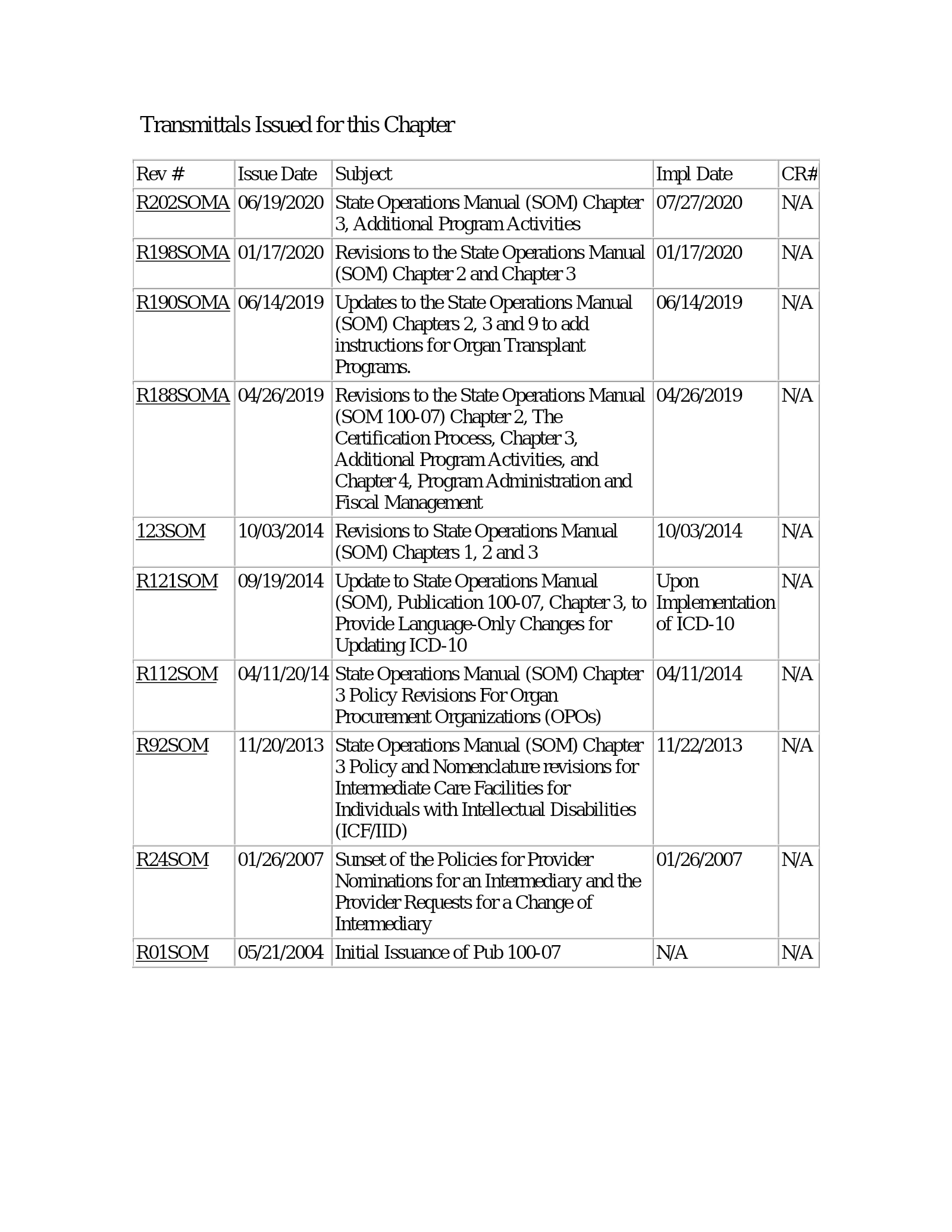
Continue your research in ChatGPT or Claude
Connect Omnilex to search the legal corpus from your AI assistant.